
The single highest-leverage move in any consignment or dealership sale is this: lock in a written reserve price before you hand over the keys, and require that every bona fide offer reaches you within 48 hours of receipt. Everything else in the negotiation builds on those two controls.
Before you sign anything, insist on these three contract items:
- Reserve price clause: A written minimum below which the dealer cannot accept any offer without your explicit written approval.
- 48-hour offer-presentation rule: All offers must be presented to you within 48 hours of receipt, with full buyer details and offer terms.
- Re-evaluation clause: Any price change after the initial listing period (typically 60–90 days) requires mutual written agreement, not unilateral dealer action.
These three items directly protect your net-to-owner proceeds. Without them, a dealer motivated to clear inventory can accept a low offer at your reserve floor, or quietly reduce the asking price, before you even know a buyer was interested.
Pro Tip: Print these three items on a card and bring it to every appraisal meeting. Dealers who push back on any of them are signaling exactly where they plan to take margin from you.
Table of Contents
- What contract clauses should you demand before signing?
- How do you set an asking price that commands a premium?
- What does the consignment timeline look like, and when do you act?
- How do commission structures affect your net proceeds?
- What red flags should you watch for in a consignment contract?
- Your printable negotiation checklist and sample clauses
- Common seller questions during negotiation
- What seller controls should you retain throughout the process?
- What are the typical costs, and who pays them?
- How do you negotiate effectively when offers start coming in?
- Key Takeaways
- The seller's posture that actually holds value
- Bavarian gives you the negotiation structure built in
What contract clauses should you demand before signing?
Consignment agreements must explicitly name a minimum sale price that the dealer cannot accept offers below without your approval. That reserve clause is your price floor and your veto right in one sentence.
Beyond the reserve, five clauses deserve close attention:
Reserve price / minimum sale price. Set this at your target net-to-owner figure, not the listing price. Anchor it to recent comparable sales from specialist auction results, certified-preowned lists, and condition-adjusted comps for your specific marque.
Offer presentation and seller approval protocol. Legal experts recommend a defined timeframe, typically 48 hours, for the dealer to present all bona fide offers. Pair this with a seller-approval requirement: no offer is accepted without your written sign-off.
Commission definition. Practitioners advise that sellers must explicitly define whether commission is calculated on gross sale price or net-to-owner proceeds. Always push for gross. Ambiguous language here creates predictable disputes on high-value cars.
Re-evaluation clause. Industry advisors recommend a mutual-agreement trigger after 60–90 days unsold. The clause should state that neither party may change the listed price without the other's written consent.
Authority limits and termination rights. Define exactly what the dealer can do without calling you. Sellers should secure termination or withdrawal rights, often with a modest administrative fee, so a car is never held hostage if marketing goes quiet.
"Never sign a contract that gives the dealer the sole authority to set or accept a price without your written approval. You must have the final say on the selling price to protect your interests." — eathealthy365.com, citing legal guidance on consignment contracts
Pro Tip: Ask the dealer to initial next to the commission-calculation clause specifically. It signals you have read it, and it creates a clear record if a dispute arises later.
How do you set an asking price that commands a premium?
A defensible asking price is built from evidence, not optimism. For high-end and performance cars, the valuation framework has four inputs:
- Comparable sales: Pull recent sold prices from specialist auction houses and certified-preowned listings for the same model, year, and specification. Adjust for mileage, color rarity, and options.
- Condition adjusters: A full service history, original paint, and matching numbers add measurable value. A single undisclosed repair can cut buyer willingness to pay by more than any discount you could negotiate back.
- Provenance documentation: Ownership history, factory build sheets, and any competition or celebrity provenance can justify prices well above standard comps.
- Market timing: Selling at the right moment relative to seasonal demand and model-cycle timing affects how much negotiating room you have before the first offer arrives.
Presentation is where the price case gets made in person. Dealers prefer presented vehicles, and professional detailing with full documentation shifts the appraisal upward. The pre-sale detailing checklist covers the specifics, but the short version is:
- Full professional detail, paint correction if needed, and fresh tires if worn.
- Complete service records, stamped by the authorizing dealer or specialist.
- High-quality photography and a walk-around video that shows the car at its best.
- Any factory options list, window sticker, or build confirmation from the manufacturer.
On a $300,000 car, a 3% uplift in agreed asking price adds $9,000 to gross proceeds before commission. On a $1,000,000 exotic, the same 3% is $30,000. The presentation investment pays for itself many times over at this price point.
What does the consignment timeline look like, and when do you act?
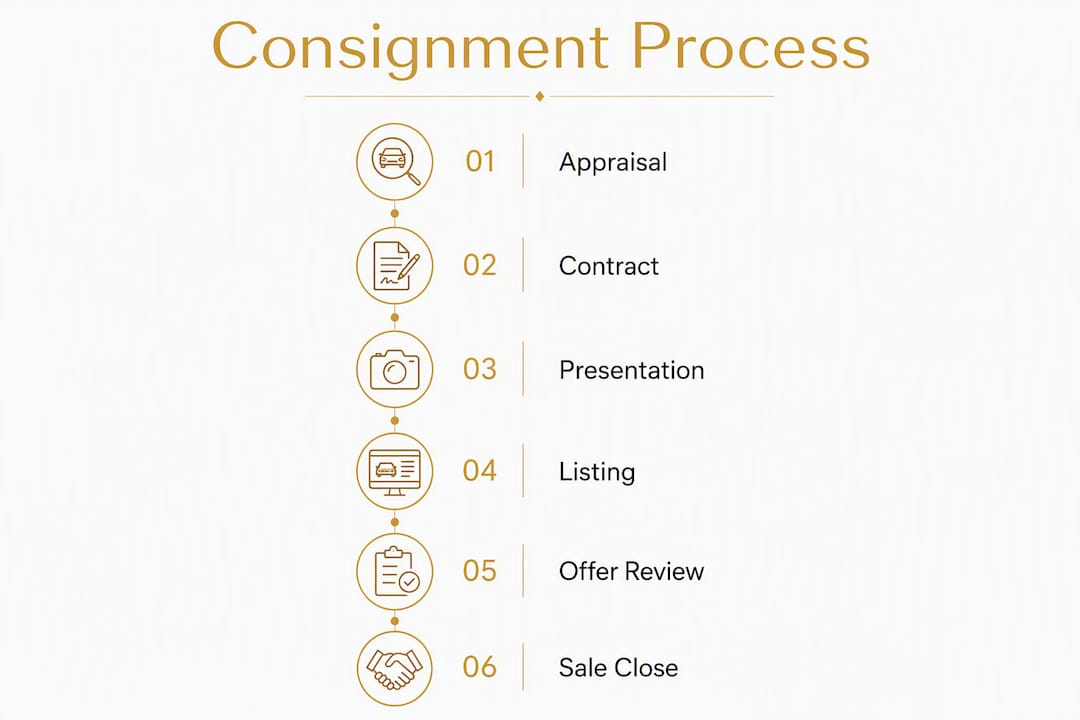
The consignment process moves through six phases. Knowing where each negotiation lever sits stops you from missing it.

Phase 1: Appraisal (Day 1–3). Bring your comps, service records, and provenance documents. This is where you establish the target price and negotiate the reserve. Do not leave without both numbers agreed in writing.
Phase 2: Contract negotiation (Day 3–7). This is your window to insert the clauses above. Once signed, your leverage drops sharply. Get legal counsel to review any clause you are unsure about before you sign.
Phase 3: Presentation and prep (Day 7–14). Detail, photograph, and video the car. Approve all marketing copy and imagery before it goes live. Retain that approval right in the contract.
Phase 4: Listing and marketing (Day 14 onward). The dealer lists across agreed channels. Consignment dealers handle all buyer interactions, including test drives and financing inquiries, while you remain the legal owner until transfer.
Phase 5: Offer handling. Every offer arrives to you within 48 hours. You have a 48–72-hour seller response window to accept, reject, or counter. Never feel pressured to decide faster than your contract allows.
Phase 6: Close and payment. Once you accept an offer, the dealer handles title transfer, lien payoff if applicable, and paperwork. Confirm the payment timeline in writing before signing the sale agreement.
"Granting a dealer authority to accept any offer above your reserve can lead to a quick sale at your absolute floor. Require written approval for offers, or limit dealer discretion, to keep higher negotiations moving in your favor." — LegalClarity
Pro Tip: If you receive a private offer during the consignment term, check your exclusivity clause before responding. Some agreements prohibit accepting private offers; others allow it with notice. Know your rights before the call comes.
How do commission structures affect your net proceeds?
Commission rates for high-end vehicles typically range from 5% to 15%, or a flat fee. The model you agree to changes the dealer's incentives and your net check.
| Model | $300,000 sale | $300,000 sale | $1,000,000 exotic | Dealer incentive |
|---|---|---|---|---|
| 5% of gross | — | — | — | Moderate push to sell high |
| 10% of gross | — | — | — | Strong push to sell high |
| Flat fee | — | — | — | Incentive to close fast, not high |
| Net-floor model | Varies | Varies | Varies | Strong push above floor, but dealer captures all upside |
The net-price floor model gives the dealer everything above your floor as their commission. It creates a strong incentive to sell high, but if the car sells well above floor, the dealer captures a windfall. For exotic cars with wide price ranges, a percentage-of-gross model usually serves the seller better.
Key rules for luxury and performance cars:
- Always specify commission is on gross sale price, not net after deductions.
- List every allowable deduction separately and cap them.
- Any pre-sale preparation costs must be contractually defined before work begins.
What red flags should you watch for in a consignment contract?
Four contract traps routinely reduce final sale price on high-value cars:
Unilateral re-pricing authority. Any clause letting the dealer reduce the asking price without your approval is a direct threat to your reserve. Strike it or replace it with a mutual-agreement requirement.
Hidden deductions. Photography, detailing, storage, and "administrative" fees rolled into the seller's proceeds without prior agreement are a common way dealers quietly reduce your net check. Demand an itemized fee schedule before signing.
"Always specify that commission is calculated on the gross sale price and list any allowable deductions separately. In luxury deals, dealers have sometimes attempted to deduct prep costs or photography from the seller's proceeds." — Rolls-Royce Motor Cars of Charlotte
Vague exclusivity clauses. An open-ended exclusivity clause that prevents you from accepting private offers, combined with a long lock-in period and steep exit penalties, can trap your car in a slow-moving listing. Negotiate a defined term, a clear exit fee, and the right to accept private offers with notice.
Commission on net proceeds. If the contract calculates commission after deducting fees from gross, the dealer has an incentive to add fees. Push for gross-based commission language every time.
Your printable negotiation checklist and sample clauses
Bring this list to every appraisal or contract meeting:
- Reserve price agreed and written into the contract.
- 48-hour offer-presentation rule confirmed in writing.
- Seller approval required for every offer, above or below reserve.
- Commission defined as a percentage of gross sale price.
- All prep costs itemized and capped before work begins.
- Re-evaluation clause: mutual agreement required after 60–90 days.
- Dealer authority limits defined (what they can do without calling you).
- Termination/withdrawal rights with a stated administrative fee.
- Marketing approval: you approve all copy, photos, and video before publication.
- Payment timeline confirmed in writing post-sale.
Sample clause language (have counsel review before use):
Reserve Price Clause: "The Dealer shall not accept any offer below $[AMOUNT] ('the Reserve') without the prior written approval of the Owner. Any offer at or above the Reserve remains subject to Owner's written acceptance."
Offer Presentation Clause: "The Dealer shall present all bona fide offers to the Owner within 48 hours of receipt, including full buyer details and offer terms. No offer shall be accepted without the Owner's written sign-off."
Re-Evaluation Clause: "After [60/90] days from the listing date, either party may request a price review. Any change to the listed or reserve price requires mutual written agreement and takes effect no sooner than 48 hours after both parties sign."
Commission Definition Clause: "Commission shall be calculated as [X]% of the gross sale price. No fees, preparation costs, or deductions shall be subtracted from the gross sale price before commission is calculated. All allowable deductions are listed separately in Schedule A."
Get these clauses reviewed by a Singapore-qualified lawyer before inserting them into any agreement. LTA transfer requirements add a local compliance layer that standard US-market templates do not cover; the car sale paperwork checklist covers the Singapore-specific documentation steps.
Common seller questions during negotiation
Can I accept a private offer while my car is on consignment? Check your exclusivity clause first. Many agreements prohibit it; some allow it with written notice to the dealer. If your contract is silent, get written confirmation before responding to any private buyer.
How do I counter a lowball offer without burning the deal? Respond within your 48–72-hour window with a written counter at or just below your target price, citing your comps. A short note explaining the basis ("comparable sold at $X last quarter") keeps the tone factual rather than emotional.
Should I let the dealer accept offers above my reserve without calling me? No. Granting that authority means the dealer can close at your floor the moment a buyer appears. Require written approval for every offer.
How long should I wait before triggering the re-evaluation clause? Wait the full initial term (60–90 days) unless market conditions shift materially. Dropping the price early signals flexibility and invites lower offers.
What if the dealer wants to reduce the asking price after two weeks? Point to your re-evaluation clause. If it is not yet triggered, the answer is no. If the dealer cannot explain why the market has moved, the price holds.
What seller controls should you retain throughout the process?
Three controls matter most and should never be delegated:
Final approval of all offers. Every offer, at any price, comes to you before acceptance. This is non-delegable. A dealer who argues otherwise is asking for the right to close without you.
Minimum reserve. The reserve is your floor, not a suggestion. It should be set at a level you would genuinely accept, not an aspirational number you expect to be talked down from. Setting it too high invites a stale listing; setting it at your true minimum gives the dealer a real target.
Marketing approvals. Photography, video, listing copy, and channel selection all affect buyer perception and, ultimately, the offers you receive. Approve everything before it goes live. On a luxury car sale, a poorly framed listing can anchor buyer expectations below market before the first inquiry arrives.
What are the typical costs, and who pays them?
Costs in a consignment arrangement fall into two categories: the dealer's commission and pre-sale preparation costs. Who pays each one depends entirely on what the contract says.
Commission: Paid by the seller from gross proceeds at closing. Range is typically 5%–15% for high-end vehicles, or a negotiated flat fee.
Marketing and photography: Reputable consignors often include prep in their service, but any charge must be spelled out in the agreement. If the dealer charges separately for photography or video, cap the amount and confirm it in writing before work starts.
Transport and inspection: If the car needs to move to the dealer's showroom or an inspection facility, clarify who bears that cost. On high-value cars, transport insurance during transit is a separate item worth confirming.
Storage: Some dealers charge a daily or monthly storage fee if the car sits unsold beyond the initial term. Cap this or negotiate it out entirely in exchange for the right to withdraw the car after the initial term.
The cleanest arrangement is one where all costs are itemized in a Schedule A attached to the main agreement, with a hard cap on each line item. Any cost not listed in Schedule A cannot be deducted from your proceeds.
How do you negotiate effectively when offers start coming in?
Offer handling is where most sellers either capture or lose value. The tactics that work consistently on high-value cars:
Hold the first 48 hours. When an offer arrives, do not respond immediately even if it is strong. Use your full response window to check current comps and confirm whether the buyer is qualified. A fast yes signals you were waiting for any offer.
Counter in writing, always. Verbal counters are unenforceable and easy to misremember. Every counter should be a written document with a clear expiry time (24–48 hours). This keeps the negotiation formal and prevents the buyer from claiming a different number later.
Anchor to evidence, not emotion. When countering a lowball, cite a specific comparable sale. "A matching-spec example sold at auction for $X in [month]" is harder to argue with than "I think it's worth more."
Use silence strategically. After a counter, stop talking. Buyers who are genuinely interested will respond. Buyers who were fishing will move on, and that is useful information too.
Handle multiple offers carefully. If two buyers are active simultaneously, do not create a bidding war verbally. Inform each that other interest exists, set a deadline for best-and-final offers, and let the written numbers decide. This approach is cleaner, more defensible, and usually produces a better outcome than informal back-and-forth.
Know when to hold. On a rare or limited-production car, the right buyer may take months to find. A slightly lower immediate offer is rarely worth taking over a well-priced sale to the right buyer four weeks later, especially when your reserve and re-evaluation clause give you the time to wait.
Key Takeaways
Sellers who lock in a written reserve price and a 48-hour offer-presentation rule before signing any consignment agreement retain the most control over net proceeds and avoid the most common dealer-side margin captures.
| Point | Details |
|---|---|
| Reserve clause is non-negotiable | Set a written minimum sale price the dealer cannot accept offers below without your written approval. |
| 48-hour offer rule protects you | Require all bona fide offers in writing within 48 hours so you never miss or lose a buyer to a fast close. |
| Commission must be gross-based | Specify commission on gross sale price; list all allowable deductions separately in a Schedule A. |
| Re-evaluation needs mutual consent | Any price change after 60–90 days requires both parties' written agreement, not unilateral dealer action. |
| Bavarian handles this end-to-end | Bavarian manages valuation, marketing, offer handling, and LTA paperwork for high-end and performance car owners in Singapore. |
The seller's posture that actually holds value
Most sellers walk into a consignment negotiation thinking about the car. The dealers are thinking about the contract. That asymmetry is where proceeds get lost.
The posture that works is collaborative but evidence-based. Bring your comps. Know your reserve before you walk in, and treat it as a number you calculated, not a number you want. When a dealer pushes back on the reserve, the response is not "I think it's worth that" — it is "here are three comparable sales from the last 90 days." That shifts the conversation from opinion to data, and data is much harder to argue down.
On the question of accepting a slightly lower immediate offer versus holding for market price: the answer depends on how rare the car is and how long you can afford to wait. For a limited-production car with a small buyer pool, holding is almost always right. For a car with strong comparable supply, a clean offer within 5% of target is worth serious consideration rather than a reflexive counter.
One thing that gets underestimated is the relationship with the dealer. You need them motivated. A seller who is combative about every clause gets a dealer who does the minimum. A seller who is firm on the key protections but reasonable on everything else gets a dealer who picks up the phone when a serious buyer calls. Protect your reserve, your offer-presentation rule, and your commission definition. On everything else, be easy to work with.
Bavarian gives you the negotiation structure built in
Selling a high-end or performance car through a consignment service that does not have these protections built into its standard agreement means you are negotiating from scratch every time. Bavarian's consignment model is structured around exactly the controls this article describes: a clear reserve, professional photography and video marketing across SgCarMart, Instagram, TikTok, and Facebook, full handling of buyer inquiries and viewings, and transparent fee terms before any work begins.
For owners of BMW, Porsche, Ferrari, Lamborghini, Mercedes-Benz, and other performance marques in Singapore, Bavarian offers a free valuation with no obligation to list. The showroom at Gillman Barracks gives your car a premium presentation environment that supports the asking price rather than undermining it. If you want a consignment partner who handles the negotiation process so you do not have to manage it offer by offer, get your free valuation at Bavarian and see what your car is worth in the current market.