The PARF rebate is a partial refund of the Additional Registration Fee (ARF) paid when a car is first registered in Singapore, returned to owners who deregister their vehicles before the 10-year COE period expires. The Singapore PARF scheme exists to encourage timely vehicle renewal and keep the national fleet younger and less pollutive. In 2026, the government made the most significant revisions to this rebate in years, cutting rates sharply and halving the maximum payout. If you own a car in Singapore and plan to sell or deregister it, understanding these changes is the difference between a well-timed exit and leaving real money on the table.
What are the 2026 changes to the PARF rebate policy?
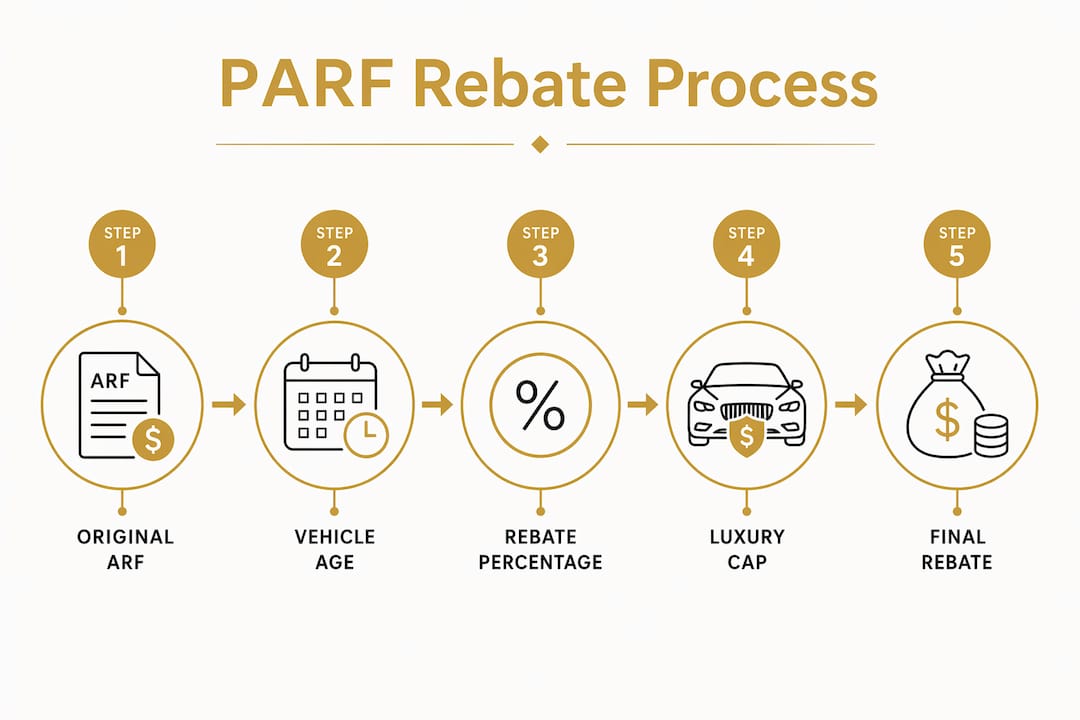
The 2026 revisions represent a fundamental reset of the Singapore PARF scheme, not a minor adjustment. The maximum rebate cap dropped from S$60,000 to S$30,000. That single change cuts the ceiling payout in half for every eligible vehicle registered under the new rules.
The rebate percentages across all age tiers fell by approximately 45 percentage points. The scale now looks like this:
- Vehicles five years old or younger: rebate dropped from 75% to 30% of ARF paid.
- Vehicles older than five years up to six years: rebate dropped from 70% to 25% of ARF paid.
- Vehicles at the 10th year: rebate fell from 50% to 5% of ARF paid.
The scope of affected vehicles is specific. The new rates apply to cars registered with COEs from the second COE exercise of february 2026 onward, and to non-COE vehicles such as taxis registered after february 13, 2026. Vehicles registered before that cutoff follow the old schedule.
The government reduced PARF rebates in 2026 because electric vehicle adoption has increased significantly, reducing fleet pollution and lessening the need for aggressive financial incentives to push owners toward early deregistration. The rebate was always a policy tool, not a permanent financial guarantee. As EVs become more common, the original rationale for high rebates weakens.
Vintage and classic cars are exempt from the new rules. Vehicles that were previously laid up are also exempt, though owners should note that laid-up vehicles lose PARF rebate eligibility during the lay-up period, which directly affects their resale value.
How is the PARF rebate calculated, and who is eligible?
The PARF rebate calculation starts with the ARF, which is the Additional Registration Fee paid when the vehicle was first registered. ARF is calculated from the vehicle's Open Market Value (OMV) using progressive tiered rates: 100% on the first S$20,000 of OMV, 140% on the next S$20,000, 190% on the next S$20,000, 250% on the next S$20,000, and 320% on any OMV above S$80,000. A car with a high OMV pays a much larger ARF, which historically meant a larger PARF rebate at deregistration.

The PARF rebate is then a percentage of that ARF, determined by the vehicle's age at deregistration. The older the car, the lower the percentage. At year one through five, you recover 30% of ARF under the new rules. By year ten, you recover only 5%.
| Vehicle age at deregistration | Old rebate (% of ARF) | New rebate (% of ARF) |
|---|---|---|
| Up to 5 years | 75% | 30% |
| Over 5 to 6 years | 70% | 25% |
| Over 6 to 7 years | 65% | 20% |
| Over 7 to 8 years | 60% | 15% |
| Over 8 to 9 years | 55% | 10% |
| Over 9 to 10 years | 50% | 5% |
Eligibility requirements are straightforward:
- The vehicle must be under 10 years old at deregistration.
- The COE must not have been renewed. Renewing the COE voids PARF rebate eligibility entirely, with no exceptions.
- The vehicle must not be a vintage or classic car (those follow separate rules).
- The vehicle must not have been laid up at the time of deregistration.
For luxury vehicle owners, the S$30,000 cap creates a hard ceiling. A Porsche or Mercedes-Benz with a high OMV might have an ARF of S$150,000 or more. Even at 30% of ARF, the theoretical rebate would far exceed S$30,000. The S$30,000 cap limits the actual payout regardless of what the calculation produces. This is the single biggest financial hit for owners of high-value vehicles registered after the february 2026 cutoff.
Pro Tip: Deregister before the vehicle crosses into the next age tier. Moving from year five to year six drops your rebate percentage by 5 percentage points under the new schedule. Timing matters more than ever with lower base rates.
How can you check and claim your PARF rebate in Singapore?
Checking your PARF value before making any decision is the first practical step. The LTA OneMotoring portal gives you access to your vehicle's PARF eligibility and estimated rebate amount. Log in with your Singpass credentials, navigate to Vehicle Hub, and search by your vehicle registration number. The portal shows your current estimated PARF rebate based on the vehicle's age and the ARF paid at registration.
If you need to verify or dispute a rebate amount without logging in through Singpass, LTA also offers a PARF and COE rebate enquiry option that does not require Singpass authentication. This is useful for checking records after deregistration has already occurred.
The claim process after deregistration follows these steps:
- Clear all outstanding payments, including road tax and any fines, before initiating deregistration.
- Dispose of the vehicle properly through a licensed scrap dealer or export it.
- The PARF rebate is credited after the deregistration is processed by LTA.
- Both the PARF and COE rebates are valid for 12 months post-deregistration. Fail to redeem within that window and the amount is forfeited.
Pro Tip: Check your PARF value before deciding whether to renew your COE. Once you renew, the rebate is gone permanently. Run the numbers on both options before committing.
What do the 2026 changes mean for owners selling or deregistering their cars?
The practical impact of the 2026 revisions falls the hardest on two groups: owners of luxury vehicles with high OMVs, and owners who planned to use the PARF rebate as a significant component of their car's resale value.
For the broader market, lower PARF rebates reduce the financial incentive to deregister early. A car that previously offered a S$45,000 PARF rebate to a buyer might now offer S$18,000 under the same age and ARF conditions. That gap directly affects what a buyer is willing to pay, because buyers factor the remaining PARF rebate into their offer price.
The key practical points for car owners navigating this environment:
- Deregistration timing is now more critical. With lower base rates, every year you hold a car past the five-year mark costs you more in percentage terms than it did before.
- The PARF rebate and COE rebate are separate. When you deregister, you receive both. The PARF rebate encourages early deregistration while the COE rebate returns the unused portion of your COE premium. Add both together to understand your total deregistration value.
- COE renewal permanently eliminates PARF eligibility. Many owners renew without fully calculating what they surrender. The math often favors deregistration over renewal for cars in years seven through nine.
- The rebate is a policy tool, not a guaranteed asset. The government adjusts rebate rates based on policy goals. Owners who treated high PARF values as a fixed component of vehicle worth have had to recalibrate.
A common misconception is that the PARF rebate transfers automatically to the buyer in a private sale. It does not. The rebate belongs to the registered owner at the time of deregistration. In a private sale, the buyer takes over the vehicle and its remaining PARF value, but only if they eventually deregister before the COE expires. The seller does not receive the rebate at the point of sale.
Pro Tip: When pricing your car for sale, calculate the buyer's remaining PARF rebate and present it clearly. Buyers who understand the rebate value they are inheriting will pay more for it.
Key Takeaways
The PARF rebate is a partial ARF refund that rewards early deregistration, but the 2026 revisions have cut rates and capped payouts in ways that permanently change how car owners should calculate vehicle value in Singapore.
| Point | Details |
|---|---|
| 2026 cap reduction | The maximum PARF rebate dropped from S$60,000 to S$30,000, halving the ceiling for all newly registered vehicles. |
| Rate cuts across all tiers | Rebate percentages fell by roughly 45 percentage points; a car under five years old now returns 30% of ARF instead of 75%. |
| COE renewal kills eligibility | Renewing your COE permanently voids your PARF rebate entitlement, with no way to recover it afterward. |
| 12-month redemption window | PARF and COE rebates must be claimed within 12 months of deregistration or the amount is forfeited. |
| Luxury vehicle cap impact | High-OMV vehicles registered after february 2026 are capped at S$30,000 regardless of ARF paid. |
Why the PARF rebate shift signals a bigger change in Singapore's car market
I have watched Singapore's vehicle policy evolve for years, and the 2026 PARF revisions are the clearest signal yet that the government views the car market through an environmental lens first and a financial one second. The rebate was never meant to be a savings account. It was designed to nudge behavior. As EV adoption rises and the average fleet age drops naturally, the government no longer needs to pay as much to achieve the same outcome.
What concerns me about how most owners respond is the tendency to treat the old rebate rates as a baseline. They are not. The new rates are the baseline, and future adjustments could go in either direction depending on EV penetration targets and COE supply decisions. Owners who plan deregistration around a fixed PARF assumption are taking on policy risk they may not have priced in.
My advice is straightforward. If your car is between four and six years old and registered under the new COE exercise, run the deregistration numbers now. The difference between deregistering at year five versus year seven under the new schedule is meaningful. Do not wait until the COE renewal deadline forces your hand. Plan the exit on your terms, with full visibility into both the PARF and COE rebate components.
— Shawn
Selling your car in Singapore? Bavarian can help you get more for it
The 2026 PARF rebate changes have shifted how buyers and sellers calculate vehicle value across Singapore. Getting the pricing right now requires more than a quick online estimate.

Bavarian specializes in premium car consignment for owners of BMW, Mercedes-Benz, Porsche, Audi, and other performance brands. The team factors in your vehicle's remaining PARF rebate, current market demand, and COE position to price your car competitively and attract serious buyers. From professional photography and targeted marketing across SgCarMart, Instagram, and TikTok to handling all LTA documentation and ownership transfer, Bavarian manages the entire process. If you want to sell at the right price without the guesswork of navigating a shifting rebate environment, Bavarian's consignment model is built for exactly that.
FAQ
What is the PARF rebate in Singapore?
The PARF rebate is a partial refund of the Additional Registration Fee paid when a car is first registered in Singapore, returned to owners who deregister their vehicle before the 10-year COE expires. The rebate percentage decreases as the vehicle ages and reaches zero after 10 years or COE renewal.
How do I check my PARF value in Singapore?
Log in to the LTA OneMotoring portal using your Singpass credentials, navigate to Vehicle Hub, and search by your vehicle registration number to see your estimated PARF rebate. LTA also offers a rebate enquiry option that does not require Singpass for post-deregistration verification.
What happens to my PARF rebate if I renew my COE?
Renewing your COE permanently voids your PARF rebate eligibility. Once the renewal is processed, the rebate entitlement is lost and cannot be recovered, regardless of how much ARF was originally paid.
How long do I have to claim my PARF rebate after deregistration?
Both the PARF and COE rebates are valid for 12 months after deregistration. If you do not redeem them within that window, the amounts are forfeited.
Does the 2026 PARF rebate cap affect all cars in Singapore?
The new S$30,000 cap and reduced rebate percentages apply to cars registered with COEs from the second COE exercise of february 2026 onward, and to non-COE vehicles registered after february 13, 2026. Vehicles registered before that date, as well as vintage and classic cars, follow the previous rebate schedule.