
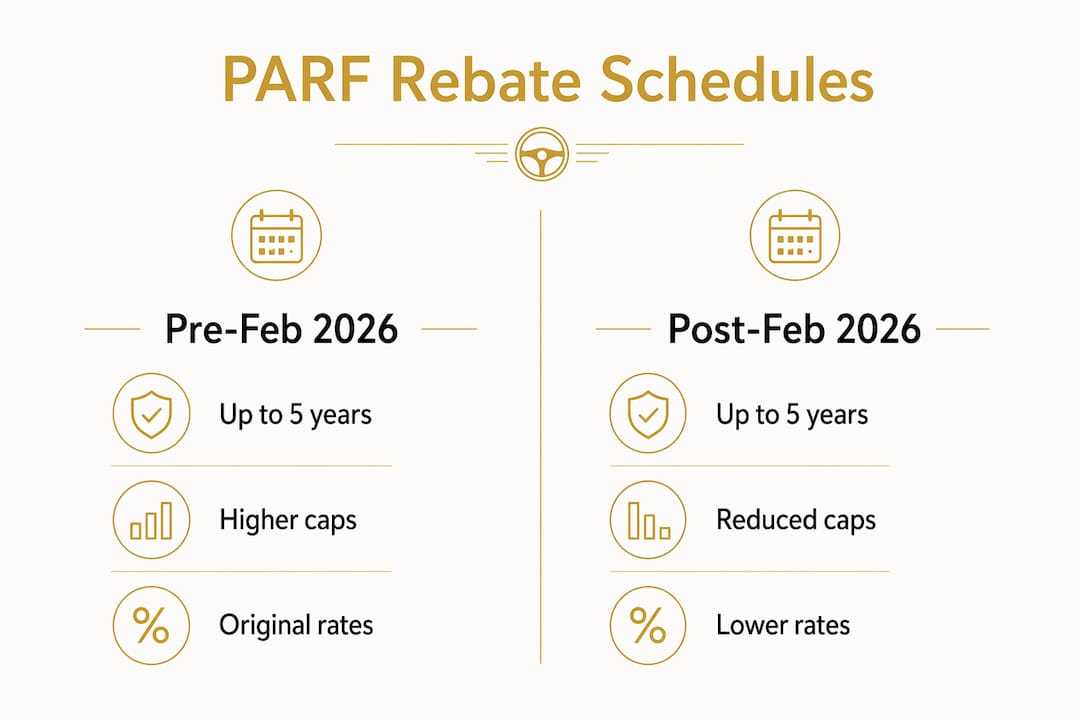
The PARF rebate is a partial refund of the Additional Registration Fee (ARF) you paid when you registered your car, returned to you when you deregister the vehicle. Budget 2026 changed the rules significantly: the maximum rebate cap dropped from S$60,000 to S$30,000, and the percentage you recover at each age band was reduced for any car registered on or after February 13, 2026. If your car was registered before that date, you keep the original, more generous schedule for your entire first COE cycle.
Here is the quick split:
- Cars registered before February 13, 2026: Original schedule applies with a higher percentage of ARF rebate and a larger cap.
- Cars registered on or after February 13, 2026: Revised schedule applies with a lower percentage of ARF rebate and a smaller cap.
- COE-exempt vehicles: New rules apply if registered on or after February 13, 2026.
- Taxis: Subject to statutory lifespan rules; check with LTA directly.
Check your vehicle's current PARF/COE rebate figures on OneMotoring using your registration number. For high-end car owners weighing their options under the new cap, Bavarian offers a premium consignment service that can help you recover more than the capped rebate alone.
Table of Contents
- What Budget 2026 changed about the PARF rebate schedule
- Which vehicles qualify for a PARF rebate, and how it differs from the COE rebate
- How PARF is calculated: age bands, caps, and worked examples
- How to claim your PARF and COE rebates step by step
- What the 2026 cap means for high-end car owners, and how to protect your value
- Key Takeaways
- The cap change reveals something most owners miss
- Bavarian can help you recover more than the cap allows
- Authoritative sources to verify the numbers yourself
What Budget 2026 changed about the PARF rebate schedule
On February 12, 2026, the Land Transport Authority announced a revised PARF rebate schedule and a reduced maximum cap. The changes took effect immediately at the point of registration to prevent market distortion.
The headline changes:
- The maximum PARF rebate cap was cut to S$30,000.
- Rebate percentages across all age bands were reduced.
- The new schedule applies to cars registered from February 13, 2026 onward.
- Cars registered before February 13, 2026 retain the original schedule and rebate cap through their first 10-year COE cycle.
Why the government made this change:
The Ministry of Transport explained that the PARF scheme was originally designed to encourage early deregistration of older, more pollutive vehicles. With electric vehicles becoming far more common and less pollutive than the ICE cars the scheme was built around, the policy rationale for high rebates has weakened. MOT noted that fewer than 2,000 buyers were estimated to be affected by the immediate implementation, which is why the government chose a clean registration-date cutoff rather than a phased transition.
Key stat: The cap was reduced from S$60,000 to S$30,000 for all vehicles registered on or after February 13, 2026.
The implementation approach matters. Because ARF and PARF are levied and calculated at the point of registration, not the point of sale, the cohort rule is clean: your registration date determines your schedule permanently for that COE cycle.

Which vehicles qualify for a PARF rebate, and how it differs from the COE rebate
Eligibility checklist:
- The vehicle must have been registered as a new car, or as a used import no more than 3 years old at the time of registration on or after September 1, 2007.
- The vehicle must not be more than 10 years old at the point of deregistration.
- The vehicle must not be on a laid-up status at the time of deregistration.
- Taxis are subject to their own statutory lifespan rules; confirm with LTA before planning deregistration.
- The vehicle must be within its first COE cycle. Renewing COE by paying the Prevailing Quota Premium (PQP) permanently forfeits PARF eligibility.
PARF vs. COE rebate: they are not the same thing.
The PARF rebate is a refund of a portion of the ARF you paid at registration. It only applies during the first COE cycle and is calculated based on the vehicle's age at deregistration. The COE rebate, by contrast, is a pro-rated refund of the remaining COE months, calculated as: QP × months remaining ÷ 120. The COE rebate still applies even if you renew COE via PQP, but once you renew, PARF is gone permanently.
Cohort sensitivity reminder: The eligibility criteria are identical for both cohorts. What changes is the percentage you recover and the cap that applies, based purely on your registration date.
How PARF is calculated: age bands, caps, and worked examples
The formula is straightforward:
The ARF itself is calculated from your vehicle's Open Market Value (OMV) using tiered rates set by LTA. As a reference, the ARF structure applies progressively higher rates to higher OMV bands, so a Porsche 911 with a high OMV generates a much larger ARF base than a Toyota Corolla.
The two PARF schedules side by side
| Vehicle age at deregistration | Pre-Feb 13, 2026 (original) | Post-Feb 13, 2026 (revised) |
|---|---|---|
| Up to 5 years | 75% of ARF | 30% of ARF |
| Above 5 to 6 years | 75% of ARF | 25% of ARF |
| Above 6 to 7 years | — | 20% of ARF |
| Above 7 to 8 years | 60% of ARF | 15% of ARF |
| Above 8 to 9 years | — | 10% of ARF |
| Above 9 to 10 years | 50% of ARF | 5% of ARF |
| Maximum cap | S$60,000 | S$30,000 |
Sources: LTA news release Feb 2026; MotorMetrics PARF guide
Worked Example 1: Mid-range private car (registered before Feb 13, 2026)
- ARF paid at registration: S$30,000
- Vehicle age at deregistration: 4 years 8 months (under 5 years)
- Applicable percentage: 75%
- PARF rebate: S$30,000 × 75% = S$22,500
- COE rebate (QP = S$80,000, 16 months remaining): S$80,000 × 16 ÷ 120 = S$10,667
- Total LTA rebate: S$33,167
Worked Example 2: High-end performance car (registered after Feb 13, 2026)
- ARF paid at registration: S$150,000 (high OMV vehicle)
- Vehicle age at deregistration: 3 years (under 5 years)
- Applicable percentage: 30%
- Calculated PARF: S$150,000 × 30% = S$45,000 — but the cap is S$30,000
- PARF rebate: S$30,000 (cap applies)
- COE rebate (QP = S$100,000, 24 months remaining): S$100,000 × 24 ÷ 120 = S$20,000
- Total LTA rebate: S$50,000
Under the old S$60,000 cap, this owner would have received S$45,000 in PARF alone. The new cap costs them S$15,000.
The one-day age boundary rule
Key stat: Deregistering before your vehicle crosses an age-band anniversary preserves the higher percentage for that entire band.
If your car turns 5 years old next month, deregistering today means you claim the 30% rate (new schedule) rather than the 25% rate that kicks in the day after the anniversary. Timing your deregistration around these annual thresholds is one of the few levers you still control under the revised scheme.
How to claim your PARF and COE rebates step by step
The rebates are not paid automatically. You must apply, and you have exactly 12 months from the deregistration date to do so. Miss that window and the entitlement expires.
- Check your figures first. Log in to OneMotoring and use the PARF/COE rebate enquiry tool with your vehicle registration number. This shows your current estimated rebate before you commit to deregistration.
- Deregister at an authorized center. Bring your vehicle to an LTA-authorized scrapyard or export agent. They will handle the physical deregistration and submit the required paperwork to LTA.
- Submit your rebate application. After deregistration is confirmed, log in to OneMotoring to apply to encash the rebate, offset it against a new vehicle purchase, or transfer it to another party. Each option has its own process and applicable fees.
- Clear outstanding obligations. Any unpaid road tax, outstanding fines, or missing documents can delay or block your rebate payment. Resolve these before you deregister.
- Receive payment. LTA processes the rebate after all checks clear. Encashment goes to your designated bank account; offset is applied directly against the ARF of your new vehicle.
Pro Tip: If you are buying a new car at the same time, coordinate with your dealer or consignment agent to apply the PARF rebate as an offset against the new vehicle's ARF. This reduces your upfront outlay and avoids the 12-month clock pressure entirely.
The 12-month redemption window sounds generous, but it creates a real risk if you deregister and then delay the paperwork. Set a calendar reminder the day you deregister.
What the 2026 cap means for high-end car owners, and how to protect your value
The reduced S$30,000 cap hits premium car owners hardest in absolute dollar terms. A mid-range car with an ARF of S$30,000 deregistered within 5 years under the new schedule gets S$9,000 in PARF (30% × S$30,000). A Porsche or BMW with an ARF of S$120,000 also gets S$30,000, capped. The percentage loss is the same; the absolute dollar shortfall compared to the old cap is far larger for the high-end owner.
LTA's 2023 ARF revision already flagged this dynamic when caps were first introduced. The 2026 revision tightened it further.
Practical options for premium car owners:
- Professional consignment: Maximizes open-market exposure and sale price, which matters more when PARF alone no longer covers a meaningful share of the car's value. Automotive marketing data shows dealers and consignors are actively reworking valuations and marketing approaches for high-end cars in response to the cap change.
- Timing the deregistration: As noted above, deregistering before an age-band anniversary preserves the higher percentage. For a car with a large ARF base, even a 5-percentage-point difference is meaningful.
- Private sale with targeted marketing: Platforms like SgCarMart, combined with professional photography and video, can attract buyers willing to pay closer to market value than a trade-in offer reflects.
- Export or scrap as a last resort: Export may recover more than scrap in some cases, but it forfeits the ability to offset the PARF against a local purchase.
Checklist for evaluating a consignment provider:
- Transparent, commission-based fee structure (no sale, no fee)
- Professional photography and video marketing across multiple platforms
- Handles LTA transfer documentation and rebate offset logistics
- Provides an independent market valuation with comparable sales evidence
- Clear timeline expectations and a dedicated point of contact
Pro Tip: Get an independent market valuation before you accept any trade-in offer. Dealers pricing against the new S$30,000 cap may undervalue your car relative to what a private buyer would pay. The gap between a trade-in offer and a consignment sale price can easily exceed the PARF rebate itself for a high-end vehicle.
For a concrete comparison: a premium car sold via consignment with professional marketing and full market exposure will typically achieve a higher net proceed than the same car traded in at a dealer who factors the reduced PARF into their offer. The 2026 PARF impact on resale value is worth reading before you make that call.
Key Takeaways
The single most important fact: cars registered on or after February 13, 2026 face a reduced PARF cap and lower rebate percentages, making professional resale strategies more valuable for high-end owners.
| Point | Details |
|---|---|
| Two-cohort system | Cars registered before February 13, 2026 keep the original schedule and higher cap; newer registrations use the reduced schedule and lower cap. |
| New cap applies | High-ARF vehicles (luxury and performance cars) are most affected in absolute terms under the revised ceiling. |
| 12-month redemption window | PARF and COE rebates must be applied for within 12 months of deregistration or the entitlement expires. |
| PQP renewal forfeits PARF | Renewing your COE via PQP permanently removes PARF eligibility; only a pro-rated COE rebate remains. |
| Bavarian consignment option | For high-end car owners, Bavarian's premium consignment service may recover more market value than the capped rebate alone through targeted marketing and full LTA handling. |
The cap change reveals something most owners miss
Most coverage of the 2026 PARF revision focuses on the percentage cuts. The more consequential shift is the cap reduction, and specifically what it means for how you should think about your car's value.
Under the old S$60,000 cap, a high-end car owner could count on a meaningful government-backed floor for their vehicle's residual value. That floor is now S$30,000. For a car with an ARF of S$150,000, that is a S$15,000 reduction in guaranteed rebate, minimum. The practical effect is that the open-market resale price now matters more than it ever did, because the PARF safety net is thinner.
What I see owners get wrong is treating the PARF rebate as the primary valuation anchor. It was never designed to be that. It was an environmental incentive dressed up as a financial one. The owners who come out ahead under the new rules are the ones who treat the rebate as a bonus and focus their energy on maximizing the sale price through proper market exposure. For a Porsche, a Ferrari, or even a well-specified BMW, the difference between a rushed trade-in and a properly marketed consignment sale can dwarf the PARF rebate entirely. Timing around age-band boundaries helps at the margin. Getting the right buyers in front of the right car is what actually moves the number.
Bavarian can help you recover more than the cap allows
When the PARF cap drops by half, the resale price of your car becomes the number that matters most. Bavarian specializes in exactly this: getting premium and performance car owners the highest possible market price through professional consignment, not just the rebate floor.

Bavarian handles the full process: independent market valuation, professional photography and viral-style video, targeted listings across SgCarMart, Instagram, TikTok, and Facebook, plus all LTA documentation, transfer of ownership, and rebate offset logistics. For owners of BMW, Mercedes-Benz, Porsche, Ferrari, Lamborghini, and similar marques, the gap between a dealer trade-in and a Bavarian consignment sale routinely exceeds what the PARF cap change costs you. No sale, no fee.
When you're ready to sell your car at the right time and the right price, contact Bavarian for a free valuation. The team at Gillman Barracks handles everything from the first enquiry to the final LTA transfer, so you don't leave money on the table because of paperwork or timing.
This article is general information only and does not constitute financial or legal advice. Verify current PARF rates, caps, and effective dates directly with LTA before making deregistration decisions.
Authoritative sources to verify the numbers yourself
The PARF scheme is cohort-sensitive and subject to revision. Always confirm figures with LTA before acting.
- LTA PARF/COE Rebate page (OneMotoring): The authoritative source for eligibility rules, redemption timelines, and the OneMotoring enquiry tool.
- LTA news release, February 12, 2026: The official announcement of the revised schedule, new cap, and cohort cutoff rules.
- Ministry of Transport PARF page: MOT's explanation of the policy rationale and implementation approach.
- LTA ARF structure (OneMotoring): How ARF is calculated from OMV, the base figure for all PARF calculations.
- SmartCalculator PARF guide: A practical third-party explainer with worked examples and timing guidance.
LTA's published tables are the final word on effective dates and percentage bands. If you registered your car close to February 13, 2026, confirm your exact cohort with LTA directly before calculating your expected rebate.