
A balloon scheme car loan lets you pay lower monthly installments throughout the loan tenure by deferring a large lump sum, called the balloon payment, to the very end. In Singapore, that deferred amount typically represents 30–50% of the vehicle's original value, calculated based on the car's estimated scrap or PARF value at loan maturity. Monthly payments are smaller because you're only financing a portion of the principal during the tenure, while the rest sits waiting at the end.
Here's how the structure works in practice:
- Monthly installments cover interest plus a reduced principal, keeping payments noticeably lower than a standard hire purchase
- Balloon payment is the residual lump sum due at loan maturity, often tied to the vehicle's projected PARF or scrap value
- Loan tenure is capped at 7 years by the Monetary Authority of Singapore, with no 10-year car loan option permitted under MAS motor vehicle loan regulations
- Loan-to-value limits are set at 70% for vehicles with an open market value (OMV) at or below $20,000, and 60% for vehicles above that threshold
- Down payment must be at least 30–40% of the purchase price, depending on OMV
- Total borrowing cost is higher than a standard loan because interest accrues on the deferred balloon amount throughout the tenure
Compared to a standard hire purchase, where each payment chips away at the full principal from day one, a balloon loan front-loads interest and back-loads principal repayment. That's the core trade-off.
What are the real benefits of balloon scheme financing?
The clearest advantage is monthly cash flow. Smaller installments free up money for other expenses, investments, or simply a financial cushion. For buyers with predictable income growth or a clear plan to sell the vehicle before the balloon comes due, balloon schemes ease cash flow without necessarily costing more than alternatives, provided the exit strategy holds.
Key benefits for Singapore buyers:
- Lower monthly outlay makes budgeting easier, particularly for buyers managing multiple financial commitments
- Access to higher-value vehicles without stretching monthly budgets beyond comfort
- Flexibility at loan end: you can pay the balloon in cash, refinance it into a new loan, or sell and trade in the car to settle the balance
- Useful for short-term ownership plans, since buyers who sell or trade in before maturity avoid the balloon entirely
- Cash flow management during the loan tenure allows capital to be deployed elsewhere
Pro Tip: Balloon scheme loans work best as cash-flow tools, not as a way to buy a car that's genuinely beyond your budget. If the only way the numbers work is with a balloon structure, revisit the vehicle price first.
Risks you need to understand before signing
The biggest risk is the balloon payment itself. Balloon loan payments concentrate early installments on interest rather than principal, which means you build equity slowly. For most of the loan tenure, you may owe more than the car is worth.
- Negative equity: because principal repayment is minimal early on, the loan balance often exceeds the car's market value for the bulk of the tenure
- Higher total interest: interest accrues on the deferred balloon amount, so total borrowing cost is greater than a comparable standard loan
- Refinancing difficulty: when the balloon comes due, lenders treat the remaining amount as higher-risk because the vehicle is older and worth less, often resulting in higher rates or outright rejection
- Lump sum shock: if the car's value has dropped sharply, the balloon payment may exceed what you'd recover from a sale
- False affordability: lower monthly payments can create the impression that a more expensive car is within reach, when the deferred cost simply arrives later
Cars depreciate quickly. A vehicle that looked like a manageable balloon payment at signing can become a financial problem three or four years in, especially if your income or plans change.
Who qualifies for a balloon scheme car loan in Singapore?
Eligibility follows the same framework as standard car loans in Singapore, governed by MAS regulations. Lenders, whether banks or licensed in-house financiers, apply these criteria:
- Income documents: recent pay slips, Notices of Assessment, and CPF contribution statements are standard requirements
- Vehicle eligibility: the car must meet the lender's age and model-year criteria; older vehicles typically face stricter terms or outright exclusion
- Loan-to-value ratio: capped at 70% for OMV at or below $20,000, and 60% for OMV above $20,000, per MAS regulations
- Maximum loan tenure: 7 years; no lender in Singapore can legally offer a longer term for motor vehicle financing
- Interest rate expectations: rates vary by lender, vehicle type, and applicant profile; in-house lenders often move faster but may price higher than banks
- Credit assessment: lenders review credit bureau records, existing debt obligations, and total debt servicing ratios
In-house lenders like Speed Credit or Golden Charter can sometimes approve applications that banks decline, particularly for buyers with non-standard income profiles, though their rates may reflect that added flexibility.
How do leading providers compare on balloon scheme car loans?

Six providers in Singapore stand out for buyers researching car loans with balloon payment structures. Each brings a different combination of rates, services, and specialization.

| Provider | Interest Rate | Loan Tenure | Additional Services | Best For | Rating |
|---|---|---|---|---|---|
| Golden Charter Pte Ltd | From 2.88% p.a. | Up to 7 years | COE renewal, insurance | Buyers wanting full-service automotive finance | 4.8★ (454 reviews) |
| Speed Credit Pte Ltd | From 2.38% | Up to 7 years | COE renewal, PHV, refinancing | Buyers prioritizing lowest rates and fast approval | 4.9★ (266 reviews) |
| SG Cash N Cars | Not publicly listed | Up to 7 years | COE renewal, insurance, ownership transfers | One-stop financing and vehicle services | 5★ (247 reviews) |
| Tokyo Century Leasing (S) Pte Ltd | Not publicly listed | Up to 7 years | Leasing, equipment, commercial vehicle finance | Flexible leasing from a global network | 4.5★ (213 reviews) |
| COE Car Loan | COE renewal from 2.48% | Up to 7 years | COE renewal, refinancing, insurance | COE renewal and competitive refinancing | 5★ (117 reviews) |
| Bavarian AutoHaus | Not publicly listed | Up to 7 years | Consignment, financing support, resale | Luxury car buyers needing financing and resale expertise | 4.7★ (114 reviews) |
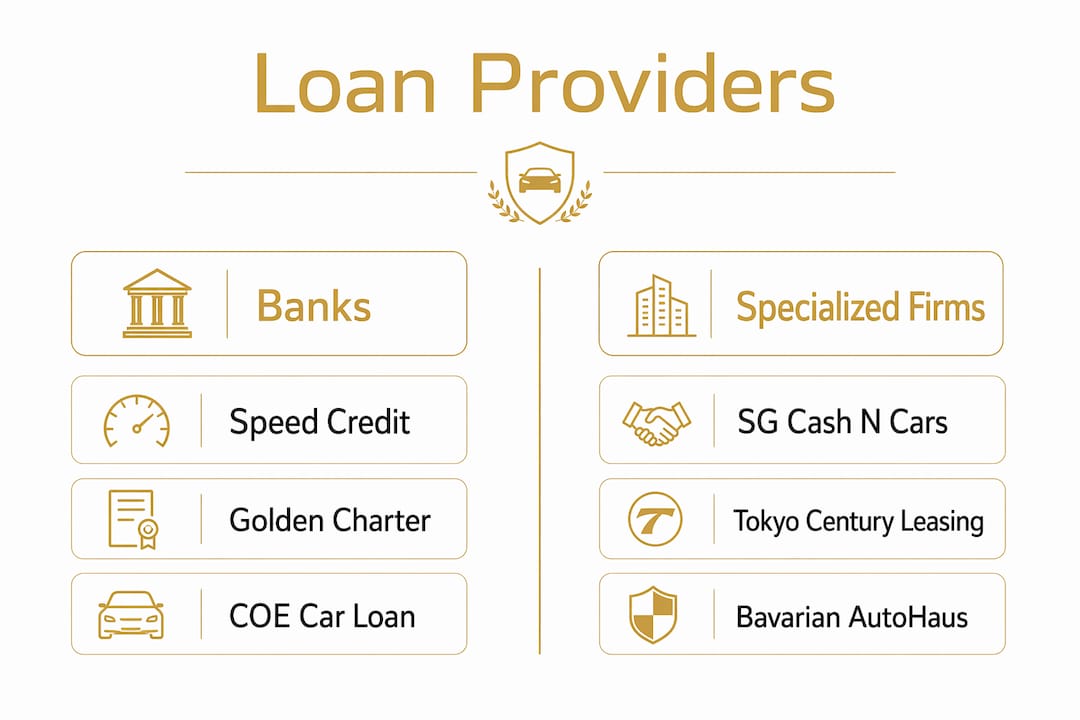
Speed Credit leads on advertised rate, with car loans from 2.38% and over $1.7 billion in transactions processed. For buyers who want the lowest possible rate and a fast decision, it's the most direct option.
Golden Charter has been in the market for over 15 years, with car loans from 2.88% p.a. and a full suite covering insurance and COE renewals. Buyers who want a single relationship for all their automotive finance needs tend to gravitate here.
COE Car Loan focuses specifically on COE renewal financing, with renewal loans from 2.48%. If your primary concern is renewing a COE rather than financing a new purchase, this is the most targeted option.
SG Cash N Cars covers private, commercial, and PHV vehicles under one roof, including ownership transfers and insurance. It suits buyers who want to handle multiple vehicle-related transactions without switching providers.
Tokyo Century Leasing brings 45 years of global financing experience and extends beyond personal car finance into equipment and commercial vehicles. Buyers considering leasing rather than outright purchase will find more options here than at most local lenders.
Bavarian AutoHaus operates differently from the lenders above. It specializes in luxury and performance vehicles, offering financing support alongside professional consignment and resale services. For buyers in the premium segment, where balloon payment management intersects with resale strategy, Bavarian's expertise is genuinely relevant.
What should you check before applying?
Choosing the right balloon finance option requires more than comparing headline rates. Work through these steps before signing anything:
- Request the full amortization schedule: see exactly how much principal you're paying each month versus interest, and when equity starts building
- Compare flat rate versus effective interest rate: the flat rate understates true cost; the effective rate gives you an apples-to-apples comparison across lenders
- Calculate the total repayment amount: add all monthly payments plus the balloon to understand the full cost of the loan
- Assess your balloon payment capacity: can you realistically pay it in cash, refinance it, or sell the car to cover it at maturity?
- Plan your exit strategy now: decide before signing whether you'll pay, refinance, or sell, and stress-test each scenario against a lower resale value
- Get quotes from at least two or three providers: rates and terms vary enough that shopping around typically saves money
Pro Tip: Set aside a fixed monthly amount toward the balloon payment from day one. Treating it like a savings target rather than a future surprise is the most reliable way to avoid a refinancing scramble at loan maturity.
Luxury car financing insights from Bavarian Autohaus
Balloon payments interact with luxury car ownership in ways that standard financing guides rarely address. Depreciation curves on high-end vehicles can be steep, and the gap between the balloon amount and the car's actual market value at maturity is often wider than buyers expect.
- Negative equity risk is amplified in the luxury segment, where market values can shift sharply based on model updates, COE cycles, and buyer sentiment
- PARF and scrap values on premium vehicles need careful review before committing to a balloon structure; understanding PARF rebate calculations helps you assess whether the residual value assumption in your loan is realistic
- Professional valuation before loan end gives you leverage in negotiations, whether you're refinancing or selling
- Consignment services can recover significantly more than a quick trade-in when you need to exit the vehicle at balloon maturity
- Timing the sale to align with favorable COE cycles and market demand is a strategy that in-house lenders rarely advise on, but it materially affects your net position
Luxury car buyers using balloon loans should treat the exit strategy as part of the original purchase decision, not an afterthought.
How the application process works, step by step
The timeline from inquiry to disbursement typically runs one to five business days for in-house lenders, and slightly longer for bank financing. Here's the standard flow:
- Gather documents: NRIC, income proof (pay slips or Notice of Assessment), CPF statements, and vehicle details
- Submit application: most lenders accept online submissions; in-house lenders like Speed Credit often process same-day
- Credit and vehicle assessment: the lender checks your credit bureau report, calculates your debt servicing ratio, and values the vehicle
- Loan offer: you receive a term sheet showing the loan amount, monthly installment, balloon amount, tenure, and interest rate
- Review and sign: compare the offer against at least one other quote; check the amortization schedule before signing
- Disbursement: funds are released to the seller or dealer, and the vehicle is registered in your name through LTA
- Ongoing payments: monthly installments begin; the balloon payment falls due at the end of the agreed tenure
For used car purchases, the vehicle inspection and valuation step can add a day or two. For car valuation considerations that affect your loan-to-value calculation, getting an independent estimate before applying puts you in a stronger negotiating position.
Bavarian offers a different path for luxury car buyers

If you're financing a BMW, Mercedes-Benz, Porsche, or another performance vehicle, the lenders compared above handle the loan. What they don't handle is what happens when the balloon comes due and you need to exit the car at the best possible price. That's where Bavarian fills a gap none of the finance companies above can.
Bavarian's premium consignment service manages the entire resale process, from professional photography and targeted marketing across SgCarMart, Instagram, and TikTok, to viewings, negotiations, LTA documentation, and financial transactions. Sellers consistently recover more through consignment than through a dealer trade-in, which matters most when you're trying to clear a balloon payment with the proceeds. The boutique showroom at Gillman Barracks attracts serious buyers for high-end vehicles, not casual browsers. If your balloon scheme car loan is on a luxury or performance car, pairing it with a planned consignment exit is worth considering from the day you sign the loan.
Key Takeaways
A balloon scheme car loan in Singapore lowers monthly payments by deferring a substantial portion of the vehicle's value as a lump sum at loan end, within MAS-regulated limits of 70% or 60% LTV and a maximum 7-year tenure.
| Point | Details |
|---|---|
| Balloon payment size | The deferred lump sum typically represents 30–50% of the original vehicle value, due at loan maturity. |
| MAS loan limits | LTV is capped at 70% (OMV ≤ $20,000) or 60% (OMV > $20,000); maximum tenure is 7 years. |
| Biggest risk | Early payments build little equity, and refinancing the balloon is harder and costlier as the vehicle ages. |
| Best provider fit | Speed Credit leads on rate (from 2.38%); Golden Charter suits full-service needs; COE Car Loan targets renewal financing. |
| Bavarian's role | For luxury car buyers, Bavarian's consignment model supports a planned exit strategy when the balloon payment comes due. |