Yes, car color affects resale value, but usually less than condition, mileage, and trim. Data from iSeeCars' analysis of 1.2 million used-car listings found the average vehicle loses a substantial portion of its value after three years, while yellow cars lose less. Forbes reports that color alone can swing a used car's value by several thousand dollars after three years. Still, a clean, low-mileage car in the "wrong" color will almost always outsell a neglected one in the "right" shade.
Key Takeaways
Car color shifts resale value by hundreds to a few thousand dollars on average, while condition, mileage, and trim shift it by tens of thousands.
| Point | Details |
|---|---|
| Neutral colors are safest | White, gray, silver, and black hold broad demand and sell fastest across most segments. |
| Rare colors can outperform | Yellow, orange, and green depreciated less than average in iSeeCars' study of 1.2 million listings. |
| Condition still dominates | Mileage, trim, and mechanical condition typically move price far more than color does. |
| Segment changes the math | Bright colors help sports cars and coupes but often hurt mainstream sedans and SUVs. |
| Presentation recovers value | Professional photography, video, and targeted marketing, like Bavarian's consignment approach, help uncommon colors find the right buyer. |
Where to check the original color and resale data
- iSeeCars' color study analyzed 1.2 million listings comparing three-year depreciation against MSRP.
- Forbes and its companion coverage summarize iSeeCars alongside Edmunds/BASF market-share data.
- Kelley Blue Book and J.D. Power offer buyer-facing guidance on picking resale-friendly colors.
Table of Contents
- Why does car color affect resale value?
- What do the studies and market data actually show?
- Which colors tend to hurt resale value?
- How big is the color effect compared to other resale factors?
- What should buyers and sellers actually do about color?
- How do consignment sellers handle tricky colors?
- How Bavarian handles color and presentation for you
- Frequently asked questions about car color and resale value
- Sources
Why does car color affect resale value?
Color pricing comes down to a simple mismatch: how many buyers want a shade versus how many cars come in it. Neutral colors flood the market because manufacturers make so many of them, while a handful of rare, expressive colors stay scarce even when demand for them holds steady.
A few forces drive this:
- Supply versus demand. Rare colors like yellow or orange can command a premium precisely because so few exist on used lots, not because everyone secretly prefers them.
- Perceived luxury. Black, white, and certain deep grays read as "premium" to most shoppers, which helps them move fast even without a price edge.
- Visible wear. Scratches, swirl marks, and road grime show up faster on black and dark gray, while white and silver tend to hide daily wear better.
- Vehicle-type fit. A bright orange coupe reads as fun; a bright orange minivan reads as odd. Segment matters as much as the color itself.
Pro Tip: If you're buying a family SUV or sedan you'll sell within five years, stick with a popular neutral. If you're buying a sports car or a car you'll keep a decade, a bold color is a much safer bet on the resale math.
What do the studies and market data actually show?
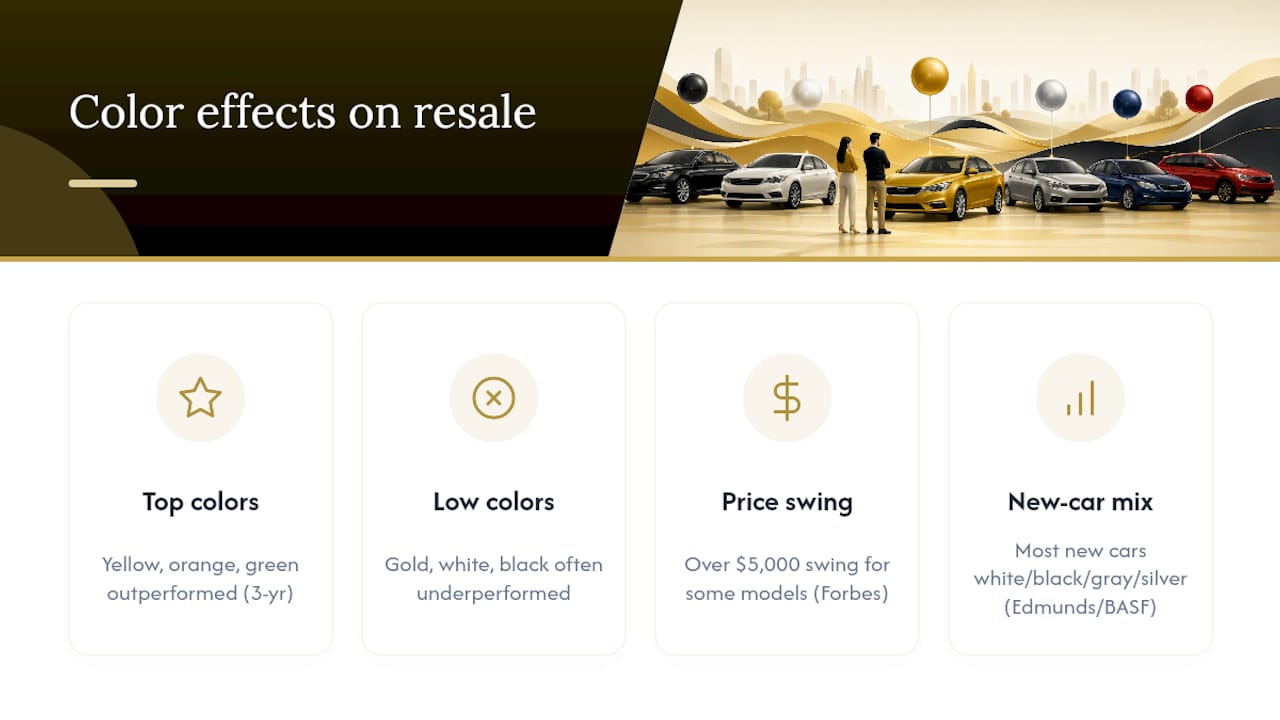
The most cited figures come from iSeeCars, which compared three-year depreciation against original MSRP across more than a million used-car listings. Yellow, orange, and green consistently outperformed the pack, while gold, white, and black often fell on the losing end.
Forbes' coverage of the same iSeeCars dataset puts the swing at over $5,000 for some models purely from color. Separately, Edmunds and BASF market-share data cited by Forbes shows a large majority of new vehicles are white, black, gray, or silver, which explains why those colors are everywhere on used lots and why standing out with a rarer shade can actually help a seller. Kelley Blue Book's guidance still leans toward neutral colors as the safest resale choice, since trends shift and segment matters. The important caveat: these are three-year averages across huge samples, not guarantees for any single sale.
Which colors tend to hurt resale value?
White, black, gold, and beige turn up repeatedly as underperformers in color studies, and the reasons vary by shade. White and black are so common they compete against thousands of similar listings. Gold and beige have simply fallen out of style with most buyers, which drags down demand even though supply isn't especially high.
- White and black: oversupplied, so any one listing has to compete harder on price.
- Gold and beige: demand has faded across most segments over the past decade.
- Muted browns and dark blues: perform inconsistently and vary widely by region and body style.
A pickup truck in beige might sell just fine in a market where buyers prize durability over style, while the same shade on a sedan could sit unsold for weeks. Averages describe a market, not your specific buyer.
How big is the color effect compared to other resale factors?
The dollar swings are real but usually modest against the bigger levers of resale value. iSeeCars' comparisons show three-year depreciation gaps of a few thousand dollars between the best and worst colors on a given model, with Forbes citing cases exceeding $5,000.
Color can shift a sale price by a few hundred to several thousand dollars. Condition, mileage, and trim level routinely swing that same car's value by tens of thousands.
Put plainly:
- A single major mechanical issue or accident history typically costs far more in resale value than any color penalty.
- High mileage and worn interiors erase whatever premium a "good" color might have earned.
- Color decides how fast a car sells and to how many buyers more often than it decides the final number.
Prioritizing color only makes sense once condition, mileage, and trim are already competitive for the segment.
What should buyers and sellers actually do about color?
If you're buying with resale in mind, treat color as a tiebreaker, not a deciding factor.
- Buy condition first, color second. A well-maintained car in a decent color beats a pristine color on a neglected one every time.
- Match color to vehicle type. Popular neutrals for family SUVs and sedans; expressive colors are fine, sometimes favorable, on sports cars and limited editions.
- If selling, fix cosmetics before listing. Paint correction and detailing often pay for themselves in faster sales and fewer lowball offers, as outlined in this guide to pre-sale detailing.
- Consider protective add-ons carefully. A PPF installation can protect an uncommon color's finish for years, which matters more if you plan to hold the car long-term.
- Price against real comparables, not averages. Check what similar-color, similar-mileage cars are actually selling for in your market before setting an ask.
Pro Tip: If your car is in an uncommon color, don't hide it in your listing title. Lead with it. "Rare Racing Yellow, One Owner" pulls a very different buyer pool than a generic model-and-year headline, and that pool is often willing to pay for exactly what makes the car different.
How do consignment sellers handle tricky colors?
Selling an unusual-color car well is mostly a marketing problem, not a pricing problem. Professional photography that shows the color under good light, short vertical video for social platforms, and listing titles that call out rarity all widen the buyer pool for a shade that might scare off a casual browser scrolling listings.
- Professional photo and video sets that make an uncommon color look intentional, not risky.
- Targeted posting on platforms like SgCarMart, Instagram, and TikTok where niche buyers actually look.
- Listing language that frames rarity as a feature, backed by an honest valuation against comparable sales.
- Direct outreach to buyer segments (enthusiasts, collectors) who specifically search for a color rather than avoid it.
Pro Tip: A rare color paired with weak photos reads as a liability. The same car photographed and marketed like a feature listing reads as a find.
A publisher's take on color versus resale reality
Buy the color you'll actually enjoy driving every day; just be honest with yourself about whether you're optimizing for love of the car or for the sale three years from now. Shawn and the team at Bavarian have watched plenty of "wrong color" cars sell for strong prices once they were presented properly, which says more about marketing than about the color itself.
How Bavarian handles color and presentation for you
Bavarian exists for exactly the situation this article has been walking through: a car that's mechanically sound and well kept but sits in a color that's harder to move on a generic listing. Instead of guessing at a fair price or writing your own ad, Bavarian's team handles the free valuation, professional photography, viral-style video, and negotiation end to end, so an uncommon shade becomes a selling point instead of a discount excuse.
That process mirrors what we outlined above: targeted marketing on platforms like SgCarMart and social channels, honest pricing against real comparables, and presentation that makes rarity look deliberate. If your car's paint has been holding back your asking price, get a free consignment valuation from Bavarian and see what a properly marketed listing actually pulls in.
Frequently asked questions about car color and resale value
Does car color really affect how much a car is worth? Yes, but modestly. Studies show gaps of a few hundred to several thousand dollars between the best and worst colors on comparable models, well below what condition or mileage typically swings.
What is the best car color for resale value? Yellow, orange, and green have shown the lowest depreciation in large-sample studies, largely because they're rare relative to demand. Neutral colors like white, gray, silver, and black remain the safest all-around choice for broad buyer appeal.
What car colors hold value the worst? Gold, beige, and in some studies white and black rank as weaker performers, mainly due to oversupply or fading popularity rather than any flaw in the color itself.
Should I avoid buying a car in an unusual color? Not necessarily. If you plan to keep the car long-term or you're buying a performance model, an unusual color can be a fine choice and sometimes a resale advantage. If you plan to sell within a few years and want the widest buyer pool, a popular neutral is the lower-risk pick.
Does color matter more for luxury and performance cars? Yes. Buyers of sports cars and limited editions often value distinctive colors, while family SUV and sedan buyers usually favor neutrals for easier resale.
Sources
- Iseecars
- What's The Best Vehicle Color For Resale Value? — Forbes
- How hot hues and cold colors affect a car’s resale value, study says — Forbes
- What Are The Best Car Colors To Buy? — Kelley Blue Book
- What Are The Best Car Colors To Buy? — J.D. Power