
Used car valuation is defined as the process of establishing a realistic price range for your vehicle using multiple trusted sources, then refining that range with local market data and honest condition assessment. Pricing a used car correctly is the single biggest factor separating a fast, profitable sale from a listing that sits for months. Tools like Kelley Blue Book (KBB), NADA, and Car Spot give you a national baseline. Singapore's market adds its own layer of demand signals, COE cycles, and buyer expectations that national estimators simply cannot capture. Get the combination right, and serious buyers show up fast.
What are the best valuation tools for pricing a used car?
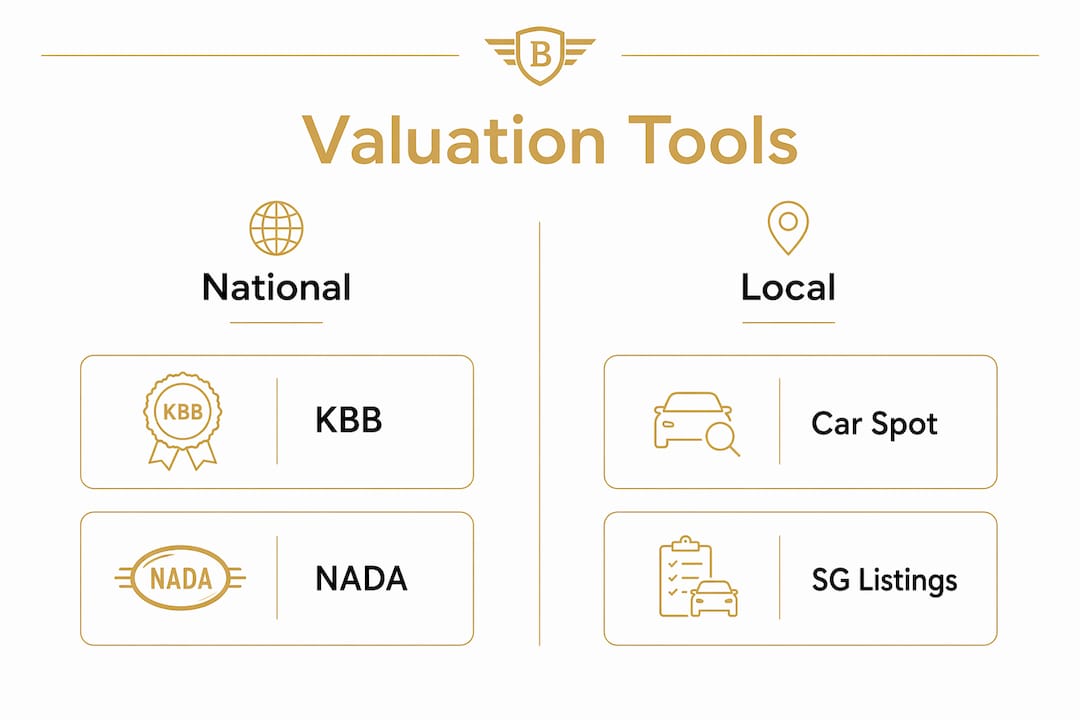
The most reliable approach to used car pricing starts with averaging estimates from at least two or three reputable valuation platforms. Averaging multiple platforms like KBB, NADA, and Car Spot, then adjusting by 5–10% for negotiation, gives you a defensible starting price. Each tool weighs inputs differently, so using just one leaves money on the table or prices you out of the market.
How to input your details correctly
Every valuation tool asks for the same core data: year, make, model, trim level, mileage, and condition tier. The accuracy of your output depends entirely on the accuracy of your input. A seller who rounds down mileage or bumps their condition tier up by one level will get an inflated estimate that collapses the moment a buyer inspects the car.

NADA values typically run about 5–8% higher than KBB private-party values. That spread matters. NADA serves as a useful ceiling reference, while KBB private-party tends to reflect what real buyers actually pay. Average the two, and you land in a range that is both credible and competitive.
Understanding condition tiers
Condition tiers are not cosmetic labels. The gap between Good and Very Good can reach approximately $1,100 on a $16,000 vehicle. That is a meaningful difference, and most sellers overestimate their tier. Be honest: if your car has a scuff on the bumper, a worn driver's seat, or a chip in the windshield, it belongs in Good, not Very Good.
The standard tiers across most platforms run from Fair through Good, Very Good, and Excellent. Excellent is reserved for near-showroom condition with full service history. Most privately owned cars fall in the Good to Very Good range.
Pro Tip: Run your car through at least two valuation tools and record both outputs. Average the private-party values, then use the NADA figure as your ceiling. Never list above the NADA ceiling unless your car has rare options or documented upgrades.
How do car condition and vehicle history impact used car pricing?
Condition and history are the two factors that most often override an online valuation. A clean estimate from KBB means nothing if your car carries a salvage title or has undisclosed accident damage. Buyers in Singapore are thorough, and any gap between your listed price and the car's actual condition will surface during inspection.
Here is how to assess and document your car's standing before you set a price:
- Check your title status. A clean title is the baseline for private-sale pricing. Salvage or rebuilt titles reduce value significantly and limit your buyer pool to cash purchasers only.
- Pull a vehicle history report. Reports from services like Carfax or equivalent Singapore LTA records reveal accident history, odometer readings, and ownership changes. Clean title and full service records notably increase private sale value, while missing records reduce buyer trust and price.
- Gather your service records. A complete service history tells buyers the car was maintained properly. Gaps in the record raise questions that buyers resolve by lowering their offer.
- Check for open recalls. An unresolved recall is a liability. Buyers will either walk away or demand a price reduction that covers the repair. Close any open recalls before listing.
- Get a pre-sale inspection. A third-party inspection report from a recognized workshop gives buyers confidence and gives you a defensible basis for your asking price.
Market-value estimates are informational and must be balanced with title brands, open recalls, and inspection findings, which often override online valuations entirely. Sellers who skip this step often face renegotiation at the last minute, which is the worst possible time to lose leverage.
Pro Tip: Scan and organize all service records, the LTA vehicle report, and any inspection certificates into a single folder before your first buyer inquiry. Sellers with complete documentation close deals faster and at higher prices.
Why is local market research essential when pricing your used car?
National valuation tools give you a floor and a ceiling. Local listings tell you where buyers in your specific market are actually transacting. Local market insight from platforms like Facebook Marketplace reveals true price ceilings that national estimators routinely miss.
Singapore's used car market is shaped by factors that no American or global pricing tool fully accounts for: COE residual values, PARF rebates, and the concentration of buyers in a small geographic area. A BMW 3 Series with three years of COE remaining commands a very different price than the same car with nine years remaining. National tools do not model that.
Here is how to build a local pricing picture:
- Search for your exact make, model, year, and trim on SgCarMart and Carousell within Singapore. Record the asking prices of at least five comparable listings.
- Note condition differences. A listing priced $3,000 above yours may have lower mileage or a longer COE. A listing priced below yours may have accident history.
- Track how long listings have been active. A car sitting for 30 days at a given price is a signal that price is too high for current demand.
- Check Facebook Marketplace for private sellers. Private listings often show the true floor price that dealers cannot match.
Sellers should expect serious inquiries within 48–72 hours if the car is priced correctly for the local market. No meaningful offers by day five is a clear signal to adjust. A 4–5% price reduction at that point is standard practice to regain competitiveness without signaling desperation.
| Signal | What it means | Recommended action |
|---|---|---|
| Inquiries within 48–72 hours | Price is competitive | Hold your price |
| Views but no inquiries by day 5 | Price is slightly high | Drop 4–5% |
| No views after one week | Price is significantly above market | Re-research local comps |
| Multiple offers above asking | Price was set too low | Note for future reference |
Pro Tip: Search best platforms to sell your car to understand where Singapore buyers are most active. Listing on the right platform for your car's segment matters as much as the price itself.
What pricing strategies help you sell faster without leaving money behind?
The right asking price is not your target price. It is your target price plus a negotiation buffer. Setting your list price 3–5% above your floor gives buyers room to negotiate while protecting your actual target. Pricing rigidity, where you list at your absolute floor and refuse to move, causes deals to stall and buyers to walk.
A few common mistakes sellers make:
- Overestimating condition. Listing at Very Good when the car is Good inflates your price and creates friction at inspection.
- Ignoring mileage milestones. Buyers treat round numbers like 100,000 km as psychological thresholds. A car at 98,500 km is perceived very differently from one at 101,000 km, even though the mechanical difference is negligible.
- Skipping disclosure. Undisclosed accident history or a known mechanical issue discovered during a test drive destroys trust instantly. Disclose known issues upfront and price accordingly.
- Comparing to dealer retail prices. Dealer prices include reconditioning, warranty, and overhead. Your private-sale price should sit below dealer retail to be competitive.
On the question of dealer instant offers: instant dealer offers can close within 24 hours with payment the next business day, and they exceed trade-in values in the majority of cases. The trade-off is that you will typically receive less than a well-executed private sale. For sellers who prioritize speed over maximum return, an instant offer is a legitimate option. For sellers who want the best price, a private sale with proper preparation wins.
Pro Tip: Price your car at a number that ends in a 8 or 9 rather than a round number. Buyers perceive $28,800 as more considered than $29,000, and it gives you slightly more room to negotiate down to your actual floor.
Key Takeaways
Accurate used car valuation requires combining national pricing tools with local market data, honest condition assessment, and a negotiation-aware asking price.
| Point | Details |
|---|---|
| Average multiple valuation tools | Use KBB, NADA, and Car Spot together; NADA runs 5–8% higher and serves as your ceiling. |
| Condition tier accuracy matters | The gap between Good and Very Good can reach $1,100 on a mid-priced car. |
| Local listings set the real ceiling | Search SgCarMart and Facebook Marketplace to find what buyers in Singapore actually pay. |
| Build in a negotiation buffer | List 3–5% above your floor price so buyers can negotiate without pushing you below target. |
| Documentation raises final price | Full service records and a clean title reduce friction and support a higher asking price. |
What I've learned from watching sellers price their cars wrong
Shawn here. After years of working with private sellers across Singapore's premium car market, the pattern I see most often is this: sellers trust the online estimate and skip the local research. They get a KBB or NADA number, add a buffer, and list. Then they wonder why the inquiries dry up after day three.
The online tools are useful. They are not sufficient. Singapore's market is small enough that five comparable listings on SgCarMart can tell you more about your car's real value than any algorithm built on American transaction data. I have watched sellers leave $5,000 on the table because they priced against a national estimate instead of checking what an identical car sold for two weeks ago in the same market.
The other mistake I see constantly is condition inflation. Sellers are emotionally attached to their cars, which is understandable. But a buyer who drives two hours to inspect a "Very Good" car and finds scuffs, worn seats, and a cracked trim piece does not just negotiate harder. They leave. Honest condition assessment is not about underselling yourself. It is about building the kind of trust that closes deals at your asking price.
My advice: do the local research, be honest about condition, have your documents ready, and price with a buffer. That combination closes more deals at better prices than any single tactic alone. Sellers who treat pricing as a process rather than a guess consistently outperform those who rely on a single estimate.
— Shawn
How Bavarian can help you price and sell at the highest value
Pricing your car correctly is the foundation. Getting it in front of the right buyers at the right moment is what turns a good price into a great outcome.
Bavarian specializes in premium car consignment in Singapore, working with owners of BMW, Mercedes-Benz, Porsche, Ferrari, and other performance brands to achieve the highest possible sale price. The team handles professional photography, targeted marketing across SgCarMart, Instagram, TikTok, and Facebook, plus all negotiations, LTA documentation, and ownership transfer. You set the price with expert guidance. Bavarian handles everything else. If you want a professional appraisal and a proven process behind your sale, start with Bavarian at their Gillman Barracks showroom.
FAQ
What is the most accurate tool for used car valuation?
No single tool is most accurate on its own. Averaging KBB private-party values and NADA estimates, then cross-checking against local listings on SgCarMart, gives the most reliable price range.
How do I know if my asking price is too high?
If your listing receives views but no serious inquiries within 48–72 hours, the price is likely above the local market. A 4–5% reduction after five days without offers is the standard adjustment.
Does a salvage title significantly reduce my car's value?
A salvage or rebuilt title reduces value substantially and limits your buyer pool to cash purchasers. Clean title cars consistently command higher prices and attract more qualified buyers in private sales.
How much negotiation room should I build into my asking price?
List your car at 3–5% above your actual floor price. This gives buyers room to negotiate while protecting your target return, and it prevents deals from stalling over rigid pricing.
Do service records really affect the final sale price?
Sellers with comprehensive vehicle history and a clean title earn higher prices and experience smoother negotiations than sellers without documentation. Complete records remove buyer doubt and support your asking price.