
Consignment lets you keep legal ownership of your car while a licensed dealer markets and sells it on your behalf, usually netting a price higher than a trade-in. The trade-off is time: you're locked into a contract for weeks, sometimes longer, and your payout depends entirely on how tightly that contract is written. It suits owners who want the best possible price and don't mind stepping back from buyer calls and viewings. A dealer like Bavarian Autohaus can run that process for you if you'd rather not chase leads yourself.
TL;DR:
- Flat fees for consignment typically range from S$500 to S$1,500, with percentage commissions usually between 5% and 15% of the final sale price.
- The contract length spans a few weeks to months, often with exclusivity, and must specify exact payout timelines and minimum acceptable sale prices.
- Proper documentation, including vehicle particulars, ownership proof, maintenance records, and insurance, significantly shortens the selling process and boosts buyer trust.
- Fraud risks are real; verify the dealer’s credentials, demand clear payment deadlines, and insist on proof of payment before releasing ownership transfer documents.
- Presentation quality and contract details directly influence final payout; professional photos, targeted marketing, and transparent terms are crucial to maximize sale proceeds.
Table of Contents
- The Car Consignment Process, Step by Step
- Documents and Prep You Need Before Consigning
- What Consignment Actually Costs
- How Long Consignment Takes and When You Get Paid
- Risks, Scams, and the Contract Clauses That Protect You
- Closing the Sale: Payoff, Title Transfer, and Your Money
- Why Presentation and Process Discipline Matter More Than People Think
- Get a Free Valuation Before You Commit to Anything
- Sources
The Car Consignment Process, Step by Step
Consignment works because you retain ownership of the vehicle right up until a buyer pays, while the dealer does the selling. The sequence below is what actually happens once you sign on.
- Valuation and pricing. The dealer inspects the car and proposes a Retail Selling Price (RSP), along with a reserve price, the floor you won't go below. This is the number that anchors every later negotiation, so push back if it feels off.
- Intake and presentation. Expect a detailed inspection, professional photography, and sometimes minor reconditioning (a scratch buffed out, wheels touched up) before the listing goes live. Sharper presentation tends to pull closer-to-RSP outcomes for well-documented, well-kept cars.
- Marketing. Listings typically run on SgCarMart, the dealer's own showroom, and increasingly Instagram, TikTok, and Facebook for cars with enthusiast appeal.
- Enquiries and viewings. The dealer fields calls, screens buyers, and schedules test drives, ideally at the showroom rather than your driveway, for both safety and control.
- Offers. Offers get relayed to you with context on buyer intent and financing status. You decide whether to accept, counter, or hold for the reserve.
- Sale and payout. Once terms are agreed, the dealer collects payment, settles any outstanding loan, handles the LTA title transfer, and pays you the balance.
Read the full consignment process breakdown if you want the mechanics of each stage in more detail before you sign anything.
Documents and Prep You Need Before Consigning
Dealers can't list your car until the paperwork and photos are sorted, so arriving prepared shortens the whole timeline.
- LTA vehicle particulars, including your log card details and current registration status.
- Government-issued ID and proof that you're the registered owner.
- Maintenance records and service receipts. A "full set" of documentation, original invoice, warranty card, service booklets, materially boosts buyer trust and net price, even though that guidance comes from the collectibles trade, the logic transfers directly to cars.
- Loan payoff details, if the car still has finance outstanding, including your lender's contact and the current payoff figure.
- A clean car and decent photos. Wash it, clear out the boot, fix small cosmetic issues before the dealer's photographer shows up.
- Active insurance, plus a written insurance certificate from the dealer confirming coverage while the car sits on their lot. See our paperwork checklist for the full document list.
What Consignment Actually Costs
Singapore dealers generally run one of three fee structures, and each one changes how hard the dealer works to get you top dollar.
- Flat fee, often in the S$500 to S$1,500 range, paid regardless of the final sale price.
- Percentage commission, typically 5% to 15% of the sale price, so the dealer earns more when you earn more.
- Net-price or reserve arrangement, where you set a floor and the dealer keeps anything above it.
Fee model shapes incentive: a flat fee gets your car listed and sold with minimal effort either way; a percentage commission aligns the dealer's payday with yours, which is why most premium consignment shops favor it.
Watch for upfront listing fees, early-withdrawal penalties if you pull the car before the contract ends, and vague language around "extras" like photography or advertising costs. Your contract should spell out the exact payout timeline and the minimum acceptable sale price in plain numbers, not ranges.
How Long Consignment Takes and When You Get Paid
Consignment agreements often run for a period of a few weeks to a few months, and that window usually comes with exclusivity, meaning you can't sell through another channel while it's active.
- Luxury and performance cars often move faster because the buyer pool is narrower and more targeted.
- Mass-market models depend more on general demand and price positioning.
- Payment timing has to be spelled out in days, not "promptly", for example, "within 5 business days of cleared funds."
- At contract end, ask what happens next: does it auto-renew, do you get the car back with no penalty, or is there an early-termination fee either way?
Contract length and exclusivity terms are two of the most overlooked details sellers skip past when they're excited to get listed.
Risks, Scams, and the Contract Clauses That Protect You
Singapore has seen real cases of consignment fraud. One Shenton Way store owner was jailed for misappropriating nearly $140,000 from five consignors who were promised fast payment and never received it. The failure point was almost always the same: vague payment terms and no independent record of where the money went.
Protect yourself with these steps:
- Verify the dealer's business registration, physical showroom, and a track record you can check through news search or written references.
- Insist your contract names an explicit payout deadline, a reserve price, and a limited power of attorney that only covers the sale, nothing broader.
- Get a written insurance certificate confirming the car is covered while it's on the dealer's lot; a proper insurance inspection matters just as much here as it does for your own policy.
- Require proof of bank transfer once funds clear, and don't release your log card or transfer documents until payment lands in your account.
Pro Tip: Ask for a written clause stating payment lands in your nominated bank account within a fixed number of business days of cleared funds, and keep your log card until that transfer clears. It's the closest thing to escrow you'll get in a standard consignment deal.
Closing the Sale: Payoff, Title Transfer, and Your Money
Once a buyer commits, a few things need to happen before you're fully off the hook.
- Loan payoff. If your car had outstanding finance, the dealer typically settles the lender directly from sale proceeds and secures a lien release before anything else moves forward.
- LTA transfer filing. The dealer usually handles the ownership transfer paperwork with LTA, but you should confirm the buyer's registration details match what was filed.
- Payment mechanics. Funds move by bank transfer after the sale clears, on the timeline your contract already specifies.
- Final payout statement. Request a written statement showing the sale price, fees deducted, loan payoff (if any), and your net amount, then confirm in writing that you're released from liability.
Our handover checklist walks through what to verify on the day title actually changes hands.
Why Presentation and Process Discipline Matter More Than People Think
Most sellers assume consignment is just "let the dealer handle it" and stop thinking about the details once they sign. That's backwards. The contract terms and the presentation quality are the two levers that actually move your final number, and both are things you can push on before you ever agree to anything.
Bavarian runs consignment differently because the team treats presentation as a sales lever, not an afterthought. Every car gets professional photography and viral-style video content built for how buyers actually shop now, on Instagram and TikTok as much as SgCarMart, alongside showroom display at Gillman Barracks. Contracts are written with clear commission terms, a defined payout timeline, and insurance coverage confirmed in writing while your car sits on the lot, addressing the exact failure points that show up in misappropriation cases elsewhere in Singapore.
The gap between a dealer who lists your car and a dealer who markets it properly is often the difference between hitting your reserve and settling below it.
— Shawn
Get a Free Valuation Before You Commit to Anything
If you've read this far, you already know the two things that determine your payout: how the contract is written and how well the car is presented to buyers. Bavarian handles both, running consignment for high-end and performance cars, BMW, Mercedes-Benz, Porsche, Ferrari, Lamborghini, Bentley, and Audi among them, out of a showroom at Gillman Barracks built specifically to make premium cars look the part in person and on camera.
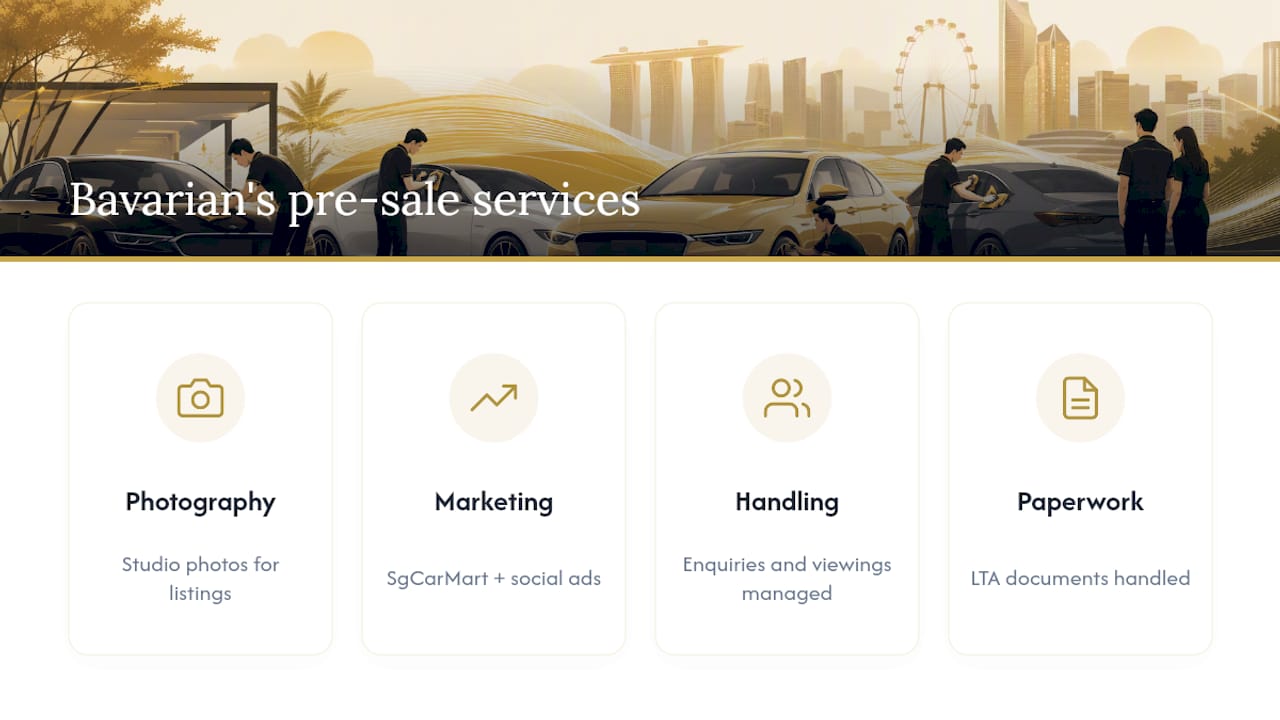
You get professional photography, targeted marketing across SgCarMart and social platforms, full handling of enquiries and viewings, LTA documentation, and a payout structure spelled out before you sign anything, no chasing buyers yourself, no guessing what happens to your money after the sale closes. If your car fits the performance or luxury segment and you want a real sense of what it's worth before committing to a contract, get a free valuation from Bavarian and see the number before you decide on anything else.
Sources
- How to Sell a Vehicle on Consignment: Process and Risks - LegalClarity
- The ultimate guide to luxury watch consignment in Singapore (2026) - Watch Capital
- Selling your car on consignment: what it is and why it pays more - Carpro
- Jail for Shenton Way consignment store owner who misappropriated nearly $140k - The Straits Times