
Car deregistration in Singapore is the formal cancellation of your vehicle's registration with the Land Transport Authority (LTA), which legally ends your ownership and makes the vehicle illegal to operate on public roads. Every car owner who plans to scrap, export, or store a vehicle must complete this process. Skip it, and you face fines up to $1,000, up to 3 months' imprisonment, and driving license disqualification. The good news is that the process is straightforward when you know the steps, the documents required, and how to protect your PARF and COE rebates along the way.
What is car deregistration in Singapore?
Car deregistration in Singapore is the official process of canceling a vehicle's registration through the LTA OneMotoring portal, triggering the legal disposal of the vehicle by scrapping, export, or storage at an Export Processing Zone (EPZ). The term "deregistration" is the recognized LTA term. You may also hear it called "scrapping" informally, but scrapping is just one of three approved disposal methods. Singapore law requires vehicle disposal through scrapping, EPZ storage, or export. Unauthorized dismantling or dumping is illegal and carries serious penalties.
The financial stakes are real. Deregistering at the right time unlocks your PARF rebate and a pro-rated COE rebate, which together can represent a significant portion of your vehicle's remaining value. Getting the process wrong, or delaying it past your COE expiry, costs you money you cannot recover.

What you need before deregistering your car
Preparation prevents delays. Gather these items before you touch the LTA OneMotoring portal.
Required documents and accounts:
- Valid NRIC (for Singapore citizens and permanent residents) or passport with valid pass
- Active Singpass account for LTA OneMotoring portal access
- Vehicle registration details, including chassis number and engine number
- Hire-purchase clearance letter from your finance company, if the car is still under a loan
- Proof of insurance (keep it active until vehicle handover)
Valid NRIC and Singpass access are mandatory for private owners using the OneMotoring portal. Without Singpass, you cannot initiate or track the deregistration online.
Financial obligations to clear first:
| Obligation | Why it matters |
|---|---|
| Outstanding road tax | LTA blocks deregistration until this is paid |
| Unpaid summonses | System will reject your application |
| ERP charges | Must be settled before approval |
| Hire-purchase balance | Finance company must release the vehicle |
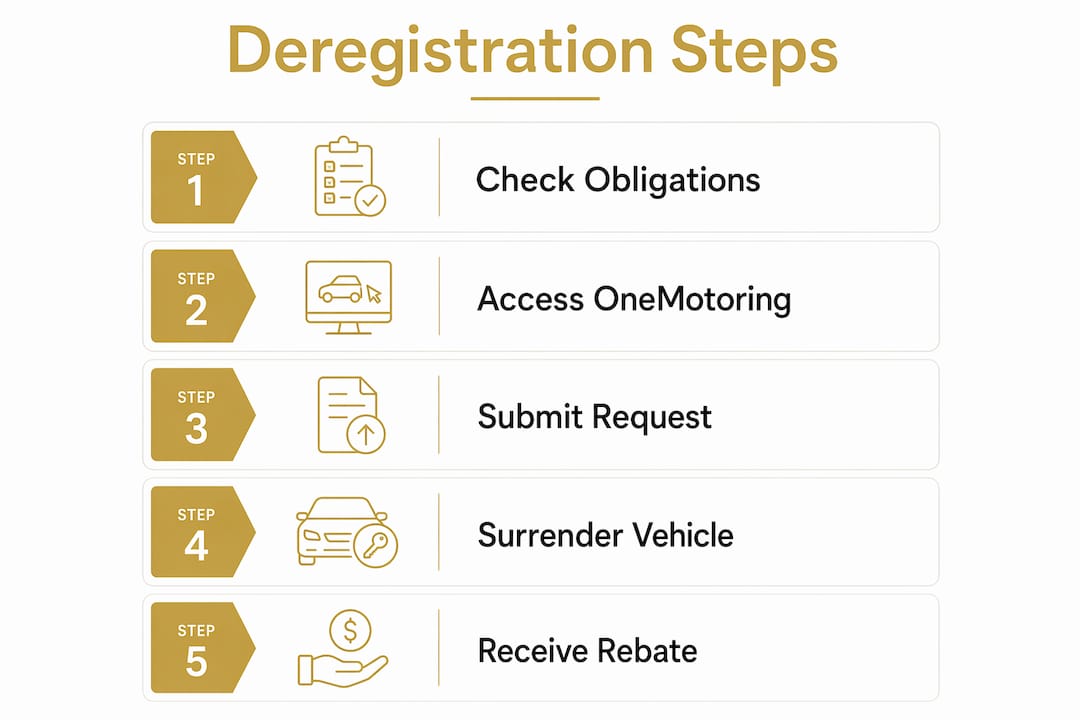
Outstanding financial obligations including unpaid road tax, summonses, or fines will block deregistration attempts on LTA's digital platform. Check your OneMotoring account for any outstanding items at least a week before you plan to deregister.
Digital Singpass access and OneMotoring accounts are now central to the deregistration process, reducing reliance on physical forms and increasing processing speed. Set up your Singpass 2FA before your appointment day to avoid last-minute problems.
How to deregister your car: step-by-step
Three disposal methods exist: scrapping, EPZ storage, and export. Each follows a slightly different path, but all begin at the LTA OneMotoring portal.
Scrapping your vehicle
- Log in to the LTA OneMotoring portal using your Singpass.
- Navigate to "Selling/Deregistering" and select "Deregister a Vehicle."
- Choose scrapping as your disposal method and select an LTA-appointed scrapyard.
- Confirm your appointment and receive a deregistration reference number.
- Drive or tow the vehicle to the scrapyard on the agreed date.
- The scrapyard submits the Notice of Disposal to LTA via their digital system.
- LTA processes the deregistration and triggers your rebate payout.
Deregistration filings for scrapping are handled by licensed scrap dealers who submit the Notice of Disposal via LTA digital systems. You do not file this paperwork yourself. The scrapyard does it on your behalf, which is why choosing an LTA-appointed facility matters.
The physical deregistration process takes 1–3 working days after vehicle surrender. Rebates are typically processed and received within 2–4 weeks after deregistration. Plan your finances around that timeline.
Pro Tip: Take dated photos of your odometer reading and chassis plate before handing the car over. These records protect you if any dispute arises about the vehicle's condition at handover.
Storing at an Export Processing Zone (EPZ)
If you plan to export later but are not ready to ship, you can store the vehicle at an LTA-appointed EPZ. The deregistration is filed when the vehicle enters the EPZ. Export deregistration is only possible through LTA-appointed EPZ operators or official transfer mechanisms. Using an unlicensed operator voids your rebate eligibility.
Exporting the vehicle
Export requires a licensed freight agent and submission of export documents to LTA. The vehicle must enter an LTA-appointed EPZ before loading. Once the export is confirmed, LTA updates the registration records and releases applicable rebates.
Timing rule for all methods: You must surrender the vehicle within 8 days after initiating deregistration on OneMotoring. Missing this window cancels the application and requires you to restart.
Understanding PARF and COE rebates when deregistering
The PARF rebate is a partial refund of the Additional Registration Fee (ARF) you paid when you first registered the vehicle. The COE rebate is a pro-rated refund of your Certificate of Entitlement based on the unused months remaining.
PARF rebate key facts:
- Available only during the first COE cycle (the original 10-year period)
- Decreases each year the vehicle ages
- PARF rebates decrease each year and are only available in the first COE cycle. No PARF rebate exists after 10 years.
- Renewing your COE by paying the Prevailing Quota Premium (PQP) permanently eliminates PARF eligibility
- COE pro-rated rebate depends on the unused months left on your COE tenure
Renewing COE by paying the Prevailing Quota Premium causes the vehicle to lose PARF rebate eligibility permanently. Only a pro-rated COE rebate remains after renewal. This is the single most expensive mistake a car owner can make when planning deregistration.
The math favors earlier action. Deregistering between years 5 and 7 often maximizes the PARF rebate relative to rising maintenance costs and depreciation. A car deregistered at year 6 retains more ARF value than one deregistered at year 9, and the owner avoids the accelerating repair bills that typically appear after the 7-year mark.
For a full breakdown of how PARF is calculated and what your vehicle qualifies for, the PARF rebate guide from Bavarian covers the numbers in detail. Knowing your rebate amount before you deregister helps you decide whether to sell, scrap, or export.
Pro Tip: Use the LTA OneMotoring portal's rebate calculator before committing to a disposal date. The difference between deregistering in month 60 versus month 72 can be thousands of dollars.
Common mistakes to avoid during the deregistration process
Most deregistration problems are avoidable. These are the errors that cost car owners time and money.
Canceling insurance too early. Canceling insurance before vehicle surrender creates an illegal uninsured status and causes deregistration delays. Keep your policy active until the scrapyard or EPZ operator physically takes the vehicle.
Not clearing financial obligations first. LTA blocks deregistration until all road tax, summonses, and ERP charges are settled. Showing up to a scrapyard appointment with an unresolved summons wastes everyone's time.
Using unlicensed scrapyards or exporters. Only LTA-appointed facilities can legally process disposal and submit the Notice of Disposal. An unlicensed operator cannot file the paperwork, which means your deregistration never completes and your rebates never trigger.
Missing the 8-day surrender window. After initiating deregistration on OneMotoring, you have 8 days to surrender the vehicle. Missing this deadline cancels the application entirely.
Misunderstanding COE renewal effects on PARF. Once a vehicle renews its COE paying PQP, the owner permanently loses PARF rebate eligibility. Many owners do not realize this until they try to deregister and find no PARF amount listed.
Not documenting the vehicle before handover. Photograph the odometer, chassis plate, and overall condition before surrender. These records protect you from liability if questions arise after handover.
Pro Tip: Call your chosen scrapyard or EPZ operator the day before your appointment to confirm they have received your OneMotoring deregistration reference. A quick confirmation call prevents wasted trips.
Key Takeaways
Completing car deregistration in Singapore correctly protects your rebates, avoids legal penalties, and closes your ownership liability cleanly.
| Point | Details |
|---|---|
| Clear all obligations first | Settle road tax, summonses, and ERP charges before starting on OneMotoring. |
| Choose an LTA-appointed facility | Only licensed scrapyards and EPZ operators can legally file your Notice of Disposal. |
| Protect your PARF rebate | Never renew your COE if you plan to deregister; renewal permanently removes PARF eligibility. |
| Deregister at the right time | Years 5–7 typically offer the best PARF rebate relative to depreciation and repair costs. |
| Keep insurance active | Maintain coverage until physical vehicle handover to avoid illegal uninsured status. |
Why timing your deregistration matters more than most owners realize
The conventional advice is to deregister when your COE expires. That advice costs money. By year 10, your PARF rebate has shrunk to its minimum, and you have spent years paying for maintenance on a depreciating asset. The owners who come out ahead are the ones who treat deregistration as a financial decision, not an administrative one.
I have seen owners hold onto a car past year 8 because it "still runs fine," only to discover their PARF rebate dropped by thousands of dollars compared to what they would have received two years earlier. The car running fine is not the point. The question is whether the cost of keeping it, including road tax, insurance, and repairs, exceeds what you gain by holding the rebate value longer.
My recommendation is to check your rebate estimate on OneMotoring at year 5 and again at year 6. Compare that number against your projected annual ownership costs. If the math favors selling or scrapping, act on it. Waiting rarely improves the outcome. If you are considering selling rather than scrapping, understanding when to sell for maximum value is worth reading before you commit to a disposal method.
Licensed scrapyards handle most paperwork and filing, relieving owners from complex administrative work while ensuring compliance. That said, the owner still needs to verify that the scrapyard has submitted the Notice of Disposal. Do not assume it is done. Follow up with the facility and check your OneMotoring account within 3 working days of surrender.
— Shawn
How Bavarian can help with your car sale and deregistration
Deregistering a car is straightforward when you know the steps. Selling it at the right price before deregistration is a different challenge entirely.

Bavarian specializes in premium car consignment for private owners in Singapore, handling LTA documentation, transfer of ownership, and all financial transactions on your behalf. If your vehicle qualifies for a strong PARF rebate and you want to sell rather than scrap, Bavarian's consignment model targets the highest market value through professional photography, targeted marketing on SgCarMart, Instagram, and TikTok, and a dedicated showroom at Gillman Barracks. Visit Bavarian's consignment service to find out what your car is worth before you commit to scrapping it.
FAQ
What is the car deregistration process in Singapore?
Car deregistration in Singapore is initiated through the LTA OneMotoring portal using Singpass. After selecting a disposal method (scrapping, EPZ storage, or export), you surrender the vehicle to an LTA-appointed facility within 8 days, and the facility files the Notice of Disposal on your behalf.
How long does deregistration take in Singapore?
The physical process takes 1–3 working days after vehicle surrender. Rebate payouts are typically received within 2–4 weeks after deregistration is confirmed by LTA.
What are the car deregistration fees in Singapore?
LTA does not publicly list a fixed deregistration fee for private owners. Scrapyards and EPZ operators may charge handling fees, which vary by facility. Check with your chosen LTA-appointed operator before your appointment.
Do I lose my PARF rebate if I renew my COE?
Yes. Paying the Prevailing Quota Premium to renew your COE permanently removes PARF rebate eligibility. Only a pro-rated COE rebate remains available after renewal.
Can I deregister my car without going to a scrapyard?
For scrapping, the owner cannot file deregistration independently. The licensed scrap dealer must submit the Notice of Disposal via LTA's digital system. For export, a licensed freight agent and LTA-appointed EPZ operator handle the filing.