Car loans in Singapore cannot be transferred to another person. Full stop. If you're buying or selling a car that still has an outstanding hire-purchase loan, the vehicle must be fully paid up and the lender must formally discharge its registered interest with LTA before any ownership transfer can proceed. LTA's OneMotoring system will reject the transfer application outright if there is an active financing lien still registered against the vehicle.
That's the legal reality of any car loan takeover in Singapore. Here's what to do immediately:
- Request a Full Settlement Letter from your lender. This is the only authoritative figure for what it costs to clear the loan. Don't rely on your monthly statement balance.
- Pause any sale listings until you know your equity position and have a plan for settling the loan at or before handover.
- Choose a settlement route — seller pays in full, buyer pays the lender directly, or a dealer or consignment agent handles it — and document every step in writing.
A private "car payment takeover agreement" between buyer and seller does not replace lender consent or LTA discharge. Banks require a fresh credit assessment for any new borrower, and LTA won't accept the transfer until the bank formally deregisters its interest.
Key Takeaways
In Singapore, car loans cannot be transferred to a buyer — the vehicle must be fully settled and the lender must discharge its registered interest with LTA before any ownership transfer can proceed.
| Point | Details |
|---|---|
| Loans are non-transferable | LTA blocks all transfer applications while a financing lien is active; the bank must formally discharge first. |
| Full Settlement Letter is mandatory | Request it from your lender before listing; it's the only authoritative payoff figure and has a limited validity period. |
| Bank discharge takes 1–3 business days | Build this window into your handover schedule — don't trigger OneMotoring until discharge is confirmed. |
| OneMotoring timelines are strict | Buyer has 5 calendar days to accept; physical handover must complete within 7 days of the handover date. |
| Bavarian manages the full process | From valuation and buyer screening to bank settlement and LTA transfer, Bavarian handles every step for financed luxury car sales. |
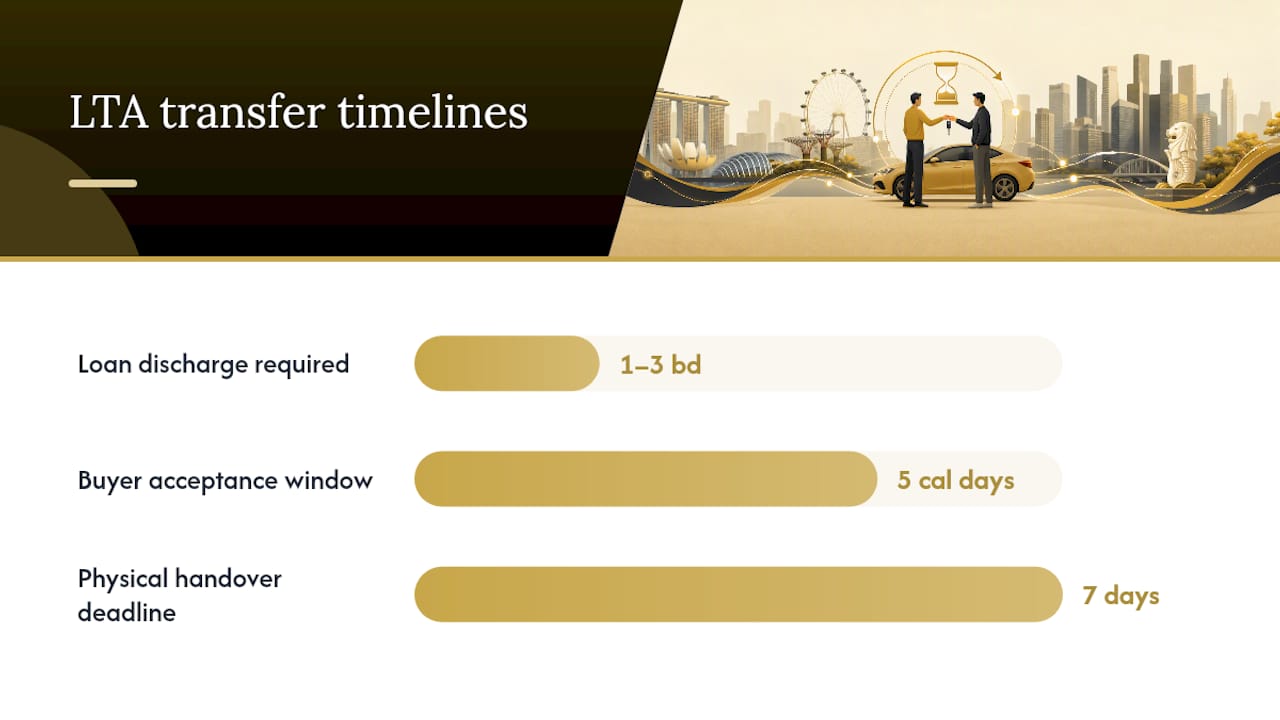
Table of Contents
- What LTA OneMotoring requires for a car loan transfer in Singapore
- Why banks won't simply transfer your existing car loan to a buyer
- The lawful options when your car still has an outstanding loan
- How positive and negative equity change the deal
- OneMotoring step-by-step: the transfer checklist once the loan is clear
- Documents, costs, and how long each step takes
- How buyers and sellers protect themselves — and red flags that should stop a deal
- How a premium consignment dealer handles loan settlement end-to-end
- What actually matters in a Singapore car loan transfer
- Bavarian handles the hard part of selling a financed car
- Sources
What LTA OneMotoring requires for a car loan transfer in Singapore
LTA's rules leave no room for interpretation. A vehicle under financing is legally blocked from transfer until the lender deregisters its interest. Once that's done, the transfer process on OneMotoring follows a strict sequence with hard deadlines.
The core prerequisites:
- The vehicle must have no active financing lien registered against it. The lender must formally discharge its interest with LTA before the seller can even initiate a transfer application.
- All outstanding road tax must be paid and all fines cleared. OneMotoring checks this automatically.
- The buyer must hold valid motor insurance in their own name, effective on or before the transfer date. The seller's existing policy cannot be transferred — it's a separate contract between the seller and their insurer.
The transfer timeline, step by step:
- Seller logs in via Singpass and initiates the transfer on OneMotoring.
- Buyer has 5 calendar days to accept the transfer online. Miss that window and the application expires — the seller must restart the process.
- The physical handover of the vehicle and the completion of the transfer must both occur within a short period after the handover date.
- Payment of the S$25 transfer fee is made via NETS, SGQR PayNow, or supported cards at the point of transfer.
One additional cost catches sellers off guard: if the vehicle is 4–6 months from its original registration date and falls under Category A or B COE, a COE-related levy may apply on top of the standard transfer fee. Check this early — it can affect your net proceeds calculation.
The 5-day and 7-day windows are the most common points of failure in private sales. Sellers who trigger the OneMotoring application before the bank has fully discharged its interest will find the system blocks them. Buyers who don't act on the acceptance notification in time force a restart. Both situations are avoidable with proper sequencing.
Why banks won't simply transfer your existing car loan to a buyer
The phrase "car loan takeover" is widely used, but it describes something Singapore banks don't actually offer. A hire-purchase agreement is a contract between the lender and the original borrower, underwritten against that specific person's credit profile, income, and risk assessment. A new buyer is a different person entirely.
The bank's registered interest in the vehicle is a legal charge — not a line item that can be reassigned. Until the lender formally discharges that charge with LTA, the vehicle cannot legally change hands. Any private arrangement that tries to work around this — a side agreement, a cash handover, a verbal promise — leaves both parties exposed.
What this means in practice:
- A buyer who wants financing must apply for a new loan with their own bank, based on their own credit standing. They cannot "step into" the seller's loan.
- The seller's lender will only release its registered interest after receiving full settlement of the outstanding loan amount, including any applicable early-redemption fees.
- Verbal assurances from a bank officer are not binding. The Full Settlement Letter — a formal written document stating the exact payoff amount and its validity period — is the only figure you can rely on.
Banks typically take 1–3 business days to process the discharge and deregister their interest with LTA after receiving settlement. That window needs to be built into the handover schedule, not treated as an afterthought.
The lawful options when your car still has an outstanding loan
There are three practical routes, and the right one depends on your equity position, your buyer's situation, and how much risk each party is willing to carry.
Option A: Seller redeems the loan before listing or handover
The cleanest path. The seller pays off the outstanding loan using personal funds or a personal loan, waits for the bank to discharge its interest (1–3 business days), then sells the car as a fully unencumbered vehicle.
- Best for: Sellers with positive equity and sufficient liquidity to bridge the gap between settlement and receiving sale proceeds.
- Watch out for: Early-redemption fees. DBS, for example, describes a formula that includes a 20% charge on the interest rebate plus a 1% fee on the total financed amount. Other lenders use similar structures. Request the Full Settlement Letter to see the exact cost before committing.
- Timeline: Allow at least 3–5 business days from settlement payment to confirmed LTA discharge.
Option B: Buyer pays the lender directly at handover
The buyer transfers the settlement amount directly to the seller's bank (not to the seller), and the remaining balance — if any — goes to the seller. This is a common arrangement in Singapore private sales, but it requires careful structuring.
- Required: Full Settlement Letter from the lender, bank account details confirmed in writing, and a clear written agreement between buyer and seller on the payment split.
- Risk: The buyer is paying money to a third party (the bank) before receiving the car. The seller is handing over a car before receiving the full proceeds. Both parties are exposed without a proper escrow or intermediary.
- Mitigation: Use a lawyer, a licensed dealer, or a consignment agent as an intermediary to hold funds and coordinate the bank payment and key handover simultaneously.
Option C: Dealer or consignment agent settles the loan on behalf of both parties
A reputable dealer or consignment service collects the buyer's payment, settles the outstanding loan with the lender directly, and coordinates the LTA discharge and transfer. This is standard practice for trade-ins and for luxury or high-value consignments.
- Pros: The dealer's established bank relationships often speed up discharge. The escrow structure protects both buyer and seller. The dealer handles the OneMotoring timing to avoid the 5-day and 7-day traps.
- Cons: Dealer fees or consignment commissions apply. Not all dealers handle negative-equity situations — confirm this upfront.
Pro Tip: Before handing over keys or signing anything, verify that the bank has issued a discharge confirmation and that LTA's system shows the financing lien as removed. A screenshot of the OneMotoring record is not enough — get written confirmation from the lender.
How positive and negative equity change the deal
Your equity position determines who pays what and whether the sale is financially viable at all. Calculating this before you list the car is the single most important step sellers skip.

Positive equity: Market value exceeds the full settlement amount.
Example: Car valued at S$95,000. Full settlement amount is S$72,000. Positive equity of S$23,000.
In this case, the buyer pays S$95,000. S$72,000 goes to the bank (directly or via dealer), and S$23,000 goes to the seller after fees. Straightforward.
Negative equity: Full settlement amount exceeds market value.
Example: Car valued at S$80,000. Full settlement amount is S$91,000. Negative equity of S$11,000.
The seller owes S$11,000 more than the car is worth. Options:
- Seller tops up the difference from personal funds before or at settlement.
- Seller takes a personal loan to cover the shortfall, then clears the car loan, then sells.
- Buyer rolls the shortfall into a new loan — some lenders allow this under specific conditions, but MAS regulations cap car loan quantum at 70% of the vehicle's open market value for cars with OMV above S$20,000. Check MAS lending guidelines before assuming this works.
- Delay the sale until depreciation slows and the loan balance drops closer to market value.
Key negotiation points to settle before signing anything:
- Who pays early-redemption fees?
- Is the agreed sale price based on the car's market value or the settlement amount?
- If the buyer is financing their purchase, has their loan been approved and at what quantum?
- What happens if the bank's settlement figure changes between the letter date and actual payment?
Use the car depreciation guide to estimate how your vehicle's value is likely to move over the next 3–6 months if you're considering delaying.
OneMotoring step-by-step: the transfer checklist once the loan is clear
Once the bank has discharged its interest and LTA's record is clean, the transfer itself follows a defined sequence. Use this as your pre-handover checklist.
Numbered sequence:
- Confirm with your lender in writing that the financing lien has been deregistered with LTA. Don't proceed until you have this.
- Check OneMotoring for outstanding road tax and fines under the vehicle's plate number. Pay anything outstanding before initiating the transfer.
- Confirm the buyer has motor insurance in their name, effective on or before the transfer date.
- Seller logs into OneMotoring via Singpass and initiates the ownership transfer.
- Buyer logs into OneMotoring via Singpass and accepts within 5 calendar days.
- Pay the S$25 transfer fee via NETS, SGQR PayNow, or a supported card.
- Complete the physical handover within a short number of days after the agreed handover date.
- Both parties retain the LTA transfer confirmation as proof.
Common pitfalls to avoid:
- Triggering the OneMotoring application before the bank discharge is confirmed. The system will block it, and you'll waste days.
- Buyer failing to check their Singpass inbox for the acceptance notification. The 5-day clock starts the moment the seller submits.
- Seller handing over keys before the transfer is confirmed on OneMotoring. Once the keys are gone, your leverage is gone.
- Missing insurance in the buyer's name. LTA will not complete the transfer without it, and the buyer driving an uninsured vehicle creates serious liability.
For a full LTA ownership transfer walkthrough, including troubleshooting common Singpass and system errors, the step-by-step guide covers the edge cases most sellers hit.
Documents, costs, and how long each step takes
Getting the paperwork right upfront saves days of back-and-forth. Here's what both parties need.
Essential documents:
- Full Settlement Letter from the lender (confirm its validity period — usually 7–14 days)
- NRIC or FIN for both buyer and seller, plus Singpass access for both
- Proof of paid road tax and clearance of outstanding fines
- Motor insurance certificate in the buyer's name, effective on or before transfer date
- Vehicle inspection certificate if the car requires one (check LTA's inspection schedule)
- Bank settlement receipt confirming the lender received full payment
| Item | Detail | Typical Timeframe |
|---|---|---|
| LTA transfer fee | S$25 (NETS / SGQR PayNow / card) | Paid at point of transfer |
| COE levy (if applicable) | Applies when car is 4–6 months from registration (Cat A or B) | Confirmed at transfer initiation |
| Full Settlement Letter lead time | Varies by lender; allow 2–5 business days to request | Before listing or handover |
| Bank discharge after settlement | 1–3 business days after lender receives payment | After settlement payment |
| OneMotoring buyer acceptance window | 5 calendar days from seller's initiation | Starts immediately on initiation |
| Physical handover deadline | Within 7 days of agreed handover date | Fixed by LTA |
Administrative tips:
- Call your lender to confirm they will notify LTA directly upon discharge. Some lenders require you to follow up separately.
- Download and keep the bank's settlement receipt. If there's a dispute later about whether the loan was cleared, this is your primary evidence.
- Check the car sale paperwork checklist for a complete document list covering both seller and buyer obligations under Singapore law.
How buyers and sellers protect themselves — and red flags that should stop a deal
Most disputes in private car sales with outstanding loans come down to one thing: someone handed over money or keys before the paperwork was confirmed. Don't be that person.
Protection checklist for sellers:
- Never hand over keys until the LTA transfer is confirmed and the buyer's payment has cleared in full.
- If the buyer is paying the bank directly, get written confirmation from the bank that the settlement has been received before the handover.
- Use a dealer, consignment agent, or lawyer as an escrow intermediary for any transaction above S$50,000.
- Keep a copy of the Full Settlement Letter, the bank receipt, and the LTA transfer confirmation.
Protection checklist for buyers:
- Verify the outstanding loan amount independently. Ask the seller for the Full Settlement Letter and cross-check it against the lender's hotline.
- Never pay the seller in cash for the settlement portion. Pay the bank directly, and get a receipt.
- Confirm the LTA record shows no financing lien before handing over any money.
- Arrange your motor insurance before the transfer date — not after.
Red flags that should stop the deal:
- Seller refuses to provide a Full Settlement Letter or claims the bank "won't issue one."
- Buyer insists on receiving the keys before the LTA transfer is confirmed.
- Either party proposes a side agreement to "transfer the loan" informally without bank involvement.
- Pressure to accept cash payments without bank receipts or written documentation.
- Seller cannot produce proof that road tax and fines are cleared.
A Car Payment Takeover Agreement template can document the payment obligations between private parties, but it does not replace lender consent or LTA discharge. Treat it as supplementary documentation, not a substitute for the formal process.
Pro Tip: For high-value transactions, ask your bank or a licensed dealer to facilitate a simultaneous settlement and handover — where the buyer's funds go directly to the lender and the keys change hands in the same meeting. This eliminates the trust gap entirely.
How a premium consignment dealer handles loan settlement end-to-end
A reputable consignment dealer doesn't just market your car. For sellers with outstanding loans, the real value is in the settlement and transfer logistics. Here's how a specialist like Bavarian handles it.
The service flow:
- Valuation: Bavarian assesses the car's market value and calculates your equity position against the Full Settlement Letter figure before any listing goes live.
- Marketing: Professional photography, video, and listings across SgCarMart, Instagram, and other platforms attract qualified buyers — reducing the time the loan continues accruing interest.
- Buyer screening: Serious buyers only. Financing pre-qualification happens before viewings, so the buyer's ability to fund the settlement is confirmed upfront.
- Secure payment collection: Buyer funds are collected through dealer-controlled channels, not paid directly to the seller. The settlement amount goes to the lender; the balance goes to the seller.
- Bank liaison and discharge: Bavarian coordinates directly with the lender to confirm settlement receipt and track the 1–3 business day discharge window.
- OneMotoring transfer: The dealer initiates and monitors the transfer sequence, managing the 5-day acceptance window and 7-day handover deadline to prevent expiry.
Why dealers can move faster than private sellers: established relationships with major Singapore banks mean discharge confirmations arrive more reliably. Dealers also know when to trigger the OneMotoring application relative to the bank's processing schedule — a timing judgment that trips up most first-time sellers.
For negative-equity deals or situations involving overseas buyers, a specialist is particularly valuable. The consignment process for luxury vehicles involves additional layers of buyer due diligence and payment verification that a private seller is rarely equipped to handle alone.
Pro Tip: If you're selling a premium car with negative equity, ask the consignment dealer upfront whether they can structure the deal so the buyer's payment covers the full settlement and the shortfall is handled separately — before the listing goes live. Trying to negotiate this mid-sale creates delays and erodes buyer confidence.
What actually matters in a Singapore car loan transfer
Most sellers focus on the wrong thing. They spend weeks polishing the car and negotiating the price, then discover on handover day that the bank hasn't discharged its interest yet and the OneMotoring application is blocked. The loan settlement logistics — not the sale price — are what determine whether the deal closes on time.
The 5-day buyer acceptance window on OneMotoring is tighter than it sounds. If the buyer is traveling, distracted, or simply doesn't check their Singpass notifications, the application expires and the seller has to restart. Sellers who treat this as the buyer's problem end up losing deals. The smarter move is to confirm the buyer's availability before initiating the transfer and to send a direct message the moment the application goes live.
Negative equity is also more common than sellers expect, particularly for cars bought at peak COE prices in 2022–2023. The math rarely works out cleanly, and the options — personal loan top-up, delayed sale, buyer rolling the shortfall into their financing — each carry their own risks. Getting an independent valuation and a Full Settlement Letter before deciding which route to take is not optional. It's the only way to know what you're actually dealing with.
The sellers who navigate this smoothly are the ones who treat the bank discharge as the critical path item and plan everything else around it.
Bavarian handles the hard part of selling a financed car
Selling a financed car privately means managing the bank, the buyer, LTA, and the timing simultaneously — and one missed step can collapse the deal. Bavarian offers a different route: a fully managed consignment service that handles loan settlement coordination, bank discharge liaison, and OneMotoring transfer from start to finish.
For sellers of premium and performance vehicles in Singapore, Bavarian's consignment model means your car is marketed professionally across SgCarMart, Instagram, TikTok, and Facebook while the team manages every financial and administrative step behind the scenes. Buyer funds are collected securely, the settlement goes directly to your lender, and the LTA transfer is handled within the legal timelines — no chasing the bank, no missed acceptance windows, no handover-day surprises.
This matters most for high-value sales, negative-equity situations, and any deal where the buyer is financing their purchase and timelines need to align precisely. Request a free valuation from Bavarian's team at Gillman Barracks to get your equity position and a clear plan before you list.
Sources
- Transfer ownership | OneMotoring (LTA)
- Redeeming Your DBS Car Loan Early? Read This First. | DBS
- Transfer Car Ownership in Singapore in 5 Easy Steps | DirectAsia
- How to Sell Your Car That Still Has a Loan | SingSaver
- Car Payment Takeover Agreement - Singapore | Genie AI
Always request a formal Full Settlement Letter from your specific lender — redemption fees and discharge timelines vary by bank and loan agreement. Never rely on a general figure from a third-party source when the actual payoff amount is what determines whether your sale is financially viable.