
A motor vehicle dealer in Singapore cannot keep your deposit unless two things happened first: you got a written refund policy before handing over any money, and, if the dealer arranged your loan, the financing fell through with a proper written rejection statement in hand. Skip either step and the dealer has no legal footing to hold your cash. If a dealer collects a deposit without giving you that written policy up front, the law treats the retention as unlawful, full stop.
TL;DR:
- Dealers must provide a written refund policy before collecting a deposit, or the illegal retention of funds can be claimed against them.
- If financing is involved, dealers must submit the loan application within a reasonable time and supply a detailed written rejection statement if the loan falls through.
- A deposit receipt should include the exact amount, vehicle identification, collection date, refund terms, and buyer and dealer details to be legally valid.
- Without proper documentation, a dealer cannot retain the deposit if the buyer insists on a refund after the dealer fails to comply with regulations.
- Consumers should demand all related documents and escalate to authorities if a dealer refuses to refund in violation of the law.
Table of Contents
- Deposit for a Car Sale in Singapore: What the Law Actually Requires
- How Car Deposits Actually Work in Singapore
- Financing Fell Through? Here's What to Demand From the Dealer
- What Should Actually Be on Your Deposit Receipt
- If a Dealer Won't Refund Your Deposit
- Why a Documented Deposit Process Beats a Handshake Deal
- Sell Your Car Without the Deposit Headaches
- Where to Verify These Rules Yourself
- Sources
Deposit for a Car Sale in Singapore: What the Law Actually Requires
The rules come from a specific piece of legislation most buyers have never heard of: the Consumer Protection (Fair Trading) (Motor Vehicle Dealer Deposits) Regulations 2009. It's short, but it closes the exact loophole dealers used to exploit.
Regulation 3 sets the baseline. Before a dealer touches a single dollar of your deposit for car sale in Singapore, they must tell you in writing how refunds work. Not verbally at the counter. Not "we'll sort it out later." In writing, before collection.
Regulation 4 covers the financing scenario, which is where most disputes actually happen. If the dealer is arranging your loan, they need to apply for it on the agreed terms within a reasonable time. If the bank rejects the loan, the dealer can only keep the deposit if they hand you a written rejection statement from the lender with specific details spelled out.
Regulation 5 is the part that favors you as a buyer: in any dispute, the burden of proof sits with the dealer, not with you. They have to prove they followed the rules. You don't have to prove they didn't.
Here's how that plays out in real terms:
- Non-financed sale: You pay cash, no refund policy was given in writing, dealer changes the price later and refuses to return your deposit. That's a clear breach of Regulation 3.
- Financed sale: Dealer takes your deposit, sits on the loan application for three weeks, bank rejects it, dealer keeps the money without a written rejection statement. That's a breach of Regulation 4.
Quick fact: the regulations apply specifically to motor vehicle dealers, meaning private sellers operate under a different, less formal set of expectations, which we'll get to below.
How Car Deposits Actually Work in Singapore
Forget the legal text for a second. What does a deposit actually look like on the ground?
Dealers commonly ask for a holding deposit somewhere in the low thousands of dollars, though the exact figure varies by dealer and by how in demand the car is. Think of it less as a regulated fee and more as a goodwill gesture that takes the car off the market while paperwork gets sorted. There's no law dictating the amount. It's market practice, and it varies by dealer, by vehicle value, and by how much competition there is for that particular unit.
Where people get confused is mixing up the deposit with the down payment. They are not the same thing, and treating them as interchangeable causes real problems.
A deposit secures your intent to buy and holds the car. The down payment is the regulated minimum you must pay under MAS loan to value rules, which sit at 30% of the vehicle price for cars with an Open Market Value of $20,000 or below, and 40% for anything above that. The OMV itself is set by LTA and drives the tax structure that determines your final purchase price, which in turn determines how much down payment you owe.
Your deposit should count toward that down payment, but only if it's written down explicitly. If the paperwork is silent on this, don't assume it. Ask, and get the answer in writing.
Watch for these warning signs:
- A dealer asking for a deposit before you've agreed on a final price.
- Any request for a deposit just to "secure a test drive."
- No written refund policy offered, even after you ask directly.
Financing Fell Through? Here's What to Demand From the Dealer
When a dealer arranges your car financing deposit in Singapore and the loan doesn't come through, you're not automatically out of pocket. But you need to actively manage the paper trail, because dealers who drag their feet count on buyers not knowing the rules.
- Confirm the loan application was actually submitted. Ask for the date it was filed and a copy of the application. Don't take a verbal "yes, we sent it in" at face value.
- Set a timeline expectation. "Within a reasonable time" isn't defined by a strict number of days in the regulation, but in practice, a dealer sitting on an application for weeks with no update is a red flag worth escalating.
- If the loan is rejected, demand the written statement. Under Regulation 4(3), that statement must name the lender, identify the dealer, list your details as the buyer, specify the vehicle and loan amount, carry a date, and state plainly that the loan was rejected.
- Keep everything. Emails, application copies, the rejection letter itself. This is your evidence if the dealer stalls on the refund.
Pro Tip: If a dealer can't produce a dated loan application or a proper rejection statement within a week or two of you asking, that gap alone is often enough leverage to force a refund conversation, because Regulation 5 puts the burden on them to prove compliance, not on you to prove they failed.
What Should Actually Be on Your Deposit Receipt
A verbal promise means nothing if things go sideways. Every deposit for car sale in Singapore should come with a receipt that includes:
- The exact deposit amount, in dollars.
- The vehicle's VIN or registration number.
- The date the deposit was collected.
- Clear refund terms and conditions.
- A statement confirming whether the deposit will be credited toward your down payment.
- The dealer's business registration number.
- Your name and identification details as the buyer.
If any of those fields are missing, ask why before you pay anything. A dealer unwilling to fill in the blanks is telling you something.
On payment method: bank transfer with a clear reference note, or a cashier's order, beats cash every time. Both create a paper trail that a receipt alone can't fully replace. Avoid handing over cash with no traceable record, no matter how rushed the transaction feels.

Bavarian treats every consignment deposit as funds held in trust until the sale completes, attached directly to the signed sale contract rather than floating as a separate, ambiguous transaction. That single habit, tying the deposit receipt to the contract itself, is what prevents most disputes before they start. Sellers working through a consignment arrangement get the same structure automatically instead of having to negotiate it deposit by deposit.
Pro Tip: Ask for your deposit receipt and refund policy at the same time, in the same document. If a dealer separates them, or delays one, treat that as a signal to slow down before paying.
If a Dealer Won't Refund Your Deposit
Start by putting your request in writing and asking directly for the refund policy document and, if financing was involved, the lender's rejection statement. Keep every receipt, bank record, and message in chronological order.
- Send a written demand for an explanation, referencing the regulations by name.
- Gather your evidence: payment proof, texts, emails, and any sale paperwork you signed.
- Escalate to CASE or file with the Small Claims Tribunal if the dealer stonewalls.
- Remember that the dealer, not you, has to prove they followed the rules.
That last point does most of the heavy lifting for consumers who escalate.
Why a Documented Deposit Process Beats a Handshake Deal
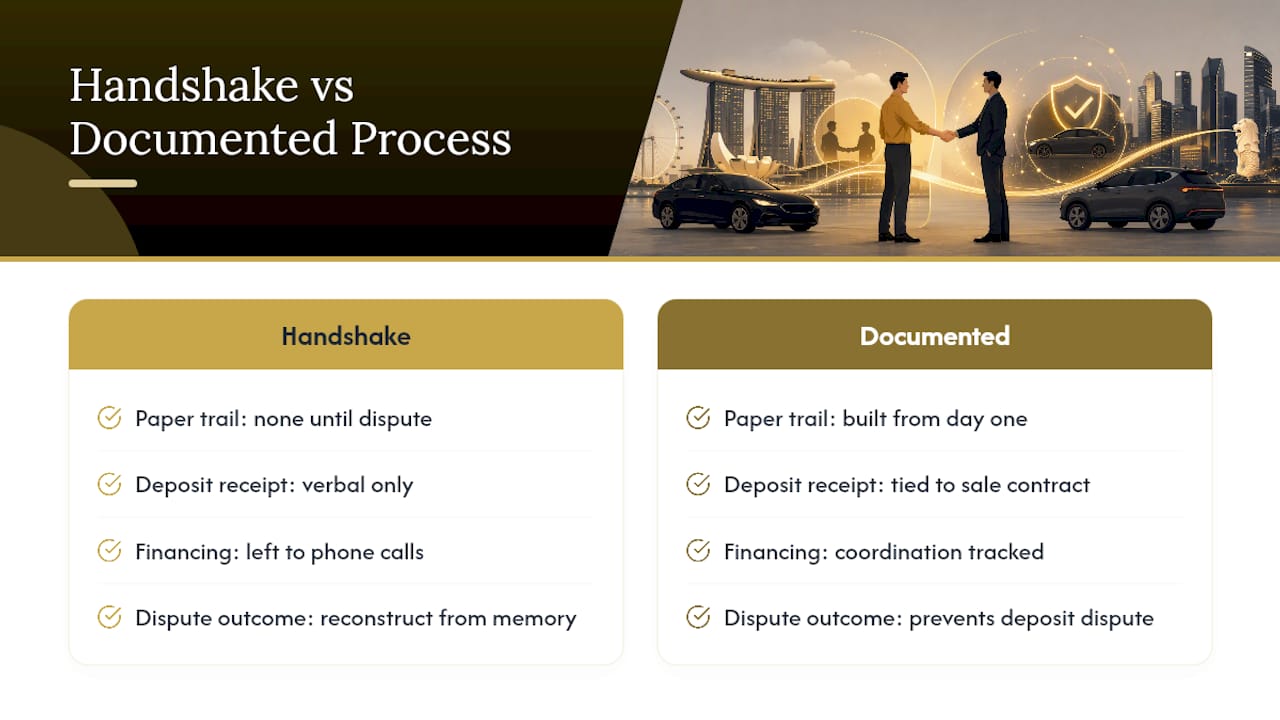
Most deposit disputes I've looked into share one root cause: nobody wrote anything down until it was already a problem. A verbal "don't worry, you'll get it back" is worthless the moment a dealer decides otherwise, and by then you're reconstructing a paper trail from memory.
Bavarian's consignment process builds the paper trail in from day one: valuation, a documented deposit receipt tied to the sale contract, and financing coordination that's tracked rather than left to a phone call nobody wrote down. If you're selling, that structure is what keeps a buyer's deposit dispute from ever becoming your problem.
— Shawn
Sell Your Car Without the Deposit Headaches
Handling your own deposit paperwork, chasing lender rejection statements, and drafting refund terms is a lot to manage on top of actually selling your car. Bavarian's consignment service removes that burden entirely: every deposit gets a documented receipt tied to the sale contract, financing coordination is tracked from application to approval, and LTA transfer paperwork is handled on your behalf from start to finish.

That's the real advantage over managing a private sale solo: you're not the one drafting a refund policy or arguing with a buyer's bank. Bavarian also handles the professional photography and marketing that gets your listing in front of serious buyers faster, so deposits convert to completed sales rather than sitting in limbo. If you're weighing what a consignment sale actually costs, the fee breakdown is worth a look before you decide. Request a free valuation today and see what your car could bring in a managed, documented sale.
Where to Verify These Rules Yourself
- Consumer Protection (Fair Trading) (Motor Vehicle Dealer Deposits) Regulations 2009: the primary law covering deposit refund policies and dealer obligations.
- Lender rejection statement particulars: the exact fields a rejection letter must contain.
- SGCarMart's loan eligibility calculator: a practical tool for estimating loan size against your deposit and down payment.
Sources
- Consumer Protection (Fair Trading) (Motor Vehicle Dealer Deposits) Regulations 2009
- Consumer Protection (Fair Trading) (Motor Vehicle Dealer Deposits) Regulations 2009 (Supplement)
- Car Loan Eligibility Calculator - Sgcarmart