
Odometer tampering meant to deceive a buyer is a criminal offence in Singapore, prosecutable under the Penal Code, and it also counts as an unfair trade practice under the Consumer Protection (Fair Trading) Act. If a car's mileage claim doesn't match its service records, wear, or general condition, stop the deal and get an independent pre-purchase inspection before you hand over a deposit.
Here's what backs that up, and what to do right now:
- The Ministry of Transport reported an average of 14 odometer tampering cases a year between 2016 and 2020, so it's a known, tracked problem, not a rare fluke.
- Ask for full authorised-service records first. If a seller can't produce them, treat that as a warning sign, not a formality.
- Book a certified pre-purchase inspection, ideally at an authorised distributor, before you commit. The Consumers Association of Singapore has fielded complaints on exactly this issue and can guide you on next steps if something looks off.
Key Takeaways
Verifying mileage authenticity before purchase, through service records and authorised-distributor diagnostics, is the single most reliable defense against odometer fraud in Singapore.
| Point | Details |
|---|---|
| Know the legal footing | Odometer tampering with intent to deceive is a Penal Code offence and an unfair trade practice under CPFTA. |
| Use the mileage benchmark | Compare claimed mileage against roughly 17,000 km per year for private Singapore cars. |
| Check records and body wear together | Match service-history continuity against seat, pedal, and steering wheel wear before trusting the odometer. |
| Escalate with a technical check | Request an OBD2/ECU download and authorised-distributor inspection for high-value cars. |
| Document before you report | Gather invoices, diagnostics, and photos before filing with CASE, police, or MOT. |
Table of Contents
- How Odometer Tampering Singapore Laws Actually Work
- What Physical and Paper Signs Reveal Odometer Fraud
- Can OBD2 and Vehicle History Checks Confirm the Mileage?
- What To Do If You Suspect Mileage Fraud
- How Professional Consignment Reduces Mileage Fraud Risk
- Why Buyers Get This Wrong More Often Than You'd Think
- Sources
How Odometer Tampering Singapore Laws Actually Work
Singapore doesn't treat mileage fraud as a gray area. When someone winds back an odometer with the intent to mislead a buyer, that act can be charged under the Penal Code as a form of cheating. Separately, if a dealer knowingly withholds accurate mileage information or misrepresents a car's history, that's an unfair trade practice under the CPFTA, which gives consumers a civil route to pursue compensation.
The Ministry of Transport's written parliamentary reply confirms the offence status and puts a number on it: roughly 14 cases annually over that five-year stretch. That's a modest figure, but it likely undercounts actual incidents, since many buyers never realize their car's history was altered.
Enforcement runs into real friction, though:
- Proving intent requires showing someone deliberately altered the reading, not that it was simply inaccurate.
- Cars often pass through several hands and multiple dealers before resale, which muddies who's responsible for a tampered reading.
- Courts weigh evidence case by case. In one widely reported dispute, a buyer lost his case against a dealer over a tampered odometer because the evidence trail wasn't strong enough to establish fault.
The law gives you tools. It doesn't guarantee an easy win.
What Physical and Paper Signs Reveal Odometer Fraud
Spotting odometer manipulation doesn't require special equipment during a viewing. It requires patience and a checklist.
- Pull the service history first. Look for continuous mileage entries across visits, authorised workshop stamps, and no unexplained gaps. A jump from 40,000 km to 38,000 km between two service visits is an immediate red flag.
- Inspect the driver's seat, pedals, and steering wheel. A car claiming 30,000 km with a sagging seat bolster, a glassy-smooth steering wheel rim, or heavily worn brake and accelerator pedal rubber has probably seen far more use than the dashboard suggests.
- Check for tool marks around the instrument cluster, dashboard screws, or door handles. Scratches near these areas can indicate someone accessed the cluster to alter the display.
- Compare the mileage to a sensible benchmark. Private cars in Singapore average roughly 17,000 km a year, so a ten-year-old car showing 60,000 km total is worth questioning rather than celebrating.
- Watch how the seller behaves. A refusal to allow a test drive, hesitation around an independent inspection, or documents that arrive "later" are all reasons to walk.
Pro Tip: Bring a flashlight to viewings and check the wear pattern on the rubber floor mat under the accelerator pedal. Genuine low-mileage cars rarely show the deep grooves that come from years of use, no matter how clean the interior looks otherwise.
If two or more of these signs show up together, don't negotiate the price down. Walk away and look at the next listing.

Can OBD2 and Vehicle History Checks Confirm the Mileage?
Physical inspection catches obvious cases. Digital verification catches the sophisticated ones, and for anything above ordinary market value, it's worth the extra step.
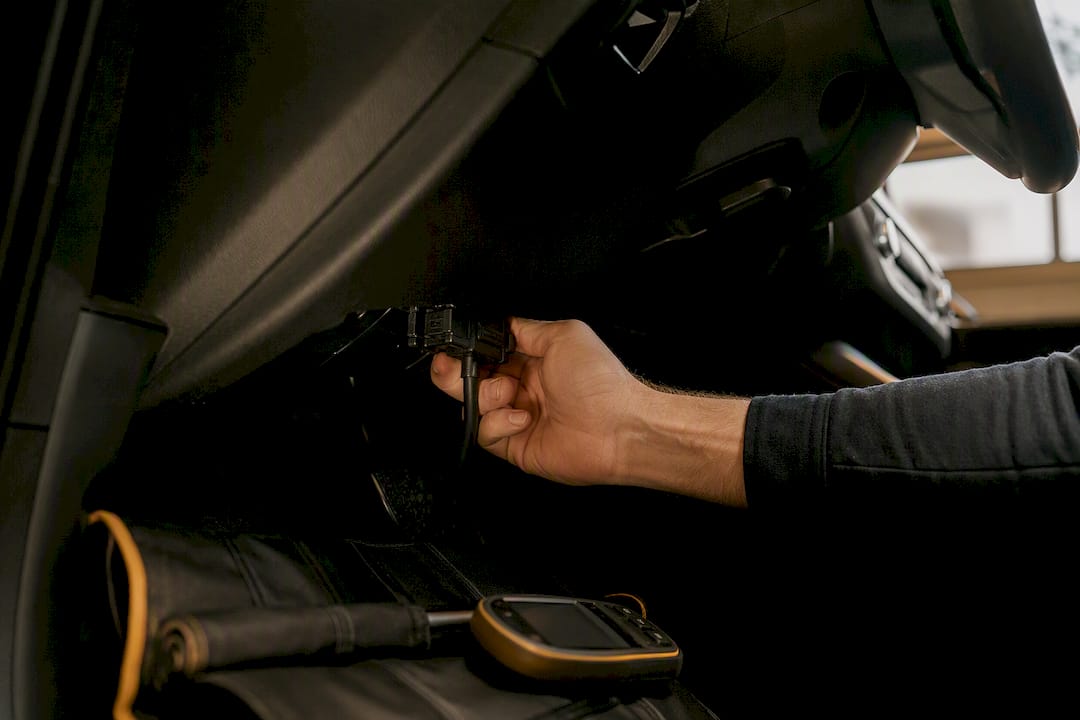
An OBD2 scan or full ECU download can expose mismatches that a dashboard readout alone will never reveal. Modern cars often store mileage data across multiple modules, not just the instrument cluster, so someone who resets the visible odometer frequently leaves a mismatched figure sitting in the transmission control unit or airbag module. Authorised-distributor diagnostics can pull these logs directly, and practitioner guidance on this points to cross-ECU mismatches as one of the more reliable tells of digital rollback.
ASEAN NCAP's guidance on the region recommends combining three layers: physical inspection, service-record verification, and OBD2/ECU diagnostics, rather than relying on any single method. That same source notes that odometer tampering affects a portion of used cars across the region and can significantly inflate resale prices, highlighting the financial risks involved.
- Cross-check the VIN against the logbook, insurance documents, and any vehicle history report you can obtain, keeping in mind that third-party coverage across ASEAN markets isn't always complete.
- For six-figure or performance cars, request a full ECU download, a compression test, and a complete service-log audit as a condition of sale.
- Treat any refusal to allow this level of inspection the same way you'd treat a refusal to provide service records: a reason to stop.
What To Do If You Suspect Mileage Fraud
If something already feels wrong, whether you're mid-negotiation or you've already bought the car, move fast and document everything.
- Collect original service invoices, any diagnostic printout from an inspection, dated photos of the odometer and interior wear, and copies of every written exchange with the seller.
- Note specifics from your test drive, including how the transmission, suspension, and brakes felt relative to the claimed mileage.
- Request the car's service history directly from the authorised distributor if the seller's paperwork looks incomplete.
From there, you have three main channels:
- File a complaint with CASE, which handles consumer disputes involving dealers and can mediate or advise on next steps.
- Make a police report if you believe the Penal Code offence of cheating applies, particularly where there's clear evidence of intentional alteration.
- Contact the Ministry of Transport or the relevant authorised distributor for official mileage records tied to past servicing.
Remedies range from negotiated compensation to a civil suit, but expect friction. As reporting on used-car disputes has pointed out, proving exactly who tampered with the odometer becomes genuinely difficult once a car has changed hands across several dealers. Strong documentation from day one is what tips these cases in a buyer's favor.
How Professional Consignment Reduces Mileage Fraud Risk
Bavarian works exclusively with high-end and performance cars, and mileage accuracy matters even more at that end of the market. A discrepancy on a Porsche or a Bentley doesn't just cost a buyer money at resale. It can void an OEM warranty outright, which is often the bigger financial hit. One Straits Times case involving a Lamborghini resulted in the seller being ordered to pay $20,000 over a mileage discrepancy, a reminder that this issue cuts both ways for sellers too.
The strongest defense against odometer fraud isn't a single check. It's authorised-distributor verification paired with full, unedited service-history disclosure, presented before a buyer ever asks for it.
A properly run consignment process builds this in from the start:
- Full service-history disclosure and authorised-distributor documentation before the car is even listed.
- Professional photography and video that show genuine wear, not staged shots designed to hide it.
- Managed viewings, negotiations, and LTA paperwork that leave a clear, verifiable transaction trail for both parties.
Why Buyers Get This Wrong More Often Than You'd Think
Most advice on this topic focuses on catching a criminal in the act, which misses the bigger issue: the majority of odometer discrepancies in Singapore probably aren't dramatic rollback schemes. They're undisclosed accident repairs, parallel-import registration quirks, or a previous owner who simply never kept receipts. Treating every discrepancy as fraud wastes energy chasing the wrong signal.
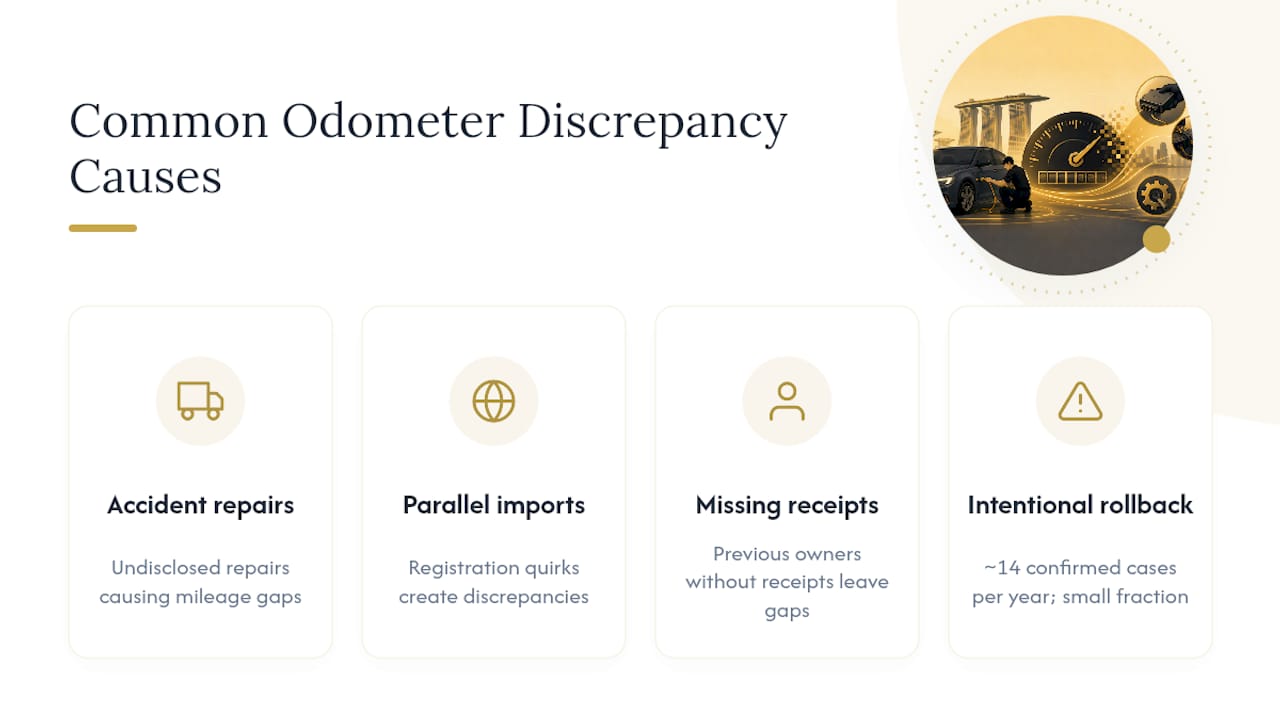
What the evidence actually supports is a documentation-first mindset, not a suspicion-first one. The Ministry of Transport's own numbers show roughly 14 confirmed cases a year, a small fraction of Singapore's used-car transactions. That tells you tampering is real but not the dominant risk. The bigger risk is buyers skipping verification altogether because a car looks clean and the seller sounds confident.
If I had to name the one habit that separates buyers who get burned from buyers who don't, it's this: insist on the paper trail before you fall in love with the car. Mileage benchmarks and physical checks are useful filters, but they're no substitute for an authorised-distributor service record with continuous entries. Prioritize that first, every time, and treat everything else as confirmation, not proof.
— Shawn