The single most reliable official record of a vehicle's reported accident history in Singapore is the GIA Vehicle Accident Report History (VARH). If you are buying or selling a used car, ask the current registered owner to purchase this report through Singpass or MyInfo before any deposit changes hands. Pair it with a physical inspection and a quick LTA check, and you have covered the three things that actually matter in an accident history resale Singapore transaction: paperwork, ownership, and the metal itself.
Here is what to do in the next hour, not the next week.
- Ask the seller to buy the VARH report through the GIA Easy Accident Reporting System (GEARS). Only the current individual owner can purchase it, using Singpass or MyInfo.
- Check the vehicle's OneMotoring log card for COE expiry, ownership history, and transfer dates. This won't show accidents, but it flags suspicious ownership patterns fast.
- If the seller stalls or refuses, book an independent inspection before you commit to anything in writing.
Pro Tip: Offer to cover the VARH fee yourself if the seller hesitates. It removes their excuse and costs you far less than an undisclosed accident would.
The report itself is not expensive. Each VARH pull costs S$90 plus prevailing GST, and it only shows report dates, not repair details. That gap matters, and we'll get into why shortly. But as a first move, S$90 is cheap insurance against a five or six figure mistake.
Key Takeaways
Verified accident history combined with an independent inspection is the only reliable way to price or trust a used car resale in Singapore.
| Point | Details |
|---|---|
| Get the VARH report | Ask the current owner to buy it via Singpass/MyInfo for S$90 plus GST before any deposit. |
| Confirm the LTA log card | Check OneMotoring for COE status and ownership transfer patterns that VARH won't show. |
| Request service records | Ask for invoices covering suspension, bodywork, and major repairs beyond routine maintenance. |
| Book an inspection if flagged | Use VICOM, AA Singapore, or an independent workshop for chassis and paint thickness checks. |
| Consider Bavarian for a hands-off sale | Bavarian coordinates VARH, inspections, and disclosure as part of its consignment service for premium sellers. |
Where to Get Reports and Book Inspections
- GIA GEARS for purchasing the official VARH report; requires Singpass/MyInfo and current ownership status.
- LTA OneMotoring for checking COE expiry, vehicle status, and ownership transfer history.
- VICOM for structured vehicle inspections covering chassis condition and general roadworthiness.
- Automobile Association of Singapore (AA Singapore) for independent pre-purchase inspection services.
- Independent workshops offering paint thickness gauge testing and structural alignment checks as a supplement to VARH and LTA data.
Table of Contents
- Telltale Physical Signs That Point to a Past Accident
- What Does the GIA Accident History Report Actually Show?
- Combining VARH With LTA, Service Records, and Inspections
- When A Seller Won't Provide VARH Or Documents
- Legal Protections When Accident History Goes Undisclosed
- Verifying Third-Party Accident History Reports Are Genuine
- How Accident History Shapes Resale Value
- How Professional Consignors Handle Disclosure
- Let Bavarian Handle the Documentation and the Disclosure
- Sources
Telltale Physical Signs That Point to a Past Accident
A clean VARH doesn't mean a clean car. Plenty of collisions never get reported to an insurer, especially minor ones where the owner paid out of pocket to protect their No Claim Discount. That's why a walk-around inspection still earns its place in every accident history resale Singapore checklist, VARH or no VARH.
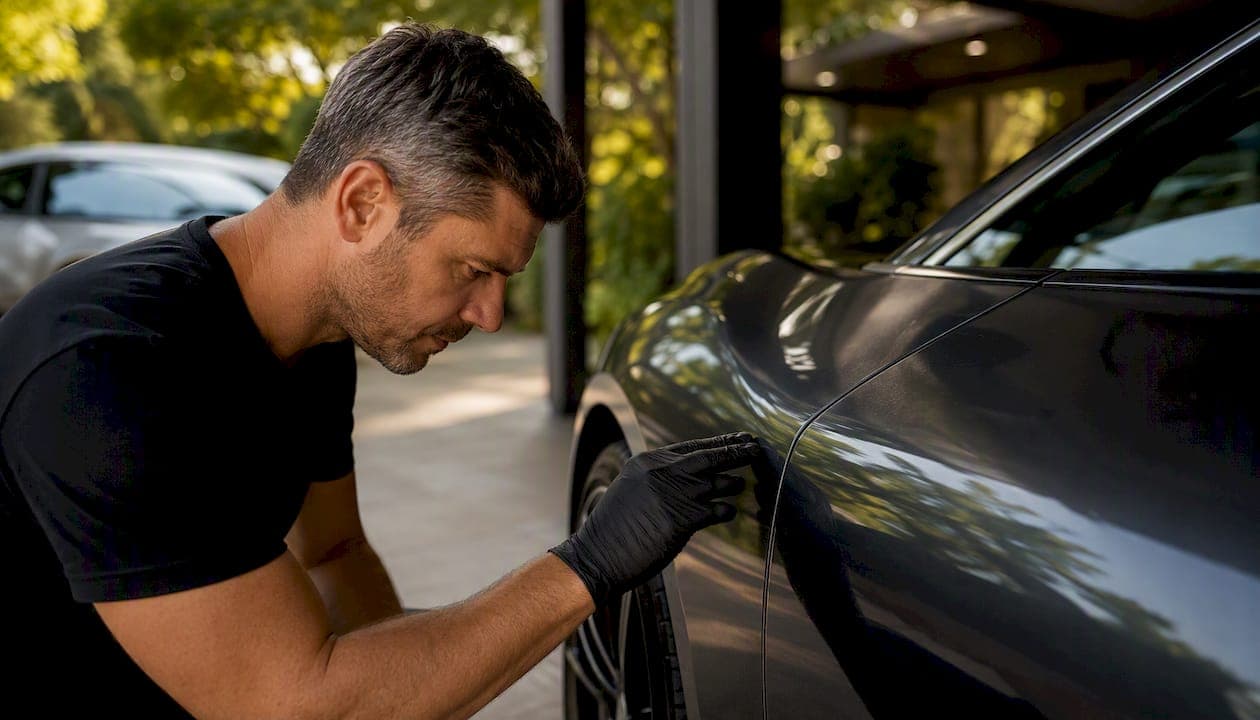
Start with the paint. Uneven texture, slightly different color under bright light, or overspray creeping onto rubber seals and trim are classic signs of a respray. Panel gaps tell a similar story. Doors, the bonnet, and the boot should sit flush and evenly spaced. If one side of the boot lid sits a few millimeters proud of the other, someone has been in there with a hammer, a jack, or worse.
Headlights and taillights are an underrated tell. Mismatched fitment, a slightly different shade of housing plastic, or a unit that sits at a different angle than its twin usually means a replacement part went in after a front or rear hit.
Take the car for a proper drive, not a cautious loop around the block. Listen for clunks over bumps, feel for a pull to one side under braking, and check whether the steering wheel sits dead center when driving straight. Uneven tire wear across the same axle often points to a bent subframe or misaligned suspension, both classic aftermath of a moderate to serious collision. Peek into the wheel arches and along the boot seam for signs of non-factory welding; a clean factory seam looks machine-precise, while a repaired seam often looks slightly rougher or has visible grinding marks.
Inside the cabin, trust your nose before your eyes. A musty or damp smell can mean water ingress from a flood repair job. Check whether the airbag warning light behaves normally on ignition, and look at wear on the pedals and driver's seat bolster against the claimed mileage. A "low mileage" car with a heavily worn brake pedal rubber is telling you something the odometer isn't.
Cosmetic paint touch ups after a minor car park scrape are common and mostly harmless. Structural signs, like a bent subframe, welded seams, or a persistent steering pull, are a different category entirely. Those need a professional opinion before you go any further, not a second look in daylight.
What Does the GIA Accident History Report Actually Show?
The GIA VARH report is the closest thing Singapore has to an official accident history report, and it's worth understanding exactly what's on it before you rely on one. GIA introduced the service on GEARS to let current individual vehicle owners pull a record showing dates when accident reports were made against the vehicle over the past six years.
A typical report includes:
- Report generation date
- Vehicle registration number (VRN)
- Chassis number
- First registration date
- Make and model
- Dates of past accident reports, including whether the report was filed by the vehicle's own insurer or by another party involved in the incident
That last point matters. An entry marked as reported by another party means someone else's insurer flagged an incident involving this car, which can happen even when the vehicle's own owner never filed a claim.
Buying the report is straightforward if you're the current owner. Log into GEARS, verify identity through Singpass or MyInfo, pay S$90 plus prevailing GST per report, and the report generates immediately.
| Report Element | What It Tells You |
|---|---|
| Report generation date | Confirms how current the data is at the time of purchase |
| VRN and chassis number | Identifies the exact vehicle, useful for cross-checking against the log card |
| Accident report dates | Shows when insurer-linked reports were filed, up to six years back |
| Reporting party | Distinguishes self-reported claims from third-party reports |
Three disclaimers deserve your full attention. First, VARH is tied to the vehicle registration number, not a fixed chassis identity in perpetuity; if a VRN has been transferred or reused in unusual circumstances, the report can reflect that history rather than a single clean lineage. Second, it only captures accidents that were actually reported to an insurer, so a private repair paid in cash to protect a No Claim Discount simply won't appear. Third, coverage runs up to six years from your query date, so anything older is invisible.
A single accident entry from years ago with no other flags is usually low risk, especially on an older car that's changed hands a few times. Multiple entries clustered within a short window, on the other hand, deserve a harder look. It suggests either repeated minor incidents or one larger event that generated more than one claim.
Keep a copy of the VARH report with your sale paperwork regardless of which side of the transaction you're on. If a dispute ever comes up later, it's evidence that due diligence was done.
Combining VARH With LTA, Service Records, and Inspections
VARH answers one question: has an accident been reported to an insurer? It says nothing about ownership continuity, maintenance quality, or whether the chassis is straight. That's where OneMotoring and independent inspections come in.
OneMotoring gives you the vehicle's legal status: COE expiry date, current registration status, and ownership transfer history. It won't tell you a thing about accidents, but a car that has changed hands four times in eighteen months is worth asking hard questions about, VARH clean or not.
| Source | Covers | Does Not Cover |
|---|---|---|
| GIA VARH | Insurer-reported accident dates | Repair quality, unreported incidents, severity |
| LTA OneMotoring | COE status, ownership transfers, log card details | Accident or damage history |
| Service/workshop invoices | Maintenance history, parts replaced | Confirmation of accident cause |
| VICOM/AA/independent inspection | Chassis condition, paint thickness, structural alignment | Historical accident dates |
Service records fill in another gap. Ask the seller for invoices going back as far as they have them. A pattern of replaced suspension components, bodywork touch ups, or panel replacements outside of routine wear tells you something the VARH never will.
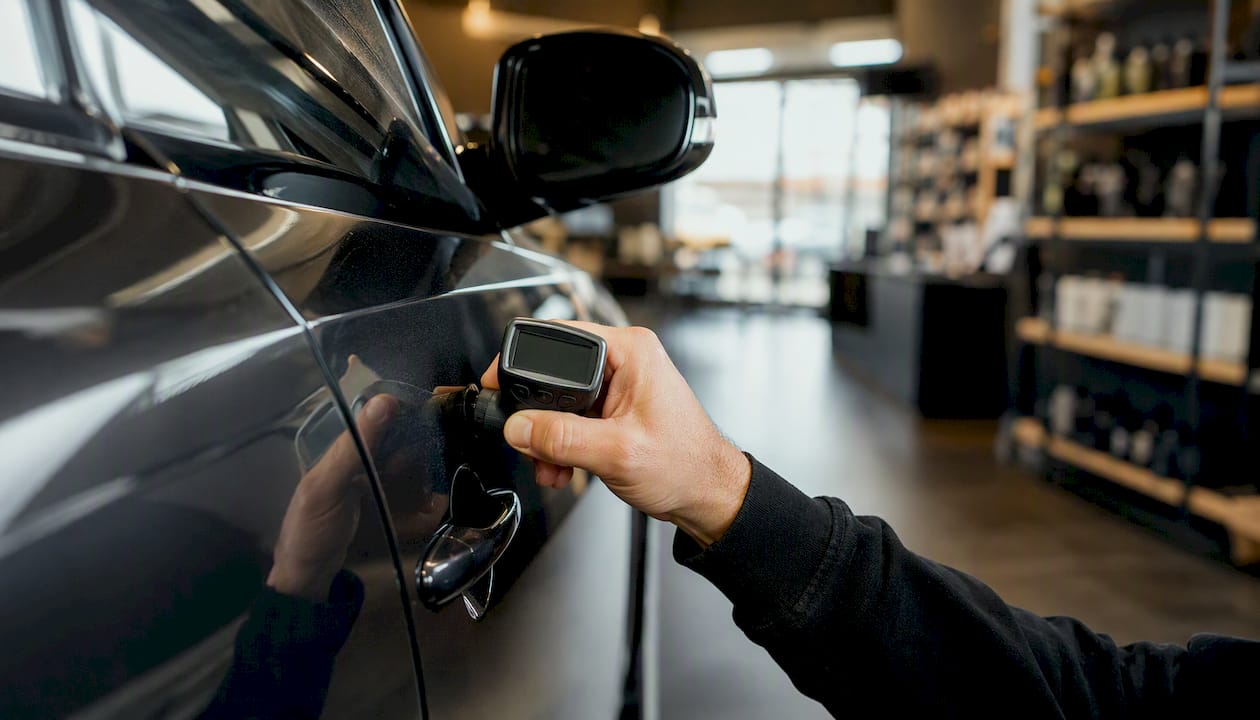
Independent inspections close the loop. Providers like VICOM and the Automobile Association of Singapore offer structured vehicle checks, and independent workshops can run the same forensic tests. A paint thickness gauge picks up filler or repainting invisible to the naked eye, and a proper inspector will check bolt heads around structural panels for tampering, since factory bolts have a distinct, machine-applied look that a repair shop rarely replicates perfectly.
Sequence matters here. Pull the VARH and check the log card first, since both are quick and cheap. Only book a paid inspection if something in those two documents raises a flag, or if the car is expensive enough that the inspection fee is trivial next to the purchase price.
Pro Tip: A paint thickness gauge reading that jumps by more than 100 to 150 microns on one panel compared to its neighbors is a strong sign of filler work or a respray, even if the color match looks perfect.
When A Seller Won't Provide VARH Or Documents
A seller who won't produce a VARH report, an LTA log card, or basic service invoices is telling you something, even if they never say a word about it. Here's how to handle it without wasting your time or your deposit.
- Offer to pay the S$90 fee yourself and have the current owner authorize the VARH purchase through Singpass. This removes cost as an excuse.
- If they still refuse, insist on an independent inspection at their expense, or split the cost, before any deposit is paid.
- Ask for a signed written statement disclosing any known accident history. It won't replace a proper report, but it creates accountability.
- If concerns remain unresolved, negotiate a price adjustment that reflects the uncertainty, or hold funds in escrow until an inspection clears the car.
Put every request in writing, even a simple text message, and set a firm deadline for a response. Use the LTA log card as leverage too. If ownership has changed hands multiple times in a short period, that's a legitimate reason to ask harder questions, and a seller with nothing to hide usually won't mind you asking.
Some behavior should send you walking. A refusal to show the log card at all, pressure to sign a deposit before you've verified anything, or service records that don't match the claimed mileage are all red flags worth taking seriously. At minimum, if a VARH genuinely isn't available, insist on a recent independent inspection certificate, complete service invoices, and a signed disclosure from the seller before you hand over money.
Legal Protections When Accident History Goes Undisclosed
Singapore doesn't have a dedicated statute that forces private sellers to disclose accident history the way some countries mandate vehicle history disclosures at point of sale. That said, misrepresenting a car's condition in a private sale, especially if a seller actively lies when asked a direct question about accidents, can expose them to claims under general contract and misrepresentation principles.
Buyers who discover material undisclosed damage after purchase generally have stronger footing if they can show the seller made a false statement of fact, rather than simply staying silent. This is one reason a written question and a written answer, even over text message, is worth more than it seems in the moment. If a dispute lands you in the Small Claims Tribunal or civil court, documented correspondence carries far more weight than a verbal assurance nobody can prove.
This is general information, not legal advice. If you are dealing with a significant dispute over undisclosed accident damage, speak with a qualified lawyer about your specific situation before taking action.
Verifying Third-Party Accident History Reports Are Genuine
Not every "accident history report" floating around the used car market carries the same weight; this is why Protect A Plate's cloning protection service is valuable background on vehicle fraud monitoring in general. Anyone can generate a slick looking PDF, so a little skepticism is healthy before you rely on one.
Confirm the report actually came from GEARS and matches the vehicle in front of you. Cross check the VRN and chassis number printed on the report against the numbers stamped on the car itself, usually found on the chassis plate under the bonnet or on the windscreen corner. A report generation date more than a few weeks old is also worth questioning; ask for a fresh pull rather than trusting an old copy that might predate a more recent incident.
Be wary of third-party summary reports from car listing platforms that claim to compile accident history from unnamed sources. If it isn't a direct GEARS printout, treat it as supplementary at best, and verify the headline claim against the actual VARH yourself.
How Accident History Shapes Resale Value
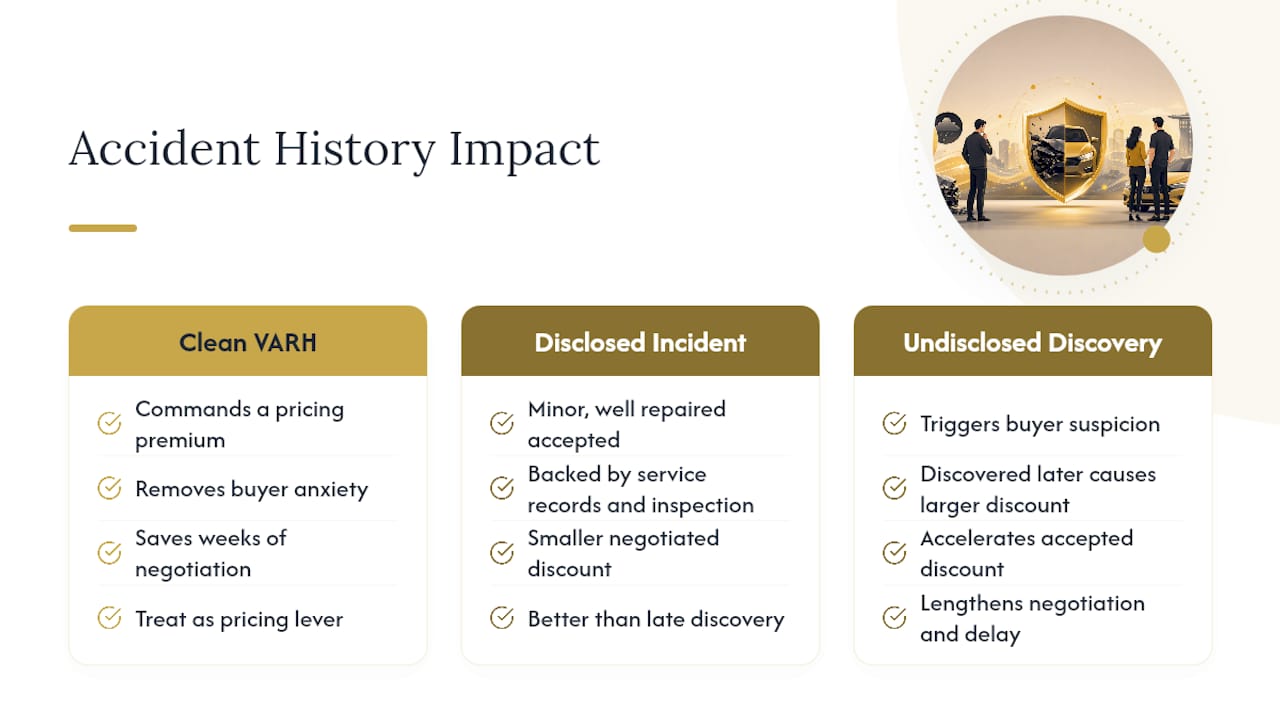
A documented clean accident history doesn't just avoid red flags, it actively commands a premium, particularly in Singapore's high-end and performance car segment where buyers are often comparing near-identical spec sheets and looking for any differentiator. Two otherwise identical cars with the same mileage and COE remaining can sell weeks apart in negotiation time purely because one seller had paperwork ready and the other didn't.
Sellers sitting on a genuine clean VARH should treat it as a pricing lever, not just a compliance checkbox. Buyers pay for certainty, and a verified report removes one of the biggest sources of buyer anxiety in a private transaction. On the flip side, a disclosed accident history doesn't automatically tank value the way sellers often fear. A minor, well-repaired incident disclosed upfront, backed by service records and a clean inspection, usually costs far less in negotiated discount than the same fact discovered after the fact by a suspicious buyer.
Depreciation curves in Singapore are steep enough already given COE mechanics; adding avoidable buyer distrust on top of that only accelerates the discount a seller has to accept.
How Professional Consignors Handle Disclosure
Reputable consignors and dealers treat accident history disclosure as part of the sale process, not an afterthought triggered by a suspicious buyer's question. A seller who proactively pulls the VARH, includes it in the listing pack, and pairs it with a recent inspection certificate is signaling something buyers notice immediately: nothing to hide.
Proactive disclosure, including VARH reports and inspection certificates, tends to build buyer confidence faster and shorten the negotiation cycle. Opacity does the opposite: it slows transactions down and typically costs the seller more in final price than the disclosure ever would have.
The practical checklist we recommend to sellers looking to maximize resale value on a premium vehicle includes the VARH report, an exported LTA log card, complete service invoices, a recent inspection certificate from VICOM or an equivalent provider, and professional photography or video that shows the car honestly rather than hiding flaws with clever angles. Buyers of BMW, Mercedes-Benz, Porsche, and similar marques are often more sophisticated than the average used car shopper, and they notice when documentation is missing.
Why Transparency Wins in the Luxury Segment
Buyers of high-end and performance cars are paying a premium precisely because they expect fewer surprises, not more. A seller who hands over a VARH report unprompted, alongside a fresh inspection certificate, usually finds negotiations move faster because the buyer isn't spending the first meeting hunting for reasons to distrust the listing.
We've seen this play out consistently in the premium segment: a seller who front-loads documentation typically closes a sale in fewer viewings than one who waits to be asked. Suspicion is expensive in negotiation time, and buyers who sense a seller is holding something back tend to lowball as a defensive move, even when the car turns out to be perfectly sound. Disclosure isn't just an ethical position, it's a faster path to the asking price.
Let Bavarian Handle the Documentation and the Disclosure
Selling a premium car privately means becoming your own paperwork department, inspection coordinator, and negotiator all at once. Bavarian's consignment model takes that entire burden off a seller's plate while making transparency the centerpiece of the listing rather than an afterthought.
Through our consignment service, we obtain the VARH report on the owner's behalf, coordinate a VICOM or equivalent inspection, and compile everything into a documentation pack buyers can review before they even book a viewing. We handle the LTA transfer paperwork, professional photography, and marketing across SgCarMart and social platforms, and we can advise whether a known accident history should change your listing price or whether a recommended repair is worth doing before the car goes live. If you're ready to sell a BMW, Mercedes-Benz, Porsche, or another performance marque and want the process handled end to end, get a free valuation from Bavarian and see what a transparency-led listing can do for your final sale price.