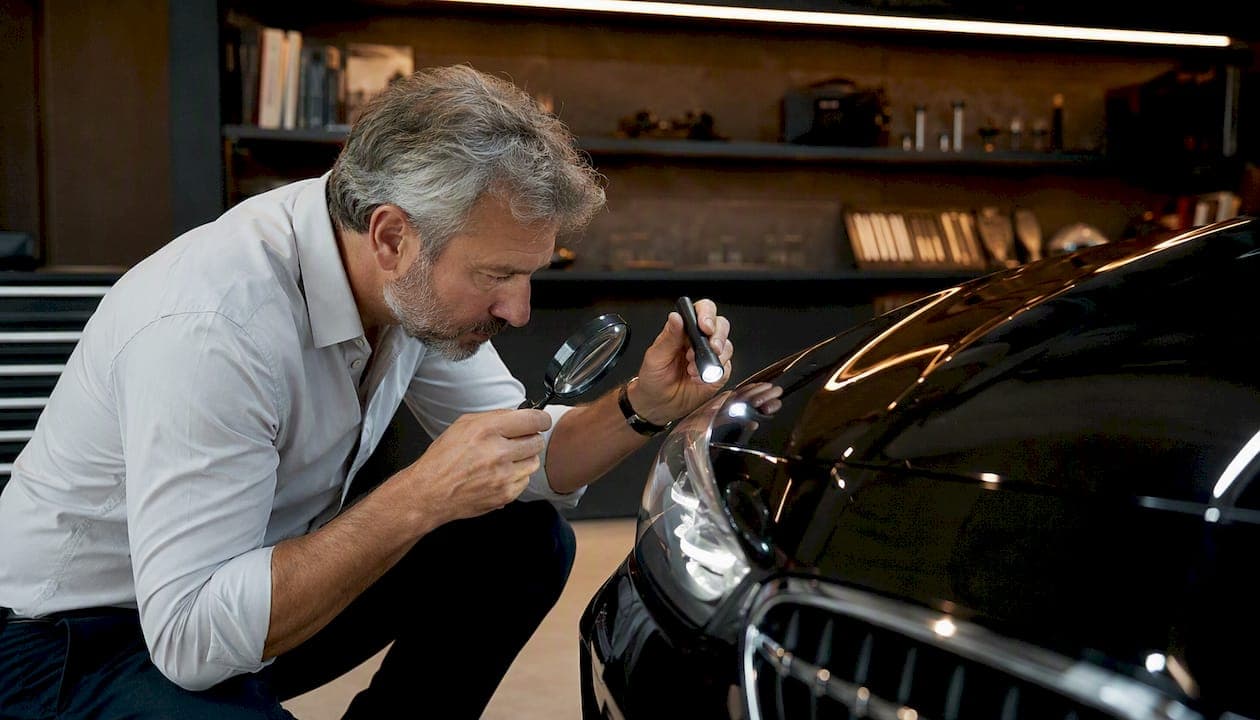
For high-end cars, the answer to the PPF vs ceramic coating debate is not either/or. The winning strategy is PPF on the front bumper, hood, fenders, and mirrors, with a professional ceramic coating applied over the entire car, including over the film. That combination gives you physical impact protection where it counts most and a chemical-resistant, hydrophobic surface everywhere else.
- Installers estimate roughly 90% of rock-chip damage concentrates on the front third of the vehicle, which is exactly why front-end PPF is the highest-return investment before any other protection.
- Ceramic coating alone will not stop a stone chip. PPF alone leaves paint vulnerable to UV fade and chemical etching.
- Documented protection, including installer receipts and warranty paperwork, is one of the clearest trust signals a buyer sees when evaluating a premium car.
Your immediate next step: inspect your front-end finish for existing chips, request a PPF coverage quote for the front third, and collect any existing protection records before listing with Bavarian.
Table of Contents
- What PPF and ceramic coating actually do to your paint
- How do PPF and ceramic coating compare side by side?
- What high-end owners preparing for resale should actually do
- What installation, costs, and maintenance actually look like
- Common myths about layering PPF and ceramic coating
- How to document paint protection so buyers believe it
- Key Takeaways
- Why documented protection changes what a car is worth at consignment
What PPF and ceramic coating actually do to your paint
These two products protect paint through completely different mechanisms, and confusing them is expensive.
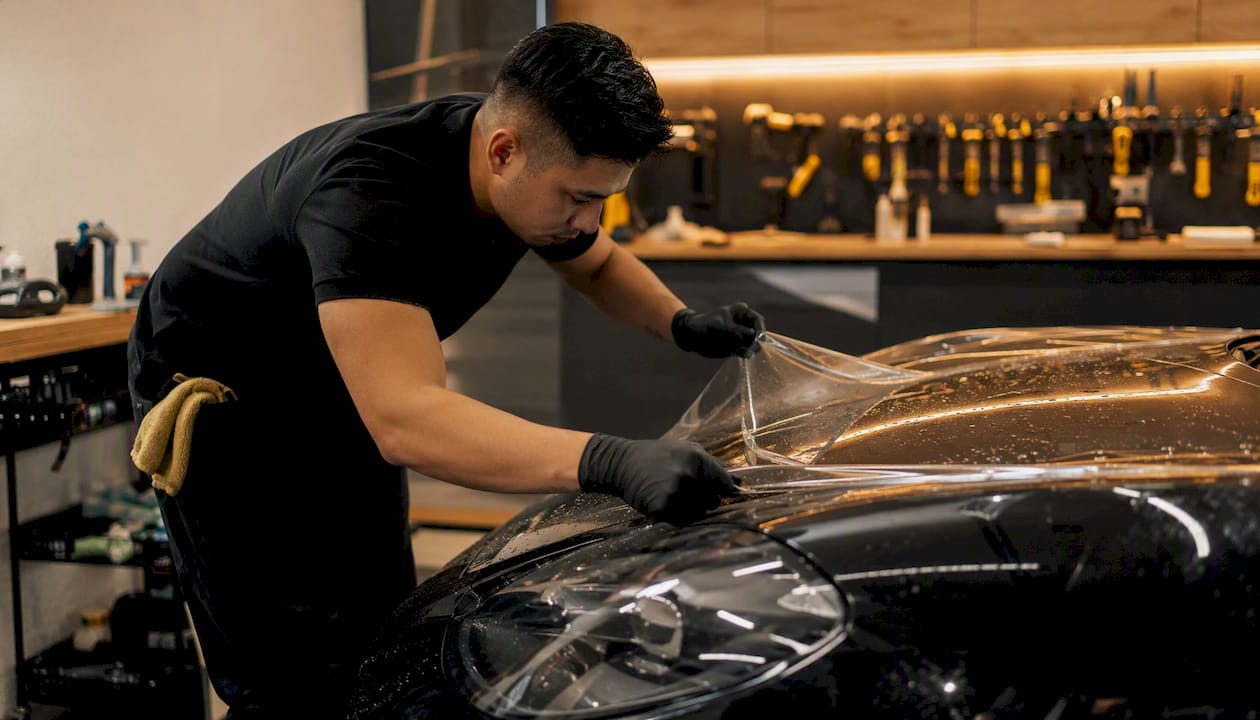
Paint protection film (PPF) is a urethane film, typically 6–8 mils thick (150–200 microns), that sits on top of your paint and physically absorbs impacts. Rock chips, road debris, door dings, and light scratches hit the film, not the paint. Premium PPF products include a self-healing topcoat that allows minor surface scratches to disappear with heat exposure. The film is optically clear when installed correctly, so it does not alter the car's appearance.
Ceramic coating is a different category entirely. It is a SiO2-based polymer layer, only 1–5 microns thick, that bonds chemically to the paint surface. That bond creates hydrophobicity (water beads and rolls off), resistance to bird droppings, tree sap, road salt, and UV radiation, and a gloss-enhancing effect. What it does not do is stop a stone chip. The layer is too thin to absorb physical impact.
Both products also fail differently. PPF can yellow or lift at edges if neglected, particularly in high-UV environments, and may require replacement when edges delaminate. Ceramic coatings gradually lose their hydrophobic performance over time but do not peel. They can be topped up or re-applied without stripping the paint underneath. Professional ceramic coatings typically last 3–7 years depending on product and maintenance.
One more common confusion worth clearing up: PPF and vinyl wrap are not the same thing. PPF is designed for invisible protection; vinyl wrap changes the car's color or finish and provides no meaningful impact resistance. If you are choosing between them for protection purposes, vinyl wrap is not a substitute.
Pro Tip: Installers apply PPF first, then coat over it. Plan for this sequence when scheduling: the film needs time to fully adhere before coating goes on top, which typically adds 24–48 hours to the total job.
How do PPF and ceramic coating compare side by side?
| Dimension | PPF | Ceramic Coating |
|---|---|---|
| Protection type | Physical impact, rock chips, abrasion | Chemical resistance, UV, hydrophobicity |
| Film thickness | 150–200 microns (6–8 mils) | 1–5 microns |
| Visual appearance | Optically clear, invisible | Gloss-enhancing, wet look |
| Lifespan | 5–10 years with maintenance | 3–7 years (professional grade) |
| Typical cost | Partial front: $1,500–$2,500; full body: higher | Professional install: $700–$2,200 |
| Repairability | Sections can be replaced; edges may lift | Tops up without stripping; no peeling |
| Maintenance | Edge care, pH-neutral washes, annual checks | Regular washes, annual inspection/top-up |
| Warranty/cert | Installer-issued, often transferable | Product + installer warranty; varies |
| Install time | 1–3 days (partial to full) | 1–2 days plus cure window |
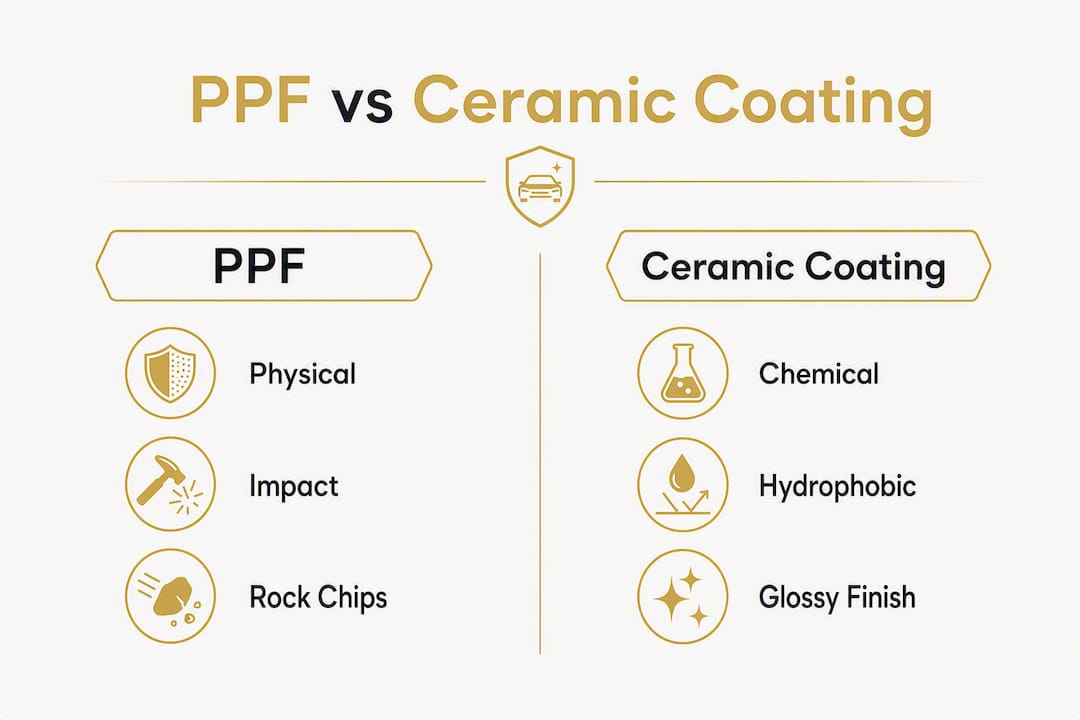
For a high-end car heading toward consignment, the table above points to one conclusion: PPF covers the risk ceramic cannot, and ceramic covers the maintenance burden PPF does not eliminate on its own.
What high-end owners preparing for resale should actually do
The technical comparison matters less than the practical decision: where do you spend, and in what order?
Minimum baseline for any premium car driven on freeways or in urban traffic: front-end PPF covering the bumper, hood leading edge, fenders, and mirrors. This is where most rock-chip damage concentrates, and a single repaint on a Porsche or BMW M-series can cost more than a full PPF job.
If you are keeping the car for five or more years, or if you regularly drive on open highways or through construction zones, full-body PPF is worth the premium. The math changes when you factor in the cost of a single panel respray versus the cost of film replacement.
When budget is the constraint, prioritize partial PPF on the most vulnerable panels and a professional ceramic coating on everything else. That combination still delivers meaningful protection and makes the car far easier to maintain between washes.
Verified protection directly affects buyer confidence and consignment value, particularly for premium and custom-color cars where repaint risk is a real concern for buyers. A buyer looking at two similar Porsche 911s will pay more for the one with documented PPF and a transferable warranty. The paperwork is part of the product.
Pro Tip: Bavarian recommends including certified installer receipts, film serial numbers, and high-resolution before/after photos directly in the listing. At viewings, a printed warranty folder on the passenger seat signals a meticulous owner before the buyer says a word.
What installation, costs, and maintenance actually look like
Timelines and scheduling: partial front-end PPF typically takes one to two days. Full-body PPF runs two to three days. Ceramic coating adds one to two days, plus a cure window of 24–72 hours before the car can get wet. If you are listing a car for sale, schedule protection work at least one week before photography to allow full cure and a final detail.
Cost framing: professional ceramic coating runs approximately $700–$2,200; partial front PPF packages typically start around $1,500–$2,500, with full-body PPF priced higher depending on vehicle size and film brand. Measured against a single panel respray, the cost-per-year math on PPF is straightforward for any car worth over $80,000.
Warranty and certification: ask every installer for a dated invoice specifying which panels were covered, the film brand and serial number, and explicit warranty terms including transferability. A warranty that transfers to the next owner is a selling point. One that does not is just paper.
Maintenance routines:
- Wash with pH-neutral shampoo every two weeks; avoid automated brush washes on PPF.
- Annual professional inspection for edge lifting on PPF and hydrophobic performance on ceramic.
- Re-apply a ceramic top-up coat every 12–18 months if the water-beading effect diminishes noticeably.
- Check PPF edges at each wash; early lifting caught early can be re-adhered without full replacement.
| Step | Timeline |
|---|---|
| PPF installation (partial) | Day 1–2 |
| PPF adhesion settling | Day 2–3 |
| Surface decontamination for coating | Day 3 |
| Ceramic coating application | Day 3–4 |
| Cure window (no water exposure) | Day 4–6 |
| Final detail and photography | Day 5+ |
Common myths about layering PPF and ceramic coating
A few misconceptions circulate widely enough to cost owners real money.
- "Ceramic coating replaces PPF." It does not. Ceramic is a chemical barrier, not an impact shield. A stone chip goes straight through it.
- "PPF never needs maintenance." Film edges need regular inspection. Neglected PPF yellows and lifts, which is worse aesthetically than no film at all.
- "Vinyl wrap gives the same protection as PPF." Vinyl changes appearance; it does not absorb impacts. These are different products for different goals.
- "You can coat over any PPF without special prep." Compatibility matters. The film's topcoat must be clean, fully cured, and decontaminated before ceramic goes on top.
What layering actually delivers is straightforward: PPF absorbs the physical hits, and the ceramic coating on top makes the film surface hydrophobic, glossier, and easier to clean. Dirt and road grime that would otherwise stain the film surface bead off instead.
Pro Tip: Before booking a combined PPF and ceramic job, ask the installer specifically how they prep the film surface before coating. Ceramic coating requires a contaminant-free surface and controlled application conditions; any dust or high spots left after PPF installation will be locked in permanently once the coating cures. A certified installer will have a documented prep protocol.
How to document paint protection so buyers believe it
Documentation is what converts a protection investment into a resale asset. Without it, a buyer has no way to verify what is under the film or how old it is.
Checklist for every protected vehicle:
- Dated installer invoice with shop name, address, and contact details
- Coverage diagram showing exactly which panels were filmed or coated
- Film brand, product name, and serial/batch number
- Warranty document with explicit transferability terms
- High-resolution before/after photos (minimum 10 images, well-lit)
- Maintenance receipts for any annual inspections or top-up coats
For online listings: upload before/after photos early in the image sequence, not buried at the end. Write a caption that names the film brand, coverage area, and warranty status. Buyers filter by condition; a listing that shows documented protection stands out immediately.
At physical viewings: keep a printed folder in the car with the warranty pages on top, followed by the coverage diagram and photos. Buyers who see organized documentation assume the rest of the car has been maintained the same way.
Pro Tip: Bavarian's consignment listings include protection documentation as a named feature in the vehicle description. When selling a luxury car through consignment, having this paperwork ready before the first viewing shortens the sales cycle because buyers spend less time on condition questions and more time on price.
Key Takeaways
For high-end cars, PPF on the front third combined with a professional ceramic coating over the whole vehicle is the most cost-effective protection strategy for both daily driving and resale value.
| Point | Details |
|---|---|
| Front-end PPF first | Roughly 90% of rock-chip damage hits the front third, making it the highest-return coverage zone. |
| Coat over PPF | Ceramic coating over film adds hydrophobicity and gloss while simplifying maintenance across the whole car. |
| Cost ranges to know | Partial front PPF starts around $1,500–$2,500; professional ceramic runs $700–$2,200. |
| Documentation is a resale asset | Dated invoices, film serial numbers, and transferable warranties increase buyer confidence at viewings. |
| Maintenance protects the investment | pH-neutral washes, annual inspections, and edge checks keep both products performing through ownership. |
Why documented protection changes what a car is worth at consignment
Most owners think about PPF and ceramic coating as a cost. The owners who get the best prices at consignment think about them as evidence.
When a buyer looks at a high-value car, they are not just evaluating the paint. They are evaluating the owner. A car with a full PPF installation record, a transferable ceramic warranty, and a folder of maintenance receipts tells a story that a freshly detailed car without paperwork simply cannot. The buyer's risk calculation changes. They are not wondering what is hiding under the surface.
The cars that move fastest through Bavarian's consignment process are not always the lowest-mileage ones. They are the ones where the seller has made it easy for the buyer to say yes. Documented paint protection is one of the clearest ways to do that, because it removes a specific, expensive uncertainty from the buyer's mind.
If you are preparing a car for consignment with Bavarian, start with the front-end inspection, get the PPF and coating work done by a certified installer, collect every piece of paperwork, and bring it all to the first conversation. That preparation is exactly what Bavarian's team uses to build listings that attract serious buyers at the right price.