
Most manufacturer warranties in Singapore follow the VIN, not the owner, so they transfer automatically when LTA records the new registrant. Extended warranties and third-party vehicle service contracts (VSCs) are different: they transfer only if the contract allows it and you notify the administrator in time.
Three things to do right now:
- Seller: Gather the original purchase receipt, stamped service book, warranty card or contract number, and any VSC paperwork before the sale date.
- Buyer: Before you complete payment, ask the seller for the VIN, confirm remaining coverage directly with the manufacturer or dealer, and get written confirmation.
- Both parties: Cross-check the VIN against the warranty document, proof of purchase, and service history. Mismatches cause denied claims.
Volkswagen Singapore's warranty T&Cs illustrate the standard manufacturer approach: coverage is tied to vehicle registration events and the term defined in the contract. Cycle & Carriage's Peugeot warranty language follows a similar pattern, linking coverage to the registered vehicle rather than the registered owner. The LTA ownership transfer is the administrative event that formally moves the VIN to the new registrant and triggers that automatic factory coverage handover.
Key Takeaways
Transferring a car warranty in Singapore is straightforward for factory coverage but requires active steps for extended plans, and missing the submission window on a VSC can permanently void the transfer.
| Point | Details |
|---|---|
| Factory warranty transfers automatically | LTA ownership transfer triggers VIN-linked factory coverage for the new registrant; no separate form needed. |
| VSC transfers require a form and fee | Submit the transfer form within 14–30 days of sale; typical fees range from S$25 to S$100. |
| LTA administrative fee is S$25 | This is the legal ownership-change event; complete it first, then handle VSC transfer separately. |
| Documents to hand over at sale | Original receipt, stamped service book, warranty card, and VSC contract number are the core package. |
| Warranty status affects price | Remaining factory coverage or a transferable VSC supports the asking price; non-transferable coverage is a negotiation discount. |
Table of Contents
- Can you transfer a car warranty in Singapore?
- How to check whether a specific car's warranty transfers
- Step-by-step checklist for seller and buyer
- How extended warranties and third-party service contracts behave on ownership change
- What typically stays covered after a warranty transfers
- How long does a warranty transfer take, and what does it cost?
- How an active warranty affects used-car value and negotiations
- How Bavarian handles warranty and ownership handover during consignment
- What most guides get wrong about warranty transfers
- Sources
Can you transfer a car warranty in Singapore?
Factory-backed warranties are typically tied to the VIN and transfer automatically to the new owner when legal ownership changes. No separate warranty form is usually required for factory coverage. What you do need is the LTA ownership transfer completed correctly, because that administrative step is what associates the VIN with the new registrant.
Extended warranties and VSCs are a different story. They are contracts between a named party and an administrator, so they transfer only when the contract permits and the administrator approves. Most car warranties transfer with the vehicle on sale, but some manufacturers shrink certain benefits for second owners. Hyundai and Kia, for example, are known for long powertrain coverage that applies only to the original purchaser; a second owner receives a shorter residual term.
The practical distinction buyers and sellers need to understand:
| Coverage type | Transfer behavior | Action required |
|---|---|---|
| Factory/manufacturer warranty | Usually automatic on LTA transfer | Confirm VIN and remaining term with dealer |
| Dealer add-on warranty | Often follows manufacturer rules | Check dealer T&Cs; get written confirmation |
| Extended/VSC (third-party) | Contract-dependent; may require form and fee | Submit transfer form within the allowed window |
Manufacturer T&Cs spell out warranty start dates, covered items, and any registration-related limits. Read them before assuming coverage carries over unchanged. The legal distinction between a "full" and "limited" warranty matters here: full warranties are harder for manufacturers to restrict from subsequent owners, while limited warranties give manufacturers latitude to impose original-owner restrictions. Almost every car warranty in Singapore is a limited warranty, which is why the exact written terms govern everything.
How to check whether a specific car's warranty transfers
Before you hand over money or keys, verify coverage with documents, not assumptions. Here is what to collect and why each item matters:
| Document | Why it matters |
|---|---|
| Original purchase receipt | Establishes warranty start date and original purchase price |
| Stamped service book | Proves authorized servicing was maintained (voids coverage if missing) |
| Warranty card or contract number | Required to look up coverage status with manufacturer or VSC administrator |
| VIN | Cross-references the car against the warranty record |
| VSC contract number | Needed to confirm transferability and remaining term with the administrator |
| Service records (invoices) | Demonstrates maintenance compliance; administrators may request these |
Contacting the manufacturer or dealer: Call or email the authorized dealer with the VIN, the current odometer reading, and the expected sale date. Ask specifically: "Is the factory warranty still active on this VIN, what is the remaining term, and does any coverage change for a second owner?" Get the answer in writing, even a reply email counts.
For a VSC administrator, the subject line that gets a fast response: "Transfer request inquiry — Contract [number], VIN [number], sale date [date]." Have the buyer's name and contact details ready; most administrators need them to initiate the transfer.
Pro Tip: If the original receipt is missing, a dealer-stamped service history combined with the VIN lookup at an authorized service center can often reconstruct the warranty start date. Payment records from a bank or financing company also work as secondary proof of purchase date.
Step-by-step checklist for seller and buyer
The car sale paperwork checklist for Singapore covers the full legal handover, but warranty transfer has its own sequence. Follow this order around the sale date:
Seller actions:
- Before listing: Pull the warranty card, original receipt, and stamped service book. Confirm the remaining factory warranty term and any active VSC with the dealer or administrator.
- At listing: Note the remaining warranty months and mileage in the listing (SgCarMart allows this in the description field). An active transferable warranty is a genuine price lever.
- At sale: Hand the buyer the complete document package: receipt, service book, warranty card, VSC contract, and any written confirmation of remaining coverage.
- Within 14–30 days of sale: Submit the VSC transfer form (if applicable) to the administrator with proof of sale, buyer contact details, and odometer reading at time of sale. Missing this window can void the transfer.
Buyer actions:
- Before payment: Confirm VIN-based factory coverage directly with the authorized dealer. Do not rely on the seller's verbal assurance.
- At handover: Receive and check all documents listed above. Verify the VIN on the warranty card matches the car's VIN plate.
- Within 14–30 days: Register any extended plan with the administrator if required. Administrators typically take 1–4 weeks to process and will send written confirmation once complete.
- Keep copies: Store digital copies of all documents. A future claim will require proof of the transfer date and the service history at the time of sale.
How extended warranties and third-party service contracts behave on ownership change
Extended plans and VSCs are where most transfer problems occur. Unlike factory coverage, these are standalone contracts with their own rules, and those rules vary significantly.
| Plan type | Transferable? | Typical fee | Submission window | Coverage change on transfer? |
|---|---|---|---|---|
| Manufacturer extended plan | Usually yes | Minimal or none | 30 days typical | Terms usually unchanged |
| Dealer-sold VSC | Often yes, with conditions | S$25–S$100 range | 14–30 days | May reduce remaining term |
| Third-party aftermarket VSC | Varies by contract | S$25–S$100 | As short as 14 days | Possible exclusion additions |
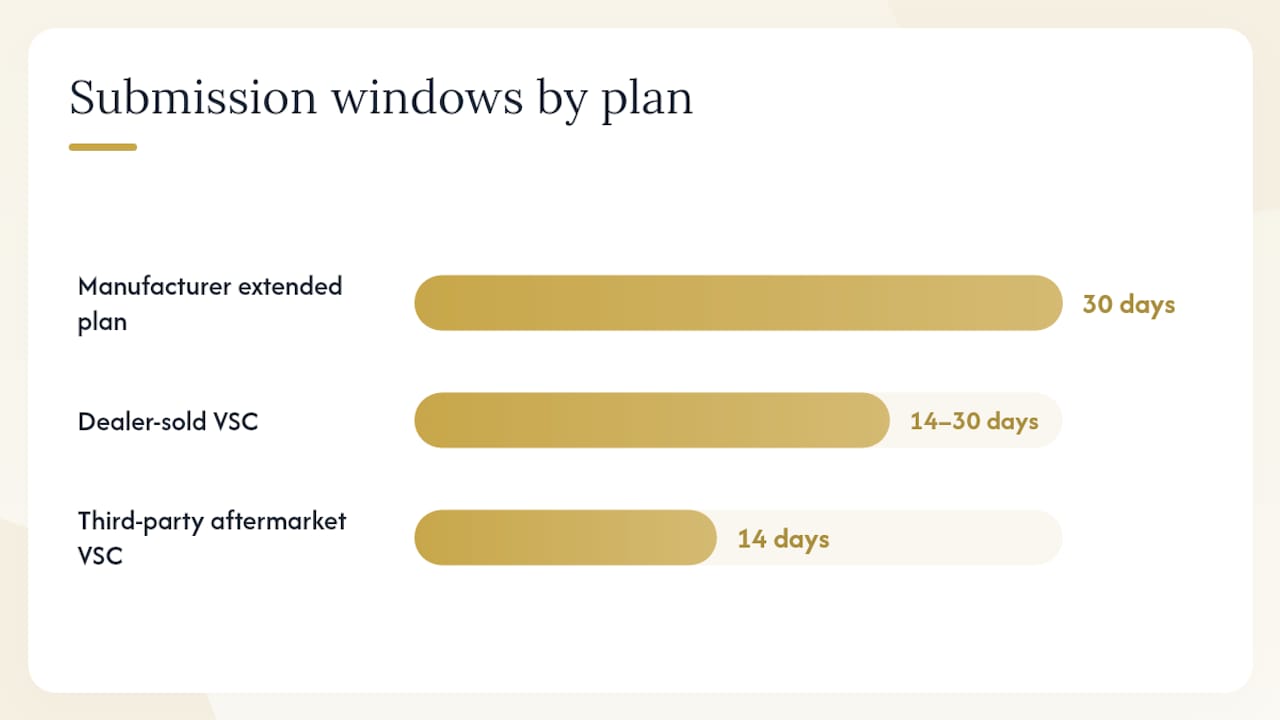
Typical transfer fees reported in guidance range from a modest amount to over a hundred dollars, with submission windows commonly 14–30 days. Some administrators require transfers within 30 days and charge a set fee; missing the window often means the plan is non-transferable from that point forward.
Common pitfalls:
- Non-transferable contracts: Some aftermarket VSCs are explicitly written for the original purchaser only. Check the contract's transfer clause before listing the car.
- Maintenance proof requirements: Administrators frequently require proof that servicing was done at authorized centers on schedule. A gap in the service book can trigger a denial.
- Tight windows: A 14-day transfer window passes fast when LTA processing and bank paperwork are also in motion. Start the VSC transfer process the day the sale completes.
If the existing VSC is non-transferable, the seller has two options: cancel it before sale for a pro-rated refund (check the cancellation clause) or disclose it to the buyer and adjust the price accordingly. The buyer can then purchase a new VSC independently. Several dealers and independent administrators in Singapore offer VSC products for used cars, so replacement coverage is available.
What typically stays covered after a warranty transfers
Factory coverage that transfers generally includes remaining time and mileage on the original term, defects in materials and workmanship, and powertrain components within the remaining warranty period. What it does not cover:
- Wear and tear items: brake pads, tires, wiper blades, clutch plates
- Pre-existing damage or defects known at the time of sale
- Modifications: aftermarket parts, ECU tuning, or suspension changes that alter the car from factory specification
- Salvage or rebuilt titles: most manufacturers void coverage on cars with a total-loss history
- Maintenance items: oil changes, filters, and scheduled service parts
Certain warranties may be voided at sale or require registration, so buyers should check T&Cs rather than assume automatic continuity. The maintenance requirement is the one that catches buyers off guard most often. If the previous owner skipped authorized servicing, the manufacturer may deny a claim even if the warranty is technically still active.
Certified pre-owned (CPO) programs work differently. A CPO warranty is written specifically for the second owner, often with a fresh inspection and a defined term from the CPO purchase date. That is generally stronger protection than inheriting the tail end of a factory warranty, but CPO programs in Singapore are brand-specific and not universally available.
How long does a warranty transfer take, and what does it cost?
| Item | Fee | Timeline |
|---|---|---|
| LTA ownership transfer administrative fee | S$25 | Same-day (online via OneMotoring) |
| Factory warranty transfer | No fee (automatic) | Immediate on LTA transfer |
| Dealer/manufacturer extended plan transfer | Minimal or none | 1–2 weeks |
| Third-party VSC transfer | S$25–S$100 | 1–4 weeks after submission |
The S$25 LTA fee is the administrative event that records the new owner against the VIN. Factory warranty coverage follows that event automatically. VSC transfers run on a separate clock set by the administrator, which is why submitting the VSC form on the day of sale is the safest approach.
Common problems and quick fixes:
- Overdue VSC submission: Contact the administrator immediately. Some will accept a late submission with a penalty fee; others will not. Document every communication.
- Missing paperwork: A dealer-stamped service history and VIN lookup can often substitute for a lost original receipt. Get the dealer to confirm in writing.
- VIN mismatch: If the VIN on the warranty card does not match the car's plate, stop the transaction. This is either a documentation error or a red flag about the car's history.
- Branded or salvage title: Factory coverage is typically void. Verify the car's history through LTA's OneMotoring portal before purchase.
How an active warranty affects used-car value and negotiations
A transferable warranty with meaningful remaining coverage is a real pricing asset. Car depreciation in Singapore is steep, and buyers are acutely aware of post-purchase risk. A factory warranty with 18 months remaining signals that the manufacturer still stands behind the car's mechanical integrity.
For sellers:
- State the remaining warranty months and mileage explicitly in your SgCarMart listing. Buyers filter and compare; a listed warranty reduces negotiation friction.
- Include the written transfer confirmation in the handover package. It removes doubt and supports your asking price.
- If a VSC is transferable, factor the transfer fee into your pricing rather than leaving it as an unknown for the buyer.
For buyers:
- If the warranty is non-transferable or has fewer than six months remaining, use that as a negotiation lever. The cost of a replacement VSC or the risk of an unprotected mechanical failure is a quantifiable discount argument.
- A short example: a car listed at S$85,000 with no transferable warranty versus an identical model with 24 months of factory coverage remaining. The buyer of the unprotected car faces potential repair exposure that a VSC would cost S$1,500–S$3,000 to replace. That gap is a defensible basis for a lower offer.
Listing an active transferable warranty on SgCarMart or through a consignment service is one of the lowest-effort ways to protect your asking price. Buyers searching used performance cars on SgCarMart treat remaining warranty as a trust signal, particularly for European brands where out-of-warranty repair costs are significant.
How Bavarian handles warranty and ownership handover during consignment
When you consign a car through Bavarian, the documentation process starts before the listing goes live. The team confirms the remaining factory warranty term with the authorized dealer, identifies any active VSC and its transfer conditions, and prepares the full handover package for the buyer.
For consignors, Bavarian coordinates the LTA ownership transfer paperwork, contacts the manufacturer or VSC administrator to initiate the transfer process, and hands the buyer written confirmation of coverage. That means the buyer receives the stamped service book, original receipt copies, warranty card, and any VSC transfer confirmation as part of the standard handover, not as an afterthought.
The consignment model also means Bavarian handles inquiries and viewings, so warranty questions from prospective buyers are answered accurately before they reach the negotiation stage. For high-end brands like BMW, Mercedes-Benz, and Porsche, where remaining warranty coverage can meaningfully affect buyer confidence, that preparation directly supports the final sale price.
Pro Tip: The single document set that most speeds up a warranty transfer is: original purchase receipt, stamped service book, and the warranty card or VSC contract number. Hand these to Bavarian at the start of the consignment process, and the administrator contact and transfer submission can happen in parallel with the listing, not after the sale.
What most guides get wrong about warranty transfers
The standard advice is "check if the warranty transfers." That is the right instinct, but it stops too early. The real question is: what triggers the transfer, and who is responsible for completing it?
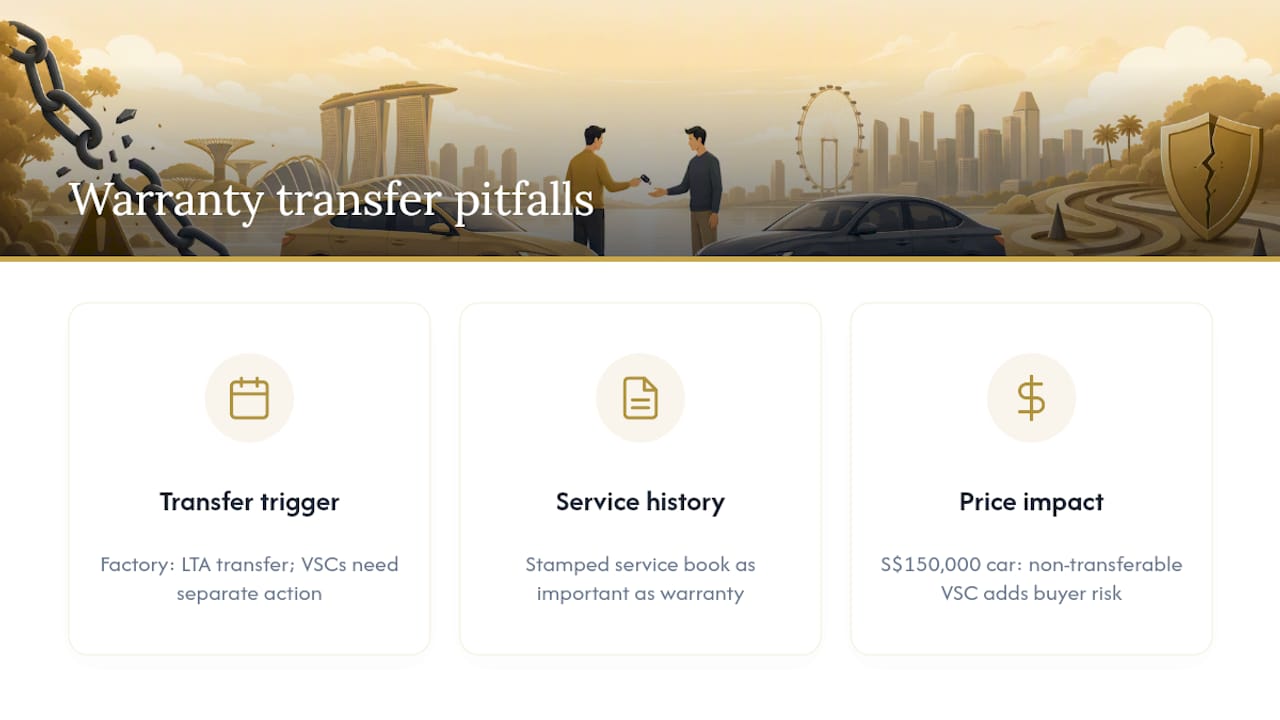
For factory coverage, the answer is simple: the LTA ownership transfer does the work. Most sellers and buyers in Singapore handle this correctly without thinking about it. The problem is that this easy case creates false confidence about extended plans and VSCs, which require a separate, time-sensitive action that neither party is automatically prompted to take.
The 14–30 day submission window is where transfers fail. The sale completes, both parties move on, and three weeks later the window has closed. The buyer discovers the VSC is non-transferable not because the contract prohibited it, but because nobody submitted the form in time. That is an administrative failure, not a legal one, and it is entirely preventable.
The second thing guides understate is the maintenance record requirement. A warranty that is technically still active can be denied on a claim if the service history shows a gap or non-authorized work. Buyers should treat the stamped service book as equally important as the warranty card itself. A car with a clean, complete service history and a warranty is worth more than a car with a warranty and a patchy service record.
The third overlooked point: for high-value cars, the negotiation math around warranty status is real. Buyers of a S$150,000 performance car who are inheriting a non-transferable VSC are taking on meaningful unprotected risk. Sellers who document and transfer coverage cleanly are not just being thorough; they are protecting their asking price.
This article is general information, not a substitute for advice from a qualified lawyer. Consult a qualified legal professional about your own circumstances before acting on anything here.
Sources
- Does an appliance warranty transfer to a new owner? - LegalClarity
- Car Warranty Guide: Everything You Need to Know - Kelley Blue Book
- New Car Warranty Terms & Conditions
- Car Warranty Transfer: Rules & How-To | NewCarAssurance
- How to Transfer a Car Warranty | Step-by-Step Guide
- Can You Transfer Your Extended Warranty? | Endurance Warranty
Always get written confirmation of any transfer from the provider and save digital copies. A future claim will require proof of the transfer date, and administrators rarely accept verbal confirmation.