The winning formula is Year + Make + Model + Trim, paired with one standout selling point and a mileage or condition cue. For a Porsche, that looks like: "2021 Porsche 911 Carrera S — 1-Owner, PDK, 18K KM, Full Service History." Copy that structure, swap in your car's details, and lead with whatever fact makes a buyer stop scrolling.
TL;DR:
- Use the Year, Make, Model, and a standout detail in the first 40-60 characters for mobile-friendly headlines that catch buyers' attention.
- Lead with proven facts like ownership, service history, or unique options rather than vague adjectives or excessive features.
- Pair your headline with a consistent opening line in the description that repeats the key proof point to build trust.
- For premium or high-mileage cars, focus on certification, warranty, or documented maintenance to reassure buyers about condition risks.
- Avoid all caps, overpromising, and hiding flaws, as these damage credibility and reduce the quality of inquiries.
Table of Contents
- Car Ad Headline Formulas That Actually Sell
- 30 Headline Examples by Vehicle Type
- Adapting Headlines for Mobile Previews and Different Platforms
- Headline Dos and Don'ts That Protect Your Credibility
- Fill-In-the-Blank Templates for Luxury and Performance Sellers
- Writing Headlines for First-Time Buyers, Families, and Enthusiasts
- The Headline Mistakes That Quietly Kill Good Listings
- Matching Your Headline to New, Used, and Certified Listings
- Why Headline Choice Matters More for Premium Cars
- Skip the DIY Guesswork With a Consignment Team That Sells Premium Cars for a Living
- Where This Headline Advice Comes From
- Sources
- FAQ
Car Ad Headline Formulas That Actually Sell
Every strong classified headline follows the same skeleton: Year, Make, Model, Trim, then a dash, then the one detail that separates your car from fifty similar listings. That could be low mileage, a rare color, a documented service history, or a price cut. The formula works because it front-loads exactly what a shopper is scanning for, and mobile previews typically cut off around 40 to 60 characters, so anything you bury past that point might as well not exist.
Different seller goals call for different variants of the same structure:
- Quick sale / price-led: "2019 BMW M4 Competition — Priced to Sell, 25K KM, Immaculate"
- Feature-led: "2022 Mercedes-AMG GT — Carbon Package, 1-Owner, Low Mileage"
- Provenance/trust-led: "2020 Audi RS6 Avant — Full Service Records, Non-Smoker Owned"
- Collector-focused: "2018 Porsche 911 GT3 — Manual, Rare PTS Color, Collector-Kept"
Mileage and condition almost always belong at the end, right after your headline claim, because that's the second thing a buyer's eye catches after the model name. Price works best in the headline only when it's genuinely competitive. If it's not your strongest card, leave it for the description and let the car's story do the talking.
30 Headline Examples by Vehicle Type
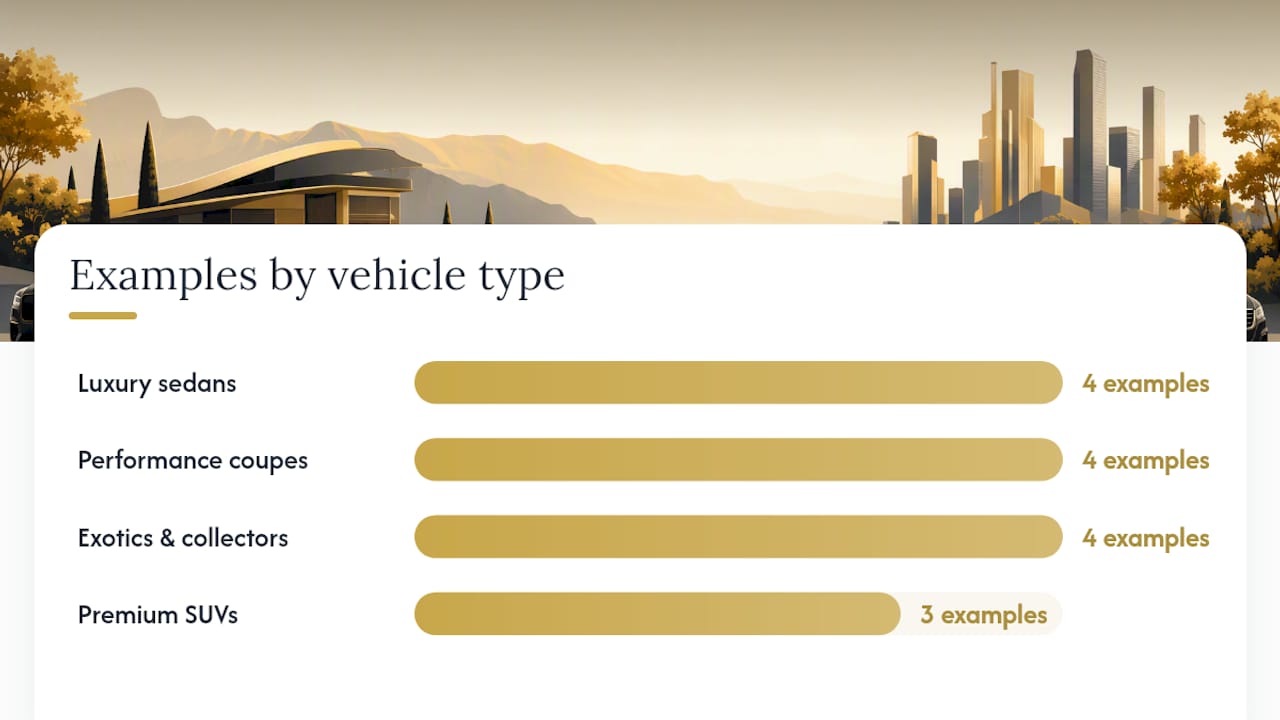
Annotated examples work better than generic templates because you can see exactly why each one earns a click. Formulas that combine year, make, model, and one real proof point tend to outperform vague adjective-heavy titles, so every line below follows that pattern.
Luxury sedans
- "2021 Mercedes-Benz S500 — 1-Owner, Under Warranty, 22K KM" (ownership plus warranty status upfront)
- "2020 BMW 7 Series 740Li — Executive Package, Full Records" (signals a documented history)
- "2022 Audi A8 L — Matrix LED, Low Mileage, Showroom Condition" (leads with a tech feature buyers search for)
- "2019 Genesis G90 — Rare Spec, Garage-Kept, No Accidents" (rarity plus condition cue)
Performance coupes
- "2021 BMW M4 Competition — Manual, 12K KM, Like New"
- "2020 Audi RS5 — Carbon Brakes, 1-Owner, Service Just Done"
- "2018 Mercedes-AMG C63 S — Coupe, Low KM, Full History"
- "2022 Toyota GR Supra — Track-Ready, Original Owner, Mint"
Exotics and collector cars
- "2019 Porsche 911 GT3 RS — Collector-Grade, PTS Color, 8K KM"
- "2017 Lamborghini Huracán — 1-Owner, Full PPF, No Track Use"
- "2020 Ferrari Portofino — Under Factory Warranty, Rare Color Combo"
- "2016 Maserati GranTurismo — Manual Gearbox, Investment Grade"
Premium SUVs
- "2022 Porsche Cayenne S — Panoramic Roof, 1-Owner, Low KM"
- "2021 BMW X5 M — Carbon Package, Full Service, Immaculate"
- "2020 Bentley Bentayga — Rear Entertainment, Garage-Kept"
Each line hits the same three beats: identity, proof, and condition, which is exactly what keeps a scroll-happy buyer reading.
Adapting Headlines for Mobile Previews and Different Platforms
Most buyers browse listings on their phones, and that changes what your headline needs to accomplish in the first two seconds. Marketplace apps typically truncate titles around 40 to 60 characters before adding an ellipsis, so the words that matter most have to come first, not last.
A few platform-specific habits make a measurable difference:
- Put your strongest fact (one-owner, certified, rare trim) inside the first 40 characters, not the last.
- On feature-heavy classifieds like SgCarMart, a slightly longer, more descriptive title performs fine because buyers expect detail; on Facebook Marketplace, short and punchy wins because the feed moves fast.
- Pair the headline with a first description line that reinforces the same claim. The first 200 characters of your description are often what shows before a "see more" prompt, so repeat your proof point there instead of introducing something new.
- Skip the dealer name or shop tag in the headline. Buyers searching classifieds are looking for the car, not your business, and dealer branding in the title reads as less trustworthy for a private-style sale.
- Avoid ALL CAPS words scattered through the title. It reads as shouting on a phone screen, and it often gets flagged as spam by platform filters.
Small adjustments like these are also where car listing photos start doing real work, since your first image loads right next to that truncated headline.
Headline Dos and Don'ts That Protect Your Credibility
A headline that overpromises costs you time, not just clicks, because every mismatch between the title and the actual car generates a viewing you'll wish you'd skipped. Here's what separates a headline that converts from one that just gets ignored (or reported).
Do this:
- Use one concrete number: mileage, year of last service, or owner count, rather than words like "amazing" or "mint" on their own.
- Mention a real trust signal if you have one: full service history, no accident record, or original owner.
- Keep punctuation simple. A single dash or comma separating claim from proof reads cleaner than exclamation points or emoji.
Don't do this:
- Don't write in ALL CAPS. It doesn't read as urgent, it reads as unreliable.
- Don't dump every option and feature into the headline. Buyers respond better to one scannable benefit than a wall of trim codes and features.
- Don't hide a known flaw and let it surface at the viewing. A short, honest note, like "minor curb rash on rear rim," actually builds trust and filters out buyers who'd walk away disappointed anyway.
- Don't oversell urgency with "must sell today" language unless it's true. It reads as desperate and invites lowball offers.
Pro Tip: If your car has one flaw worth mentioning, put it in the description, not the headline, but mention it before the buyer asks. A seller who volunteers the flaw looks more trustworthy than one who gets caught hiding it.
Fill-In-the-Blank Templates for Luxury and Performance Sellers
These templates work because they force you to lead with a fact instead of an adjective. Swap in your own year, trim, mileage, and standout detail before publishing.
- "[Year] [Make] [Model] [Trim] — [Ownership Status], [Mileage] KM, [Condition Note]"
- "[Year] [Make] [Model] — [Rare Option/Color], [Service Status]"
- "[Year] [Make] [Model] [Trim] — Priced to Sell, [Mileage] KM"
- "[Year] [Make] [Model] — Full Service Records, [Ownership Count]-Owner"
- "[Year] [Make] [Model] [Trim] — Collector-Kept, [Special Feature]"
- "[Year] [Make] [Model] — Under Warranty, [Mileage] KM, [Condition Note]"
Before you publish, confirm the facts that back up your headline: current mileage with the odometer date, VIN match against your logbook, and whether service records are complete or partial. A headline promising "full service history" that you can't actually produce at viewing kills the sale on the spot. Pair your chosen template with a first description sentence that repeats the same proof point. Consistency between headline and lede is what keeps serious buyers reading instead of bouncing to the next car listing description.
Writing Headlines for First-Time Buyers, Families, and Enthusiasts
The same car can attract different buyer types depending on how you frame the headline, and matching your phrasing to the right persona filters out mismatched inquiries before they waste your time.
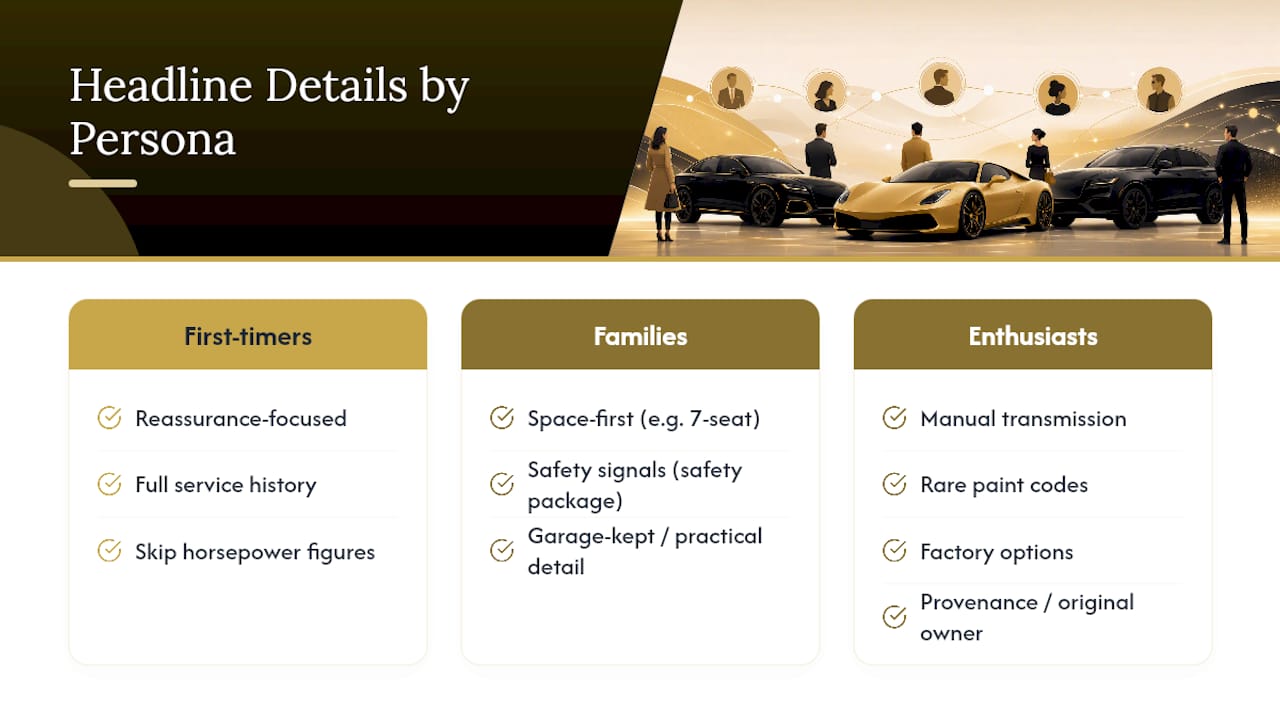
First-time buyers respond to reassurance over performance bragging. A headline like "2019 Audi A4 — Reliable, Full Service History, Great First Car" tells a nervous buyer exactly what they're worried about: will this thing break down. Skip horsepower figures here; they don't move this buyer.
Families cross-shopping SUVs or wagons want space and safety signals front and center. "2021 BMW X3 — 7-Seat Option, Full Safety Package, Garage-Kept" leads with the practical detail a parent is actually scanning for, not 0 to 100 km/h times.
Enthusiasts and collectors want the opposite: manual transmissions, rare paint codes, factory options, and mileage that proves the car has been driven sparingly or driven properly. "2018 Porsche Cayman GT4 — 6-Speed Manual, Track-Prepped, Original Owner" speaks directly to a buyer who already knows the model's history and wants proof this specific example is the right one.
Writing three different headlines for the same car isn't dishonest, it's targeting. Post the version that matches wherever you're listing and who tends to browse there.
The Headline Mistakes That Quietly Kill Good Listings
Most underperforming ads aren't bad cars badly priced, they're good cars with headlines that undersell them or actively repel the right buyer.
The most common mistake is vagueness. "Nice car, must see!" tells a scrolling buyer nothing they can act on. Compare that to "2020 Mercedes-Benz C300 — 1-Owner, 30K KM, Dealer Serviced," which gives three concrete reasons to click in the same space.
The second mistake is the opposite problem: cramming every trim code and option package into the title until it reads like a VIN decoder. Buyers skim; they don't parse acronym strings. Pick the single most compelling detail and save the rest for the description.
Third, sellers routinely bury the best detail. If your car had one owner and full dealer service records, that belongs in the first ten words, not the last. Whatever claim makes your listing rare should lead, not trail.
Fourth, exaggeration backfires fast. Calling a car "flawless" when it has visible wear invites buyers who feel misled the moment they see it in person, and that erodes trust before negotiation even starts.
Finally, skipping mileage or condition entirely leaves a gap buyers fill with suspicion. Silence on mileage reads as "high mileage they don't want to mention," even when that's not true.
Matching Your Headline to New, Used, and Certified Listings
The right headline changes depending on where your car sits on the condition spectrum, because each category answers a different buyer question.
For a car with very low mileage or still under factory warranty, lead with newness and warranty coverage: "2024 Porsche Macan S — Like New, 3K KM, Full Factory Warranty." That headline answers the buyer's real question upfront: will I inherit any risk.
For a well-used but well-maintained car, documentation does the heavy lifting: "2017 BMW M3 — 85K KM, Full Service History, Recent Major Service." High mileage isn't a dealbreaker when it's backed by a paper trail, and the headline should say so rather than avoid the number.
For certified pre-owned vehicles, the certification itself is often the strongest headline element, since it signals a multi-point inspection the buyer doesn't have to verify themselves: "2021 Audi Q5 — Audi Approved: Plus, 12-Month Warranty Included." Lead with the certification name and what it guarantees, not just the model.
Across all three, the pattern holds: the headline should answer whatever risk a buyer at that condition level is silently worried about.
Why Headline Choice Matters More for Premium Cars
A generic headline hurts a $20,000 car. It can cost you tens of thousands on a Porsche or Ferrari, where buyers are already skeptical of private listings and scanning for red flags. Provenance details like one-owner status and documented maintenance, paired with strong photography, tend to convert skeptical browsers into serious viewings rather than lowball inquiries.
That gap is why some premium consignment services pair headline strategy with professional photography, viral-style video, and multi-platform distribution to support listings. In practice, a listing that leads with a clean provenance claim and is backed by a strong first photo tends to draw noticeably more qualified inquiries than the same car described with vague, feature-dump copy, because the two elements reinforce the same trust signal instead of fighting for attention.
— Shawn
Skip the DIY Guesswork With a Consignment Team That Sells Premium Cars for a Living
Writing one great headline gets you a click. Selling a high-end car for the right price takes photography, video, multi-platform distribution, screened buyers, and paperwork handled without a hitch, and doing all of that yourself while still working a full-time job is where most private sellers lose money and time.
Some premium consignment providers offer a full-service process for luxury and performance car owners, including valuation, professional photography, video marketing, listings on major platforms, and handling all inquiries, negotiations, and transfer documentation. It's built specifically for sellers who want a boutique, hands-off experience rather than a string of lowball texts and no-show viewings. If your car deserves better than a rushed phone photo and a copy-paste headline, request a free valuation from Bavarian Autohaus and see what a professionally marketed listing actually looks like.
Where This Headline Advice Comes From
The formulas and platform guidance above draw on CarPixAI's listing optimization research for mobile character limits, ListMyCar's guide to writing car ads for lede pairing and description length, and Marketplace Pro's dealer guide for annotated example structure. For more templates, see Ecosteer's private-seller ad templates.
Sources
- How to Optimize Car Listings for AutoTrader, Cars.com & Facebook Marketplace | CarPixAI
- How to Write a Car Ad That Actually Sells the Car
- Car Descriptions That Sell: A Dealer's Guide for 2026 | Marketplace Pro
FAQ
What's the ideal length for a car ad headline?
Aim for 40 to 60 characters so your strongest claim shows in full on mobile previews before any truncation happens.
Should I include the price in the headline?
Only if your price is genuinely competitive; otherwise, lead with a stronger trust signal like one-owner status or full service history and let the price live in the description.
Is it okay to use ALL CAPS to grab attention?
No. It reads as unreliable rather than urgent, and some platforms flag it as spam.
How do I write a headline for a car with high mileage?
Pair the mileage number with proof of upkeep, such as "Full Service History" or "Recent Major Service," so the number reads as documented rather than neglected.
Does Bavarian Autohaus write headlines for sellers?
Yes. As part of its consignment service, Bavarian Autohaus handles headline strategy alongside photography, video, and multi-platform distribution for owners of luxury and performance cars.