
Start your car listing description with one sentence that gives a buyer a reason to click that isn't already sitting in the title. Everything after that hook (a few lines of context, your best three to five features written as benefits, an honest condition note, and a clear call to action) fills in the rest. Get the first line right and the rest of the listing basically writes itself.
TL;DR:
- Including verifiable details like VIN, service history, ownership, and title status builds essential trust with potential buyers.
- Highlighting only 3 to 5 features relevant to the target buyer increases engagement and makes the listing more persuasive.
- Clear, factual information such as year, make, model, mileage, and price must be front-loaded and consistently listed for search and filtering.
- Using keywords that match common search phrases enhances visibility, especially when placed early in the description.
- Matching photos to every claim in the description and avoiding hype are crucial to prevent losing buyer interest or trust.
Table of Contents
- What Makes a Car Listing Description Actually Convert
- The Structure You Can Paste Into Any Listing Today
- Six Templates You Can Copy and Adapt Right Now
- Make Your Photos and Your Copy Say the Same Thing
- Where Sellers Lose Buyers Without Realizing It
- The Non-Negotiable Basics Every Listing Needs
- Writing Copy That Search and Buyers Both Reward
- Adjusting Your Description for Where It's Posted
- What Actually Moves Buyers, From Someone Who Reads Hundreds of These Listings
- Sources
What Makes a Car Listing Description Actually Convert
A car listing description has four jobs, and most sellers only do one of them: list specs. The real work is hooking attention, highlighting the right features, building trust, and prompting action.
Buyers scan photos and price first, then skim maybe three or four lines of text before deciding whether to message you. That means your opening sentence carries more weight than almost anything else you write. A strong first line drives replies because it tells buyers something the title and price can't: why this particular car, from this particular owner, is worth their time.
Trust signals matter almost as much as the hook. Buyers browsing used listings have been burned before, so they're hunting for reasons to believe you. Include:
- VIN or chassis number, so buyers can run a check
- Full service history, even if it's not spotless
- Number of owners and how the car was used (commute, weekend car, family hauler)
- Title and loan status, stated plainly
Once the trust basics are covered, pick three to five features that matter to your likely buyer, not every feature the car has. A family SUV buyer cares about second-row space and safety ratings, not horsepower. Listings with genuinely detailed, well-written descriptions see roughly 20 to 30 percent more buyer engagement than bare spec dumps on major platforms, and that gap comes almost entirely from sellers who bother to explain why a feature matters instead of just naming it.
The Structure You Can Paste Into Any Listing Today
Every high-performing car ad description follows roughly the same skeleton, whether it's written by a private seller or a dealership. Dealer content playbooks converge on a repeatable pattern: essentials, a short story, three to five benefit statements, a condition note, and a call to action, and that structure holds up across marketplaces because it mirrors how buyers actually read.
Here's the breakdown with word targets for a standard used car listing:
- Hook (one sentence, 10 to 15 words): The single most persuasive, verifiable fact about the car.
- Context (two to three sentences, 30 to 50 words): Why you're selling, how the car was used, what makes it stand out.
- Benefit bullets (three to five lines, 40 to 60 words total): Features translated into what the buyer actually gets.
- Condition and objections (two to three sentences, 30 to 40 words): Honest notes on wear, upcoming maintenance, anything a buyer would ask about anyway.
- Call to action (one sentence, 10 to 15 words): How and when to reach you.
That lands most marketplace listings around 150 to 250 words total, which lines up with the 150 to 300 word range that performs best on platforms like marketplace apps and classifieds. A dealer site detail page can run longer since it's also working for search visibility, while a social media caption should compress the same structure into 60 to 80 words with a link out for the rest.
Before you publish, run this checklist using the best car pre wash for UK owners to ensure your vehicle is perfectly presented.
- VIN listed and matches the title
- Every claim in the text has a matching photo
- Price stated clearly, with "or best offer" only if you mean it
- Contact method and response window specified
- No spec repeated word-for-word from the manufacturer sheet
Six Templates You Can Copy and Adapt Right Now
These car description examples are built for different buyers. Swap in your own numbers, but keep the shape.
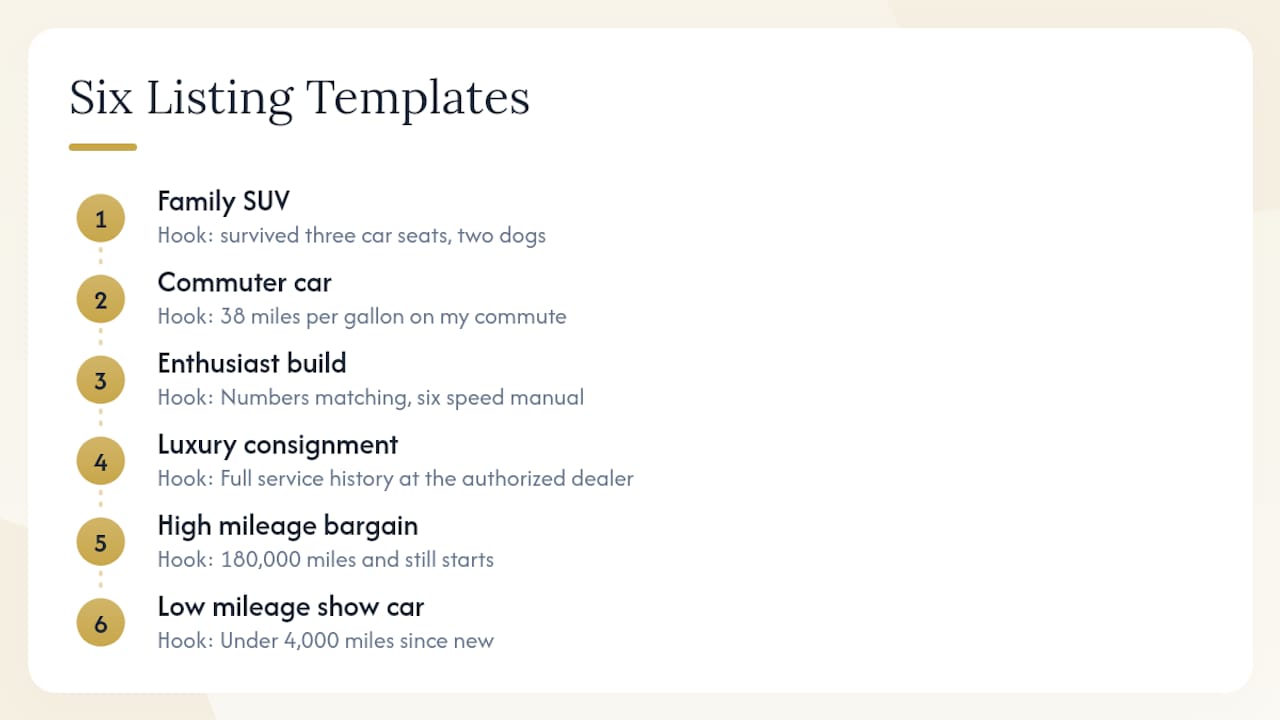
Family SUV. Hook: "This SUV has survived three car seats, two dogs, and one very long road trip to the coast, without a single warning light." Story: Bought new by our family in 2022, serviced on schedule every time. We're downsizing now that the kids are older. Benefits: third row folds flat in seconds for cargo runs; rear cross traffic alert caught two close calls in parking lots; heated seats make winter school runs bearable. CTA: Message me to see the service book and book a test drive this weekend.
Commuter car. Hook: "38 miles per gallon on my daily 40 minute commute, and it's never once left me stranded." Story: One owner, mostly highway miles, always garaged. Benefits: new tires last spring; Bluetooth and backup camera included; oil changes every 5,000 miles with receipts. CTA: Available for viewing evenings and weekends, text anytime.
Enthusiast build. Hook: "Numbers matching, six speed manual, and the exhaust note that made me buy this car twice." Story: Track days only, no daily driving, dyno sheet available on request. Benefits: upgraded brake pads with stock rotors still available; recent alignment; clean CARFAX with zero accidents. CTA: Serious inquiries only, happy to arrange a PPI (pre-purchase inspection).
Luxury consignment piece. Hook: "Full service history at the authorized dealer, and every option box checked." Story: Second owner, garage kept, driven under 6,000 miles a year. Benefits: extended warranty transferable; ceramic coating applied last year; original window sticker included. CTA: Contact us to schedule a private viewing.
High mileage bargain. Hook: "180,000 miles and still starts on the first try every morning, priced to sell fast." Story: Used as a work vehicle, maintained religiously because it had to run. Benefits: timing belt replaced last year; new battery; priced below comparable listings with fewer miles. CTA: Cash only, first to see it takes it home.
Low mileage show car. Hook: "Under 4,000 miles since new, stored indoors, driven only to car meets." Story: Weekend toy, never driven in rain, always cover-parked. Benefits: all original paint; matching numbers; recent detail with paint correction photos available. CTA: Photos and inspection reports on request, priced firm.
Pro Tip: Keep your tone matched to the car. A show car listing can afford some flourish. A commuter car listing should stay plain and factual, because that buyer is shopping on trust and price, not romance.
Make Your Photos and Your Copy Say the Same Thing
Every claim in your car listing description needs a photo that backs it up, or buyers assume you're hiding something. This is where good photography and good copy have to work as one system, not two separate tasks.
Shoot and reference these in your text:
- Odometer reading, timestamped the same day you list the car
- Engine bay, especially if you mention recent work there
- Tire tread depth, close up on all four
- Interior wear points: seat bolsters, steering wheel, pedals
- Any cosmetic flaw you disclose in the description
When you write "recent service" or "new tires," say where the proof is: "Service receipts from last month available on request" or "See photo 6 for the fresh set of tires." Dealer best practices consistently point buyers toward verifiable evidence in the gallery rather than asking them to take your word for it.
Small touches build outsized trust: a date stamped on a service receipt photo, a plain "non-smoker, no pets" line, a photo of the title itself with sensitive numbers blocked out. None of these cost you anything, and they're often the difference between a browser and a buyer who actually messages.
Where Sellers Lose Buyers Without Realizing It
Most weak listings fail in a handful of predictable ways.
- Blank or spec-only descriptions. Copying the manufacturer sheet tells buyers nothing about this specific car. Fix it with one hook sentence and a two-line ownership story.
- All caps and hype language. "MUST SEE!!! BEST DEAL!!!" reads as a warning sign, not an invitation. Replace hype with a specific, checkable claim, like an actual mileage figure or service date.
- Photos that don't match the copy. If you write "garage kept" but every photo shows the car parked on a street, buyers notice the gap immediately.
- Hiding known issues. A cracked bumper or worn clutch will surface at the viewing regardless. Disclose it upfront and price the car accordingly, and buyers trust everything else you wrote.
The Non-Negotiable Basics Every Listing Needs
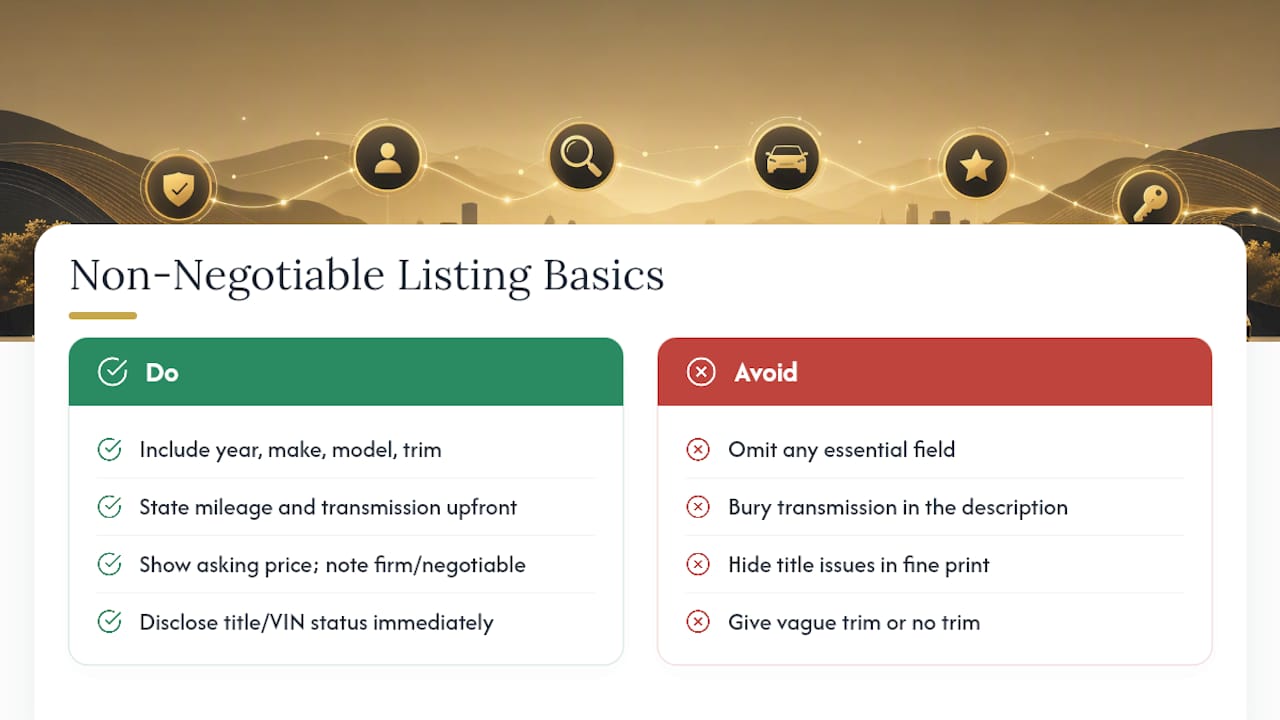
Before you write a single persuasive word, get the factual skeleton right: year, make, model, trim, mileage, transmission type, asking price, and title or VIN status. Buyers filter on these fields before they ever read your description, and marketplace search algorithms use them too, so leaving one out can quietly remove your car from results entirely.
Trim level matters more than sellers think. "2021 sedan" tells a buyer almost nothing; "2021 sedan EX with the tech package" tells them exactly what they're getting and lets them compare it against similar listings accurately. The same goes for transmission: automatic versus manual is a hard filter for a lot of buyers, and burying it in paragraph three instead of stating it upfront just costs you clicks from people who would've been interested.
Price clarity avoids wasted messages. State the number, note whether it's firm or negotiable, and mention if trade-ins are considered. If the title isn't clean, whether it's a rebuilt title, a loan still being paid off, or an out-of-state title, say so in the first few lines rather than the fine print. Buyers who feel ambushed by a title issue after they've already messaged you rarely come back, and the ones who do usually try to lowball you for the surprise.
Keep these essentials in a consistent order every time you list, whether it's a marketplace app or a classifieds site. Consistency makes your listing easier to scan, and easier to trust.
Writing Copy That Search and Buyers Both Reward
Keywords in a car listing description aren't about stuffing terms, they're about matching the exact words a buyer would type into a search bar. Think in terms of how someone searches, not how a brochure describes the car.
Front-load the essentials into the first line or two: year, make, model, and trim, since most marketplace search functions weight the opening text more heavily. "2023 hatchback SE with low miles" in your first sentence does double duty as both a hook and a search match.
Use the specific phrasing buyers actually search, not vague marketing language. "Backup camera" and "blind spot monitor" get searched directly; "advanced safety suite" doesn't. The same goes for condition terms: "one owner," "no accidents," "clean title," and "non-smoker" are all phrases buyers filter or search by, so working them naturally into your sentences (not as a stacked list of buzzwords) helps your listing surface in more searches.
Avoid keyword repetition that reads as spam. Writing "reliable, dependable, trustworthy car" back to back doesn't help visibility and makes the listing sound artificial. One clear, specific claim beats three vague adjectives stacked together.
Location terms help too, if your platform supports them. Mentioning your city or region naturally in context ("commuted from the suburbs into downtown daily") helps local search matching without reading like you're gaming the algorithm.
Adjusting Your Description for Where It's Posted
The same car needs a different car listing description depending on where you post it, because each platform's audience reads differently and rewards different things.
Marketplace apps and classifieds reward brevity and directness. Buyers here are often scrolling fast on their phones, so front-load your hook and keep the whole description under 200 words. Skip flowery language entirely; these buyers want facts fast and will message quickly if the basics check out.
Dealer or listing-service sites, where your car might sit alongside detailed spec pages, can support longer copy, closer to 250 to 400 words, since these pages often double as search-engine landing pages. This is where the full essentials-plus-story-plus-benefits structure gets room to breathe, and where SEO-minded phrasing pays off over time as the page gets indexed.
Social platforms need the shortest version of all. A caption on a photo or short video should compress your hook and one or two benefits into 40 to 60 words, then point viewers to the full listing elsewhere. The visual carries more weight than the text here, so let the photo or video do the selling and use the caption to drive the click.
Whichever platform you're using, don't just copy-paste the same block of text everywhere. Trim or expand the same core structure to fit the platform's reading habits, and you'll get more replies for the same car.
What Actually Moves Buyers, From Someone Who Reads Hundreds of These Listings
Buyers respond to specifics, not adjectives. "Runs great" tells a buyer nothing; "cold-starts fine in freezing weather and idles smooth at stoplights" tells them you actually know this car. The blind spot most sellers have is assuming buyers will fill in the gaps generously. They won't. They'll assume the worst about whatever you left out, whether that's condition, mileage context, or why you're really selling.
Before you publish anything, run this five-point check: photos that match every claim in the text, a hook in the first sentence, three to five benefits stated plainly, an honest condition note, and a call to action with real contact details. Miss any one of those and you're leaving replies on the table.
There's also a point where writing the perfect description stops being the highest-leverage move. If you're selling a performance or luxury car, professional photography, video, and multi-platform marketing tend to lift both interest and final sale price more than any paragraph you could write yourself. That's the gap consignment specialists exist to close: the presentation and reach that a single private listing usually can't match on its own.
— Shawn
Sources
- How to Write Car Listing Descriptions That Sell | CarPixAI
- How to market car dealerships in Singapore
- How to Write Effective Car Descriptions for Dealer Listings - VINCUE