
The best window to list most cars is in the third to seventh year of ownership, timed to your model's Preferential Additional Registration Fee (PARF) rebate schedule, ideally in the weeks after a monthly Certificate of Entitlement (COE) result rather than right before one. If your car's value is already sliding, that beats waiting for a seasonal bump. Spring remains the broadest demand window, but sporty models and tight-inventory years shift the math.
TL;DR:
- Selling before the fifth-year PARF rebate step-down often yields higher net proceeds, especially if the rebate value is a key factor for buyers.
- Listing during spring, especially April to June, maximizes demand for most vehicles, with sporty models benefiting most from favorable weather and aesthetics.
- Fast-paced options like trade-ins suit urgent sales under three weeks but typically result in lower net value compared to consignment, which needs more lead time.
- Monitoring COE results, market trends, and upcoming PARF or COE changes is crucial to timing the sale for optimal value, especially in tight inventory years.
- Coordinating listing timing around COE announcement days and reacting quickly to inquiries significantly increases the chances of a successful sale.
Table of Contents
- Timing Rules Worth Following
- How COE, PARF, Age, and Mileage Change Resale Timing
- When Is the Best Season to List Your Car?
- Consignment, Trade-In, or Private Sale: Which Fits Your Timeline?
- Tactical Timing for the Listing Itself
- Getting Your Car Ready to Sell: A Practical Checklist
- Should You Accept the Offer or Wait?
- Should You List Now or Wait? Quick Decision Check
- What Most Sellers Get Wrong About Timing
- Sell Your Car the Way Serious Owners Do
- Sources
Timing Rules Worth Following
You don't need a market analyst to time a car sale well. A handful of rules cover most situations, and they matter more than agonizing over the exact week.
- Sell before the depreciation cliffs specific to your car: the PARF rebate step-down around the fifth year, a mileage band that spooks buyers (often past 100,000 km), or a looming COE renewal decision.
- Match your listing window to your vehicle type where your timeline allows it. Spring works for most cars; late spring into early summer works better for sporty and convertible models.
- If your car's offers have been trending down month over month, sell now. A seasonal premium a few months out rarely beats a depreciation curve that's already moving against you.
- If you need top dollar and can wait a few weeks, consignment balances price and speed. If you need cash fast, a trade-in gets you there quicker but at a lower net.
How COE, PARF, Age, and Mileage Change Resale Timing
Singapore's car market runs on rules most other countries don't have, and they change the calendar math for sellers here. The Certificate of Entitlement system caps the number of vehicles on the road, and COE prices are set through a bidding process that publishes results twice a month. Every result shifts buyer sentiment almost overnight: a falling COE premium often pulls hesitant buyers off the fence, while a spike can freeze the market for days.
PARF is the other lever. It's a rebate on the Additional Registration Fee that a car owner can claim when deregistering a vehicle before it turns 10 years old, and the rebate percentage steps down at fixed age milestones. PARF mechanics tied to the fifth year, mean many owners see their strongest net proceeds if they sell before that threshold, since buyers factor the shrinking rebate straight into what they'll offer.
Age and mileage compound this. A car's depreciation curve isn't a straight line. It tends to fall off faster past certain mileage bands and around scheduled maintenance milestones, when buyers start asking harder questions about reliability.
Quick reference: the year-by-year mechanics
- Years 1 to 3: Slowest depreciation phase, but the smallest buyer pool willing to pay a premium for a near-new car with COE still fresh.
- Years 3 to 5: The sweet spot for many models. PARF rebate is still near its peak, and mileage is usually reasonable.
- Year 5 onward: PARF rebate value steps down, and buyers start discounting more aggressively for remaining COE life.
- Year 7+: Depreciation accelerates further as the COE renewal decision looms for the next owner.
One thing that overrides all of this: model discontinuation, an EV influx into a segment, or a sudden shift in what buyers want. If your model just got replaced by a newer generation, or if electric alternatives are eating into demand for your specific segment, that structural change matters more than what month it is.
When Is the Best Season to List Your Car?
Calendar timing still matters, just less than people assume, and less than the COE and PARF mechanics above. Here's how it breaks down by vehicle type.
- Spring (March through May) is the broadest peak across nearly every vehicle category. Tax refund season and improving weather put more serious buyers into the market at once, which shortens days-on-market for almost everything you list.
- Late spring into early summer (April through June) is when sporty and convertible cars see their sharpest premium. Warmer weather and better light for test drives genuinely change how these cars show, and buyers respond to that seasonal appeal more than they do with a family sedan.
- Family sedans and practical cars track closer to the general spring window, February through April, since that demand is driven more by refund-season cash flow than by weather or aesthetics.
- In a tight-inventory year like 2026, these seasonal swings compress. When fewer cars are available across the board, buyers can't afford to wait for their preferred season, which means the penalty for selling in what used to be a "slow" month shrinks considerably.
That last point matters more than most sellers realize. In a tight market, waiting three months for a seasonal bump might net you less than selling now, simply because your car's own depreciation clock keeps ticking while you wait for a premium that may not materialize the way it used to.
Consignment, Trade-In, or Private Sale: Which Fits Your Timeline?
The method you pick changes what "best timing" even means, because each one runs on a different clock.
- Consignment takes longer to close but usually nets a stronger price. It's worth scheduling your listing to land inside a seasonal window or right after a COE result, since a specialist consignment service can hold out for the right buyer instead of taking the first offer.
- Trade-in is the fastest option and the most convenient, but it comes with a lower net because the dealer is pricing in their own resale margin. It's the right call when you're buying a replacement car on a fixed deadline and don't have weeks to spare.
- Private sale can return a solid net if you're willing to do the work: answering enquiries fast, hosting viewings, and negotiating yourself. The tradeoff is your own availability becomes the bottleneck.
The decision rule is simple: if you must sell within two to three weeks, trade-in or an accelerated consignment arrangement is the realistic path. If you have a month or more, consignment gives you room to hit a seasonal window and let the right buyer find the listing.
Tactical Timing for the Listing Itself
Beyond the season, the day and hour you post matters more than most sellers expect. A handful of specific habits make the difference over your first two weeks live.
- Post in the evening or just before a weekend, when browsing traffic on marketplaces peaks.
- Schedule a marketing push, whether that's a platform refresh or a round of outreach, around COE announcement days, since these results reliably spike buyer activity.
- Track views against enquiries weekly. A listing with plenty of views but few messages usually points to a fixable problem: unclear COE expiry info, pricing out of line with comparable listings, or a weak photo sequence.
- Respond to enquiries within 15 minutes during business hours whenever you can. That response window has a measurable effect on whether an enquiry turns into a viewing.
Pro Tip: If your listing has been live for a week with strong view counts but almost no messages, don't drop the price first. Fix the photos and make the COE expiry date and PARF value visible in the first line of the description. That's usually the actual problem.
Getting Your Car Ready to Sell: A Practical Checklist
Preparation changes how fast a listing converts, and it changes the ceiling on your final price. A practical checklist for servicing, repairs, and documentation before moving or selling can be found in how to prepare your car for long distance relocation. Work through it roughly in this order.
- Detailing first. A proper interior and exterior detail, including engine bay cleaning for performance cars, closes the gap between how the car looks in photos and how it looks in person. This is the single highest-return step before you shoot photos.
- Address visible defects. Small paint chips, worn floor mats, or a cracked headlight cover cost you disproportionately more in a buyer's perception than they cost to fix.
- Shoot photos and a short video in sequence. Start wide (front three-quarter, rear three-quarter), then move to interior, then engine bay, then any distinguishing features. A short walkaround video for social platforms consistently pulls more enquiries than static photos alone.
- Surface your documents up front: COE expiry date, estimated PARF rebate value, full service history, and confirmation the loan is cleared or nearly cleared. Buyers who can't find this information quickly move to the next listing.
This is close to the exact sequence Bavarian runs for consignment clients selling BMW, Mercedes-Benz, Porsche, and other performance marques out of its Gillman Barracks showroom: professional photography and short-form video first, then distribution across SgCarMart, Instagram, and TikTok, with the team handling every enquiry so the seller isn't managing a phone full of messages during work hours.
Should You Accept the Offer or Wait?
Every offer needs to be measured against two things: where the market has been moving, and what waiting actually costs you.
- Compare the current offer against recent comparable listings, not just your original purchase price or what you think the car is worth emotionally.
- Check the prior month's trend for your model and COE category. A single offer tells you less than a pattern.
- If your best estimate of depreciation over the next few weeks is larger than the seasonal premium you're hoping to capture, take the current fair offer.
- Always net out commission and transaction costs before comparing offers side by side. A slightly lower offer with lower fees can beat a higher one that costs more to close.
- Before deciding to wait, get three fresh offers or valuations. One number from one buyer isn't enough information to gamble a few weeks of depreciation on.
For a deeper walk-through of turning a raw offer into an actual net figure, Bavarian's pricing guide breaks down the comparable-check process step by step.
Should You List Now or Wait? Quick Decision Check
Run through these four checks before you commit to either path.
- Do you need cash within four to six weeks? (urgency)
- Have recent offers on similar cars been trending down over the last month? (depreciation trend)
- Is your vehicle type inside its seasonal peak window right now? (seasonal fit)
- Is a COE result or PARF step-down approaching in the next 60 days that works against you? (upcoming event)
| If this many checks favor "now" | Recommended action |
|---|---|
| 2 or more | List within the next few weeks |
| 1, and your timeline is flexible | Consider waiting for the seasonal window |
| — | Wait, but re-check monthly as COE results publish |
What Most Sellers Get Wrong About Timing
Most sellers treat car timing like stock trading, waiting for a perfect signal that never fully arrives. That instinct costs them more than a bad season ever would. The seller who lists a well-prepared car in a mediocre month almost always beats the seller who waits six months for a "better" one, because depreciation doesn't pause while you wait.
The bigger blind spot is treating COE results as background noise instead of a scheduling tool. Most private sellers list whenever it's convenient for them and ignore the fact that buyer activity genuinely spikes around COE announcement days. Coordinating even a simple listing refresh around that calendar costs nothing and reliably lifts enquiry volume.
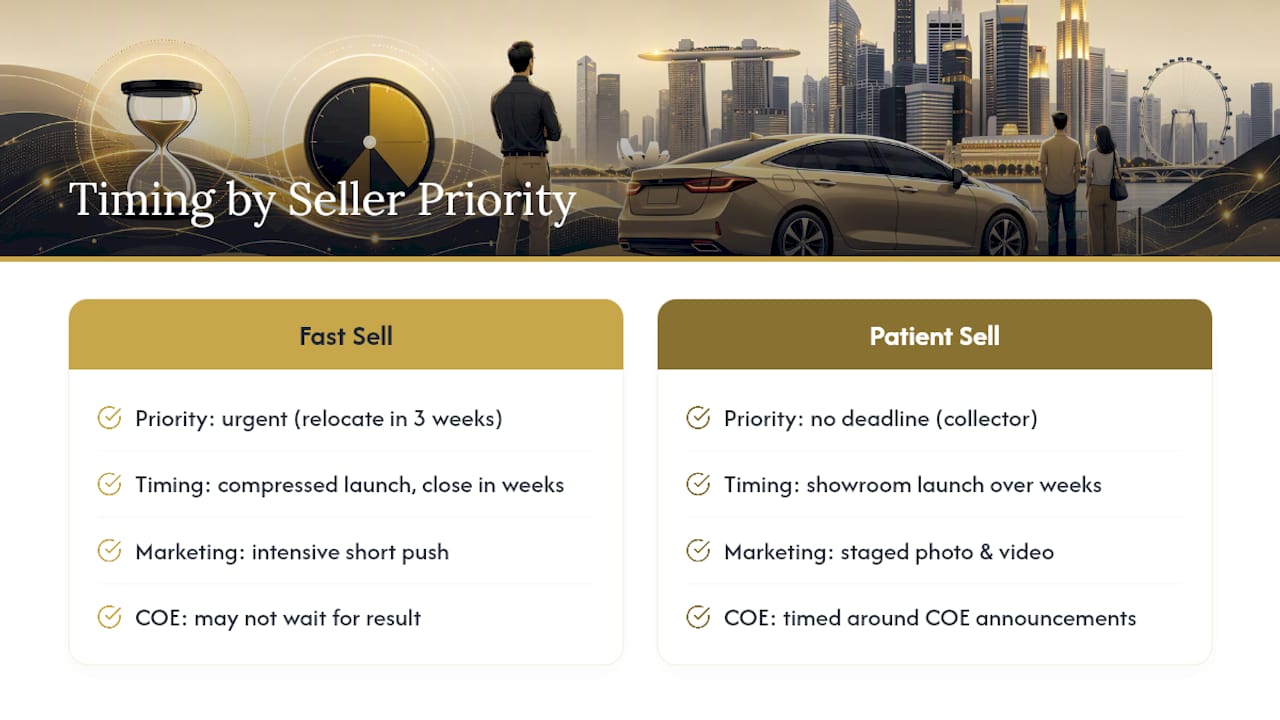
Where Bavarian's consignment team spends real effort is matching launch timing to a client's actual priority. A client relocating for work in three weeks gets a compressed marketing push and a faster close, even if it means accepting a slightly lower ceiling. A collector with no deadline gets patience: a showroom launch timed around a COE result, with photography and video staged to run over several weeks. Neither approach is wrong. The mistake is applying one playbook to both situations.
— Shawn
Sell Your Car the Way Serious Owners Do
If you own a BMW, Porsche, Mercedes-Benz, or another performance marque, timing the sale yourself means juggling COE calendars, photo shoots, and buyer messages on top of everything else you already do. Bavarian handles all of it: professional photography and video, distribution across SgCarMart and social platforms, and every enquiry, viewing, and negotiation managed on your behalf, so the only decision left for you is when to say yes to an offer.
Sellers working with Bavarian typically see their car staged for launch within days, timed against the current COE cycle rather than whatever week happens to be convenient. Get a free valuation from Bavarian and find out what your car is actually worth in this market before you decide whether to list now or wait.
Sources
- Certificate of entitlement - Wikipedia
- Automotive Marketing Singapore: Dealership Growth Guide
- Using listing data to improve vehicle listings (Car Spot)
- Best Time of Year to Sell a Car in 2026: Seasonal Timing (Clairvo Cars)