
The biggest danger in consignment contracts is vague operational terms that shift financial and legal risk onto you, the consignor. Watch for undefined payment deadlines, unlimited markdown rights, missing insurance language, weak reporting duties, unclear return and disposal rules, and broad indemnities. Every clause below has a fix you can negotiate before you sign.
TL;DR:
- Fixed payment deadlines should be within 15 to 30 days after a sale to prevent indefinite waiting and enforceability issues.
- Contracts must include a clear floor price or markdown caps to prevent unauthorized discounting and protect product value.
- Ownership retention should be explicitly documented with proper filing to avoid becoming an unsecured creditor if the consignee goes bankrupt.
- Insurance coverage must be in place before delivery, with the consignee naming the consignor as a loss payee through a certificate of insurance.
- Require detailed monthly sales reports, audit rights, and caps on storage fees to detect issues early and maintain control over the consignment process.
Table of Contents
- What are the biggest consignment contract red flags?
- Payment terms and accounting: deadlines, "pay when paid," and reporting
- Pricing control and markdown authority: who sets your floor price?
- Who legally owns your goods while they're in someone else's showroom?
- Insurance and risk allocation: proof before delivery, not after a loss
- Inventory reporting and audit rights: how you catch problems early
- Termination, returns, and storage: who controls your goods at the end?
- Dispute resolution and governing law: don't sign away your home-court advantage
- Your pre-signature checklist: what to lock in before goods change hands
- Why sellers keep getting burned by the same clauses
- Selling a high-value car? Skip the contract risk entirely
- Sources
What are the biggest consignment contract red flags?
Run through this before you sign anything. Each item names the risk and the fix to request.
- No fixed payment date. Without a deadline, you're waiting indefinitely for your money. Ask for payment within 15 to 30 days of sale.
- Unlimited discount authority. The consignee can slash your price without asking. Ask for a written floor price.
- No insurance requirement. Your item burns or gets stolen, and no one's covered. Ask for a certificate of insurance naming you as loss payee.
- No reporting schedule. You can't verify what sold or for how much. Ask for monthly itemized statements.
- Silent return logistics. Who pays to ship your item back if it doesn't sell? Ask for written terms on return shipping and condition.
- No retention of title. If the consignee goes under, your goods could get swept into their estate. Ask for a written title clause plus proof of any required filing.
Payment terms and accounting: deadlines, "pay when paid," and reporting
Missing or vague payment terms cause more consignment disputes than any other clause. Contracts should name a firm deadline, typically 15 to 30 days after a sale, not a floating promise to "settle up periodically."
Watch for "pay when paid" language, which lets the consignee delay your payout indefinitely if their own buyer is slow. Pair any payment clause with a requirement for an itemized sales report, so you know exactly what sold and when the clock started.
Negotiation fixes worth pushing for:
- A fixed payment schedule tied to sale date, not to when the consignee gets around to it.
- Interest or a flat late fee for payments beyond the deadline.
- An escrow arrangement for high-value items.
- A standing right to audit the consignee's sales records.
Pro Tip: Ask for payment terms in the same sentence as the reporting requirement. A deadline without a report attached to it is nearly impossible to enforce.
Pricing control and markdown authority: who sets your floor price?
Unrestricted discounting is one of the fastest ways to lose value on a premium item. Contracts that let the consignee cut your price without written consent frequently end in disputes over unauthorized discounting, and by the time you find out, the sale is done.
Three fixes handle this cleanly:
- A floor-price clause: "Consignee shall not sell the item below $[X] without Consignor's written approval."
- A scheduled markdown cap: discounts limited to a defined percentage after a set number of weeks.
- An express-authorization rule requiring email or written sign-off before any price change outside those bounds.
Understanding how price negotiation actually works for high-value items helps you set a floor that's realistic, not just aspirational.
Who legally owns your goods while they're in someone else's showroom?
Possession and ownership aren't the same thing, and that gap is where sellers get burned. A consignment agreement should state retention of title clearly, and where the law requires it, the consignor should perfect a security interest through the proper filing or notice.
Skip that step and you risk becoming an unsecured creditor if the consignee becomes insolvent, meaning you get in line behind banks and other lenders for whatever's left. A retention-of-title clause without the matching filing or notice procedure is often ineffective against third-party creditors; the contract language alone rarely protects you without the procedural backup.
What to ask for:
- A written retention-of-title clause naming you as legal owner until final payment.
- Cooperation language requiring the consignee to sign any notice or filing needed to protect your interest.
- A documented paper trail of ownership from delivery through sale.
Insurance and risk allocation: proof before delivery, not after a loss
General liability policies rarely cover goods that don't belong to the business holding them. Require the consignee to carry bailee's insurance and name you as an additional insured or loss payee, not just "adequate coverage" in vague terms.
Set a minimum coverage figure tied to your item's value, and get a certificate of insurance before the item leaves your hands, not after something happens to it.
Sample phrasing to request: "Consignee shall maintain insurance covering the full value of consigned goods and shall provide Consignor a certificate of insurance prior to delivery."
Inventory reporting and audit rights: how you catch problems early
Reporting is where most disputes quietly start, long before anyone notices. Set these terms up front:
- Require monthly statements listing item identifier, sale date, sale price, discount applied, commission taken, and net amount due.
- Secure audit rights letting you inspect sales records and reconcile discrepancies at any point, not just at contract end.
- Define a remedy for missing or inconsistent reports, such as a grace period followed by the right to terminate and reclaim inventory.
Periodic accounting with itemized detail is the single clearest signal of a well-run consignment relationship.
Termination, returns, and storage: who controls your goods at the end?
Termination clauses hide some of the worst surprises in consignment deals. Look for:
- A defined return timeline (30 days is common) with the consignee covering return shipping.
- A cap on storage fees if your item isn't reclaimed immediately.
- Written consent required before any disposal. An "automatic disposal after X days" clause with no notice is a serious warning sign.
- Immediate pickup rights if you terminate for cause.
Dispute resolution and governing law: don't sign away your home-court advantage
Arbitration clauses can quietly strip you of real remedies through high filing costs, limited discovery, and a hearing location nowhere near you. Push for mediation first, split arbitration costs, and a venue near your own location rather than the consignee's. A workable clause: "Disputes shall first proceed to mediation; unresolved matters proceed to arbitration in a mutually agreed venue, costs shared equally."
Your pre-signature checklist: what to lock in before goods change hands
Before you hand anything over, get these in writing:
- A floor price with written consent required for any discount below it.
- Payment within 15 to 30 days of sale, with interest on late payments.
- The consignee named as insured, with a certificate of insurance in hand.
- Monthly itemized reports and a standing audit right.
- Capped storage fees and no disposal without your written consent.
Then, before delivery: take timestamped photos of your item's condition, get a signed delivery receipt referencing the inventory schedule, and confirm the certificate of insurance is dated before, not after, drop-off. Photographing goods at delivery creates the evidentiary trail you need if a dispute ever surfaces.
Pro Tip: If more than two of these terms are missing from a draft, don't negotiate clause by clause. Write "subject to counsel review" across the signature page and get a second set of eyes on the whole document first.
Why sellers keep getting burned by the same clauses
Oral promises are the quiet killer in consignment deals. A consignee says "don't worry, we'll settle up at the end of the month," and that verbal assurance means nothing once a dispute lands in front of a judge, who defaults to whatever gap-filler rules apply when the written contract stays silent. Most disputes trace back to undocumented edge cases: markdowns, returns, termination, not a failure to sell the item at all.
Bavarian's process is built around closing those gaps before they open. Every vehicle gets a photographed condition report at intake, LTA documentation handled directly rather than left to chance, named insurance coverage while the car sits in the showroom, and an inventory schedule that tracks status from listing to sale. The showroom presentation itself protects your price by keeping the vehicle in front of serious buyers, not just anyone who walks in.
— Shawn
Selling a high-value car? Skip the contract risk entirely
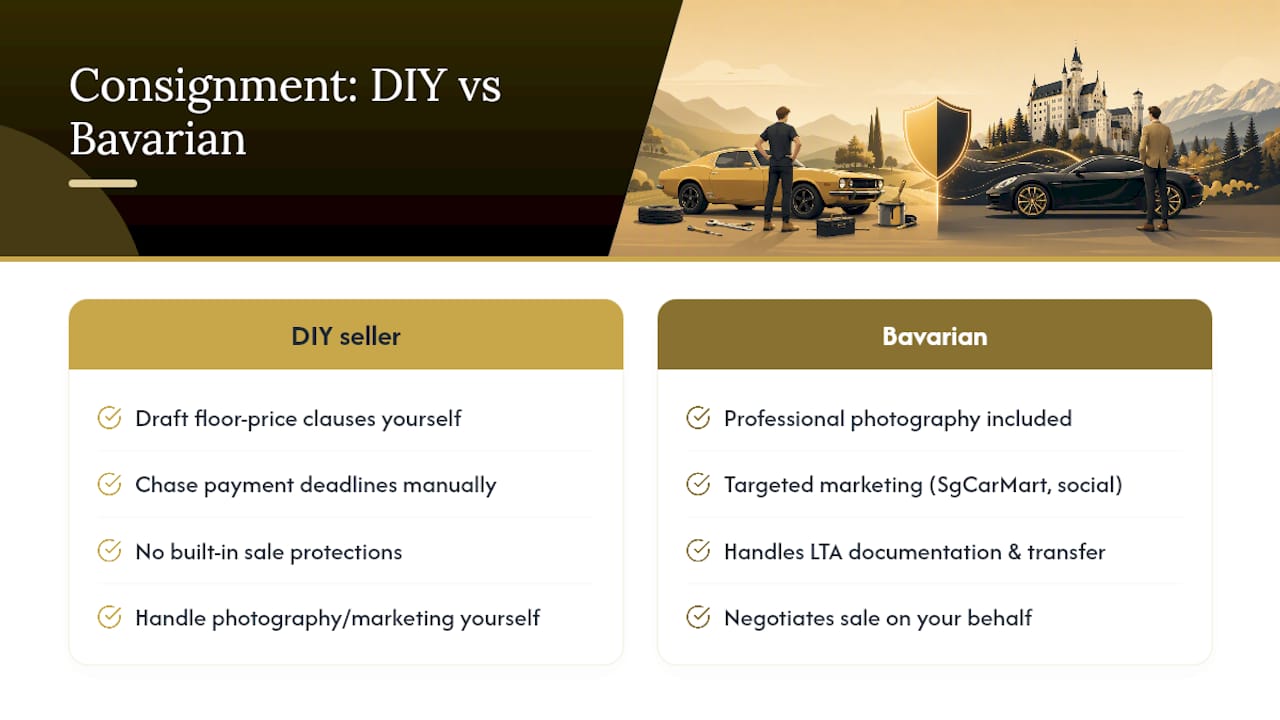
If you own a BMW, Porsche, Mercedes-Benz, or another performance vehicle and you've read this far, you already know how much can go wrong in a poorly written consignment agreement. Bavarian removes that exposure by handling the entire sale process directly: professional photography, targeted marketing across SgCarMart and social platforms, LTA documentation, negotiations, and the transfer of ownership, all under a no sale, no fee structure with no long-term lock-in.

Instead of drafting floor-price clauses and chasing payment deadlines yourself, you get a dedicated team that already builds those protections into every sale. If you're weighing an exclusive listing against an open one, that's a conversation worth having before you sign anything. Get a free valuation from Bavarian and see what your car is actually worth before you commit to any consignment terms.
This article is general information, not a substitute for advice from a qualified lawyer. Consult a qualified legal professional about your own circumstances before acting on anything here.
Sources
The clause guidance in this piece draws on payment-term standards from Taulia's payment terms research, perfection and title guidance from LegalClarity's breakdown of consignment contract risks, pricing-authority language from Genie AI's consignment contract template, and contract-drafting standards from Law & More's consignment agreement resource. If your item involves specific representations about condition or warranty, warranty and modification issues are worth reviewing separately. Perfection rules and insolvency priority vary by jurisdiction, so confirm the filing requirements that apply where you're signing before you rely on any retention-of-title clause alone.
- Payment Terms: Guide — Taulia
- Clothing consignment contract template — Genie AI (Singapore)
- Singapore: no-oral-modification clauses — White & Case
- Consignment contracts: key terms, commissions and risks — LegalClarity