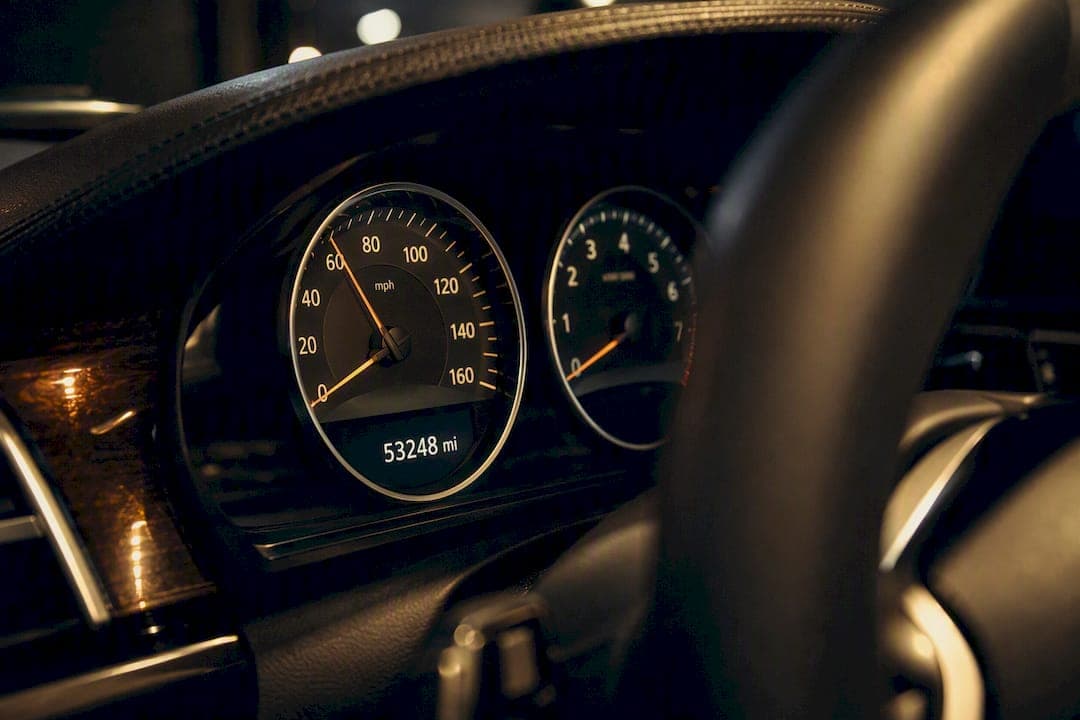
Yes, mileage lowers resale value, but it's rarely the deciding factor by itself. Buyers use it as a shortcut for risk, and dealers use it to justify lower offers, yet a well-documented service history, strong brand desirability, or a favorable Certificate of Entitlement (COE) position can outweigh a high odometer reading entirely. Your best first move isn't panicking about the number on the dash. It's building the paperwork case that lets buyers, dealers, or a consignment partner like Bavarian Autohaus argue for a higher price on your behalf.
Before you list anywhere, whether that's SgCarMart, a dealer trade-in desk, or through a consignment specialist, get these basics sorted:
- Pull together every service record, invoice, and repair receipt you can find.
- Book an independent pre-sale inspection so you have a report ready, not a promise.
- Check your paperwork against Land Transport Authority (LTA) requirements for transfer.
- Decide upfront whether you're going trade-in, private sale, or consignment. Each treats mileage differently.
Key Takeaways
Mileage lowers resale value at the margin, but documented service history, brand desirability, and Singapore's paper-value floor usually matter more than the odometer alone.
| Point | Details |
|---|---|
| Records beat raw numbers | A complete service history can outweigh a low odometer reading in a buyer's risk assessment. |
| Paper value sets a floor | COE, PARF, and OMV mechanics create a resale baseline that reduces mileage's relative weight in Singapore. |
| Dealers price for their own risk | Trade-in offers track wholesale and reconditioning costs, so private sales usually reward documentation more. |
| Presentation shifts the conversation | Professional photos, inspection reports, and detailing redirect buyer focus from mileage to condition. |
| Consignment protects high-mileage premium cars | Bavarian Autohaus markets provenance and condition to targeted buyers, reducing mileage-driven discounting. |
Where to check pricing and get answers fast
- SgCarMart for real-time comparable listings at your mileage band.
- Land Transport Authority (LTA) for ownership transfer and documentation requirements.
- An independent mechanical inspection for a shareable condition report before you list.
Table of Contents
- How Mileage and Resale Value Are Actually Connected
- Where Mileage Ranks Among Other Value Drivers
- How Dealers and Private Buyers Price Mileage Differently
- The Checklist That Actually Protects Your Price
- When High Mileage Barely Moves the Needle
- Rules of Thumb for Estimating the Mileage Discount
- Turning Mileage Concerns Into a Stronger Sale
- Frequently Asked Questions
- Sources
How Mileage and Resale Value Are Actually Connected
Mileage matters for two separate reasons, and conflating them is where sellers lose money. One is mechanical. The other is psychological, and it's often the bigger one.
On the mechanical side, higher cumulative distance means more wear on the powertrain, suspension bushings, tires, and any component tied to a service interval, like timing belts or transmission fluid. That's real and buyers are right to factor it in. But Consumer Reports points out that a documented service history often outweighs a superficially low odometer reading when it comes to actual reliability risk. A car with 120,000 km and full records can be a safer bet than one with 60,000 km and no paper trail.

The psychological side is where most of the discounting happens. Mileage is a number a buyer can see instantly, without opening the hood or reading a single invoice. It becomes a bargaining chip: "It's got a lot of kilometers on it, so I should get a discount." Buyers also anchor to informal benchmarks, using annual averages of roughly twelve to fifteen thousand miles a year as a mental yardstick, though these figures come from markets outside Singapore and should be treated as a rough gut check rather than a rule. [Kelley Blue Book]
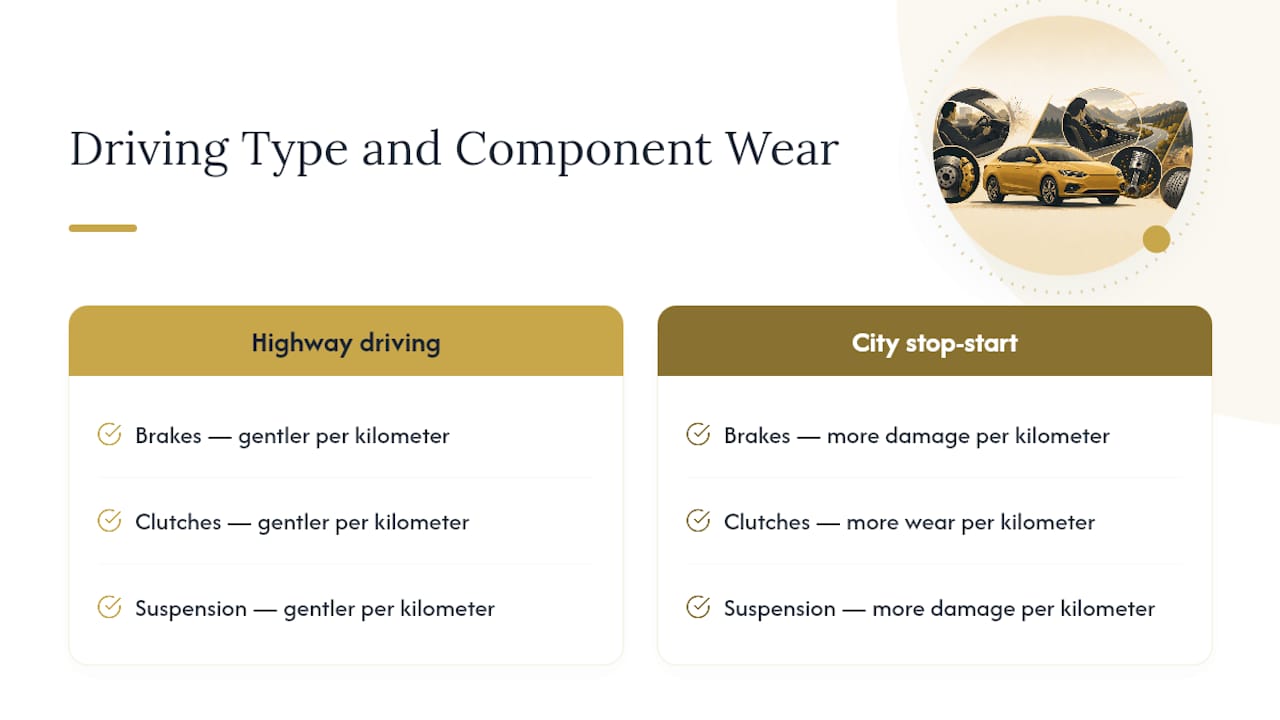
Not all miles are equal, either. Kelley Blue Book notes that steady highway miles tend to be gentler on a car than stop-start city driving, which does more damage per kilometer to brakes, clutches, and suspension components.
Pro Tip: Reframe the conversation before the buyer does. Lead with "here's the full service history and inspection report" instead of waiting for someone to ask about the odometer. You control the narrative, or you let mileage control it for you.
Where Mileage Ranks Among Other Value Drivers
Mileage is one input in a longer list, and in Singapore it's rarely the loudest one. Buyers and dealers weigh:
- Mileage — cumulative wear and a quick proxy for risk.
- Service history — documented care that can offset high mileage.
- Age and model year — how the car compares to newer versions.
- Brand and desirability — how much demand exists regardless of condition.
- Paper value — COE, PARF, and OMV mechanics that set a regulatory floor.
- Condition and presentation — how the car looks and feels in person.
- Timing — where the car sits relative to COE renewal or major milestones.
The paper-value piece is what makes local pricing different from most markets discussed in international guides. Singapore's COE system attaches a depreciating entitlement value to every vehicle, and that entitlement, combined with PARF rebates and the car's Open Market Value (OMV), creates a resale floor that has nothing to do with the odometer. A car with five years left on its COE carries baked-in value regardless of whether it's been driven hard or lightly.
That changes when mileage becomes decisive. Two nearly identical cars with three years of COE left and similar paper value will separate almost entirely on mileage and condition. But compare a low-mileage mainstream sedan against a well-kept, higher-mileage BMW with fresh COE and strong brand pull, and desirability plus paper value will usually win the argument.
How Dealers and Private Buyers Price Mileage Differently
Dealers and private buyers don't discount mileage the same way, and knowing which one you're dealing with changes your strategy.
Dealer and trade-in offers track wholesale and auction pricing closely. Consumer Reports' valuation guidance shows that reconditioning costs, high mileage, and visible damage all get baked into a lower offer, because the dealer needs margin to resell. They're pricing for their own risk, not yours.
Private buyers price more emotionally. They're comparing your listing against a dozen others on platforms like SgCarMart, and if your service history and photos are stronger than the competition's, mileage becomes a smaller factor in their decision.
- Get a dealer quote first if you want a fast, no-hassle number, even knowing it will be conservative.
- Sell privately if you have the time and documentation to justify a higher asking price.
- Consider consignment for higher-value or high-mileage premium cars, where professional marketing and buyer targeting recover value a private listing usually can't.
The Checklist That Actually Protects Your Price
Here's the order of operations that gets you the most value for the least wasted effort, ranked by return on investment:
- Assemble every service record and repair invoice. This is the single highest-leverage move you can make, and it costs nothing but time.
- Fix anything that would fail a basic safety or roadworthiness check. Small issues left unresolved give buyers an opening to chip away at your price.
- Get a pre-sale mechanical inspection report. A short, shareable document from an independent inspector removes doubt before it becomes a negotiation tactic.
- Refresh cheap consumables where it makes financial sense. New tires or brake pads can cost far less than the discount a buyer would otherwise demand.
- Invest in professional detailing and photography. Presentation is often the fastest way to shift a buyer's attention away from the odometer.
When you write the listing itself, be upfront about mileage rather than burying it. Note whether the kilometers were mostly highway or city driving, since highway miles are generally easier on a car and worth mentioning. Photograph your service binder alongside the car. It sounds small, but it signals a level of care that odometer numbers alone can't communicate.
If a buyer opens negotiations by pointing at the mileage, redirect immediately to your inspection report and service history. Ask them what specifically concerns them mechanically, then answer with documentation rather than a price concession. Most mileage objections are really condition objections in disguise, and once you address condition directly, the discount buyers ask for tends to shrink.
Pro Tip: If your car is anywhere near 60,000 or 100,000 miles, get the inspection report done before you list, not after someone asks. Buyer hesitation spikes hard around those round-number thresholds, and a fresh report closes that gap before it opens.
For a deeper look at presentation, our guide on pre-sale detailing covers the specific fixes that move the needle most.
When High Mileage Barely Moves the Needle
Rarity and provenance change the math entirely. A limited-production Porsche or a well-documented Ferrari with substantial kilometers and a complete maintenance trail will often outsell a pristine, low-mileage mainstream sedan, because collectors and enthusiasts are buying the story and the specification, not just the number on the clock.

Compare two real-world scenarios: a mainstream Japanese sedan with 40,000 km will price almost entirely on mileage and condition, because buyers see it as a commodity with dozens of near-identical alternatives. A performance coupe with 90,000 km but full service records, matching numbers, and strong presentation competes on a completely different axis, where buyers care more about originality and care than kilometers driven.
This is exactly where consignment earns its keep for higher-value cars. Bavarian Autohaus mitigates mileage concerns for owners of high-end and performance vehicles through:
- Professional photography and video that highlight condition over odometer readings.
- Marketing to a targeted enthusiast audience already primed to value provenance and rarity.
- Full handling of LTA documentation and ownership transfer, removing friction that scares off serious buyers.
Our guide to selling a luxury car in Singapore walks through this positioning in more detail.
A dealer's note on presenting high-mileage cars
Shawn: We tell every consignor the same thing. Mileage is a conversation starter, not a verdict. Once buyers see a complete service history and clean presentation, the odometer stops being the first question. Price the story, not just the kilometers.
Rules of Thumb for Estimating the Mileage Discount
You don't need a professional appraisal to get a rough sense of where your car sits. Try this sequence:
- Search comparable listings on SgCarMart at your car's mileage band, then check listings 10,000 to 20,000 km higher and lower to see the price spread.
- Note where the steepest drops happen. Depreciation isn't linear. Auto Express's analysis found values often fall fastest early on, with a common threshold around 60,000 miles, then slow again at higher mileages.
- Apply the annual-average benchmark loosely. If your car is well above 12,000 to 15,000 miles a year, expect buyers to negotiate harder.
- Get a paid professional valuation if you're within striking distance of a major decision, whether that's trade-in, private sale, or consignment.
Turning Mileage Concerns Into a Stronger Sale
Selling a high-mileage or premium car privately means managing every inquiry, viewing, and negotiation yourself, often while buyers fixate on the odometer before they've even seen the service history. Bavarian handles that entire process for you, and does it in a way built specifically to shift buyer attention from mileage to condition, provenance, and presentation.
The consignment workflow starts with a free valuation, followed by professional photography and video, targeted listing across SgCarMart and social channels, and full handling of viewings, negotiations, and LTA paperwork through to ownership transfer. Each step is designed to put your strongest evidence, not your weakest number, in front of buyers first. Our car video marketing approach in particular reaches enthusiast buyers who care more about how a car has been kept than how far it's traveled.
If mileage has you worried about what your car will fetch, request a free valuation from Bavarian Autohaus and let a specialist tell you what your documentation and presentation are actually worth.
Frequently Asked Questions
Does high mileage always mean a lower resale price? Not always. A well-documented service history, strong brand desirability, or favorable COE position can offset a high odometer reading, especially for performance and luxury vehicles.
How much does mileage typically reduce a car's value? It varies by model and market, but depreciation tends to accelerate around certain thresholds, then slow at higher mileages, according to Auto Express. Comparing similar listings at different mileage bands on SgCarMart gives a more accurate local read than any general rule.
Is mileage or age more important for resale value? Both matter, and they interact. A younger car with unusually high mileage can be viewed as more worn than an older car driven lightly, which is why service history and condition often carry more weight than either figure alone.
Should I fix mechanical issues before selling a high-mileage car? Yes, if the fix is inexpensive relative to the discount a buyer would otherwise demand. Safety and inspection items should always be addressed first.
Does mileage matter less for electric vehicles? Often, yes. Battery health and range retention tend to matter more to buyers than the odometer reading, so getting a battery health readout can support your asking price more than mileage figures alone.
Sources
- Is age or mileage more important when buying a used vehicle? - Consumer Reports
- Buying Older, Used Cars in 2026 - Kelley Blue Book
- How much does mileage affect car value? - Auto Express