Yes, you can sell a car with an outstanding loan in Singapore. The lender holds a financier's interest (a lien) over the vehicle, and LTA requires that lien to be discharged before OneMotoring will permit an ownership transfer. The buyer must also accept the transfer via OneMotoring within a short period after taking possession, using the M01 form and a valid SingPass login. None of that is complicated once you know the sequence. The single action to take right now: call your bank (DBS, OCBC, UOB, or whichever lender holds your loan) and request a formal full-settlement figure in writing.
- The settlement figure is the exact amount needed to discharge the lien as of a specific date.
- Without it, you cannot calculate your equity position or set a realistic asking price.
- With it, every other step in the sale becomes straightforward.
Key Takeaways
You cannot complete an LTA transfer while a financier's interest is active. Get your bank's settlement figure first, calculate your equity position, and choose the route that fits your timeline and car value.
| Point | Details |
|---|---|
| Get the settlement figure first | Request a formal redemption statement from your bank before listing; quotes are valid for 7–14 days. |
| Confirm LTA lien status | Check OneMotoring or LTA records to verify the financier's interest is listed correctly before negotiating. |
| LTA transfer window is 7 days | The buyer must accept the transfer on OneMotoring within 7 days of taking possession; bank lien release takes several working days. |
| Choose the route that fits your car | Dealer trade-in is fastest; consignment via Bavarian typically delivers the highest net proceeds for premium marques. |
| Never release the log card early | Hand over the log card only after the bank's discharge notice is confirmed and LTA shows the lien cleared. |
Table of Contents
- What should you collect before listing your car?
- How does a sale work when you have positive equity?
- What are your options when you owe more than the car is worth?
- Which selling route fits your situation?
- Step-by-step checklist for selling a financed car
- What documents and fees should you expect?
- How should you communicate the loan status to buyers and protect yourself?
- Should you repay the loan early before selling?
- Can partial repayments or refinancing help before you sell?
- What are the legal risks of selling without clearing the loan?
- What happens if your car is repossessed during the sale process?
- Why consignment works differently for premium cars
- Bavarian handles the hard parts of selling a financed premium car
- Sources
What should you collect before listing your car?
The settlement figure is your starting point, but it is not the only number you need. Before you list, pull together four things: the settlement letter, an independent market valuation, your vehicle documents, and your lender's contact details.
Settlement letter. Contact your bank's auto-loan department and ask specifically for a "full redemption statement" or "early settlement letter." Banks issue a time-bound settlement statement that specifies the exact amount to clear the loan, including any early-redemption penalties and administrative charges. Most quotes are valid for a limited period, so request it close to when you expect to receive a serious offer.
Market valuation. Get at least two valuations: one from a dealer or trade-in platform and one from a private-sale channel such as SgCarMart. The gap between them tells you how much extra effort a private sale is worth. Subtract your settlement figure from each valuation to see your equity position. Positive equity means the sale proceeds cover the loan and leave you a balance. Negative equity means you will need to fund the shortfall yourself. LTA's VRL tool lets you check your PARF and rebate values, which feed directly into your car's paper value and affect what buyers will pay. Our car depreciation guide explains how COE cycles and PARF interact with resale pricing.
Vehicle documents. Locate your log card (the bank may hold it as security), service records, road tax, and insurance documents. Check LTA records to confirm the financier's interest is listed under your lender's name, not a previous one.
Lender contact details. Get the direct number for your bank's auto-loan settlement team, not the general hotline. You will need to coordinate timing between buyer payment and the bank's lien release.
Pro Tip: Ask your bank to quote the settlement figure for a date that falls two to three working days after your expected buyer handover. That buffer covers bank processing time and prevents the lien from expiring before funds clear.
How does a sale work when you have positive equity?
Positive equity is the clean scenario: the car is worth more than you owe. Here is the step sequence.
- Agree on a price with the buyer. Get a deposit (typically 10% of the agreed price) in writing, with a signed sales agreement that specifies the settlement authorization and a contingency clause for bank processing delays.
- Direct the settlement portion to the bank. On the day of handover, the buyer pays the settlement amount directly to the bank (via cashier's order or bank transfer with your loan reference number) and pays you the remaining balance.
- Bank discharges the lien. Once funds clear, the bank updates LTA to release the financier's interest. This typically takes several working days after receipt of funds.
- Complete the LTA transfer via OneMotoring. Once the lien is cleared, you initiate the transfer on OneMotoring. The buyer must have valid motor insurance in their name and accept the transfer within 7 days of taking possession.
- Issue a final receipt. Confirm the transfer is complete on OneMotoring before handing over the log card and keys unconditionally.
Two common execution patterns exist. In a private sale, you, the buyer, and a bank representative often meet at the bank branch to coordinate payment and discharge on the same day. When selling to a dealer, the dealer typically handles bank settlement directly, deducting the settlement amount from the purchase price and paying you the difference. The dealer route is faster and removes the three-party coordination, but trade-in offers are usually lower than private-sale prices.
Pro Tip: Never hand over the log card or keys unconditionally until LTA's OneMotoring shows the financier's interest as cleared. A bank receipt confirms payment, not discharge. The two can be days apart.
What are your options when you owe more than the car is worth?
Negative equity is more common than sellers expect, particularly on cars bought near the top of a COE cycle. You have three realistic paths.
- Pay the shortfall from savings. The most straightforward option. You cover the gap between the settlement figure and the sale proceeds, the lien clears, and the transfer completes normally. No additional borrowing, no extended timeline.
- Roll the shortfall into a new loan via a dealer. Some dealers will absorb the negative equity into the financing of your next vehicle purchase. The shortfall becomes part of your new loan balance. This preserves your cash flow now but increases total borrowing cost over the new loan term.
- Take a short-term personal loan to clear settlement. An unsecured personal loan covers the shortfall, the car sells, and you repay the personal loan separately. This works when the personal loan rate is lower than the cost of holding the car (ongoing depreciation, road tax, insurance).
To illustrate: if your car's market value is S$80,000 and your settlement figure is S$92,000, the shortfall is S$12,000. Paying it from savings costs exactly S$12,000. The personal loan is cheapest if you can repay it within a year.
Pro Tip: Never enter an informal arrangement where the buyer "takes over" your loan payments without a formal bank novation. You remain legally liable for the loan until the bank formally transfers or discharges it.
Avoid hiding negative equity from buyers. If a buyer discovers the loan balance exceeds the agreed price mid-transaction, the deal collapses and you may forfeit time and credibility. Disclose the situation early to serious buyers and frame it as a process detail, not a problem.
Which selling route fits your situation?
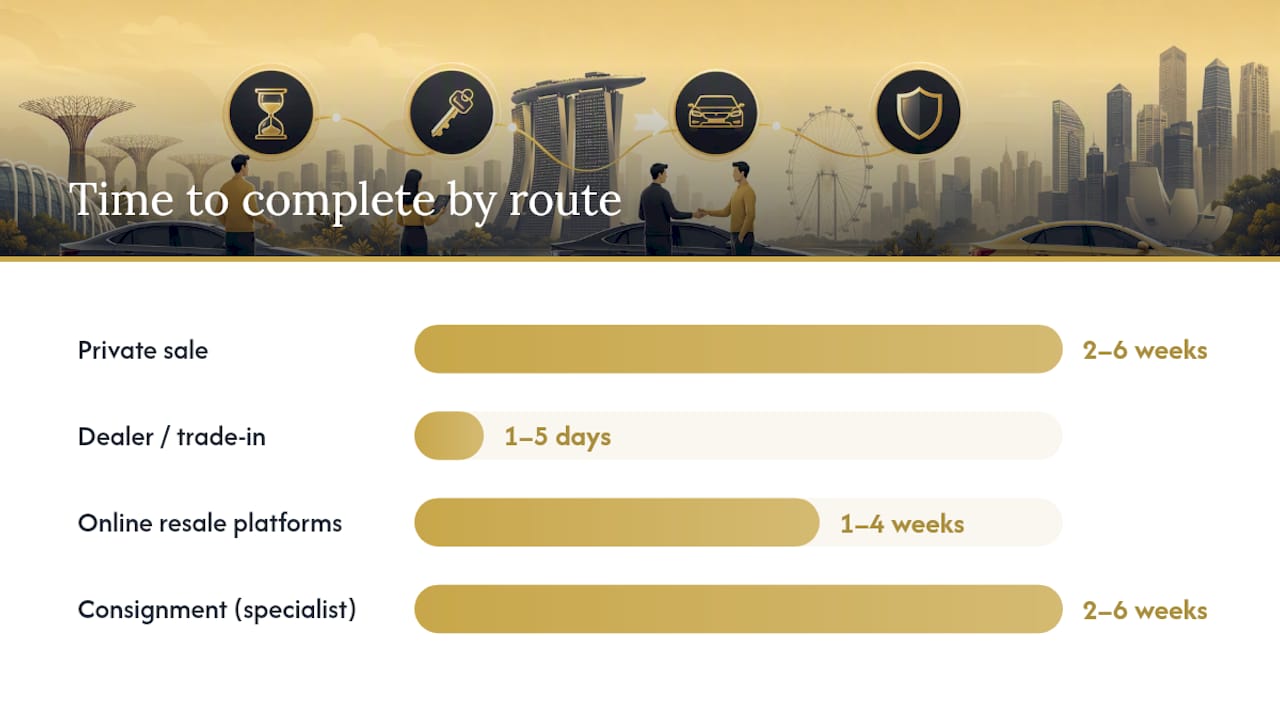
| Route | Best for | Who handles loan settlement | Seller effort | Expected net proceeds | Typical fees | Time to complete |
|---|---|---|---|---|---|---|
| Private sale | Maximum price, positive equity | Seller coordinates with bank | High (viewings, negotiation, paperwork) | Highest (no commission) | Minimal (LTA S$25 transfer fee) | 2–6 weeks |
| Dealer / trade-in | Speed, negative equity absorption | Dealer pays bank directly | Low | Lower (trade-in discount applies) | None to seller; dealer margin built in | 1–5 days |
| Online resale platforms | Convenience, moderate price | Varies by platform | Medium | Moderate | Platform listing or commission fees | 1–4 weeks |
| Consignment (specialist) | Premium / luxury cars, price maximization | Consignment agent coordinates | Very low | High (professional marketing lifts price) | Commission on sale (no sale, no fee) | 2–6 weeks |
For everyday cars with straightforward equity, a dealer trade-in or online platform gets the job done quickly. For BMW, Porsche, Mercedes-Benz, or other premium marques, the price difference between a rushed trade-in and a well-marketed private or consignment sale can be significant. Professional photography, targeted listings on SgCarMart and social platforms, and access to a curated buyer pool tend to recover more than the commission costs. Our guide to selling a luxury car in Singapore covers the valuation and marketing considerations specific to high-end models.
Step-by-step checklist for selling a financed car
- Request a full redemption statement from your bank. Note the validity date.
- Check LTA records for the financier's interest and run the VRL tool for PARF/rebate values.
- Get at least two independent valuations and calculate your equity position.
- List the car (private, platform, or consignment) with the loan status disclosed.
- Draft a written sales agreement that includes: deposit amount and forfeiture terms, settlement authorization, contingency clause for bank processing delays, and handover conditions.
- On handover day, direct the buyer's settlement payment to the bank with the correct loan reference. Use a cashier's order or bank transfer, not cash.
- Obtain the bank's written confirmation of discharge (sometimes called a clearance letter or discharge notice).
- Initiate the LTA ownership transfer on OneMotoring once the financier's interest is cleared.
- Confirm the buyer has valid motor insurance in their name before the transfer is accepted.
- Issue a final receipt and hand over the log card only after OneMotoring confirms the transfer is complete.
If a dealer or consignment agent is coordinating on your behalf, sign a letter of authority so the bank can liaise with them directly. Without it, the bank will not release settlement details or the log card to a third party.
- The sales agreement should specify that the deposit is non-refundable if the buyer withdraws after the settlement has been initiated.
- Include a clause that handover is conditional on LTA confirming the transfer, not just on bank receipt of funds.
What documents and fees should you expect?
Documents required:
- Formal settlement / redemption letter from your lender
- Log card (if the bank has returned it; otherwise the bank holds it until discharge)
- NRIC (both seller and buyer)
- Valid motor insurance in the buyer's name
- M01 form (Transfer of Ownership), completed by both parties
- Written sales agreement
- Bank receipts confirming settlement payment
- Bank discharge notice / clearance letter confirming lien release
Fees:
- LTA transfer fee: S$25, paid by the buyer
- Bank early-redemption penalty: variable; commonly around 1% of the financed amount, per lender schedules
- Interest rebate handling charge: some banks apply a percentage charge on the rebate amount (DBS, for example, describes a 20% charge on the interest rebate plus a 1% fee on the financed amount for early redemption)
- Dealer or consignment commission: varies; consignment is typically commission-on-sale only
- Administrative fees: some lenders charge a processing fee for issuing the settlement letter or discharge notice
Timeline to plan around:
Banks commonly take several working days after receiving settlement funds to update LTA records and release the financier's interest. The LTA OneMotoring transfer must be completed within 7 days of the change of possession. Build that lag into your handover date. If you hand over the car on a Monday and the bank takes 10 working days to update LTA, the buyer is driving a car they cannot yet legally transfer into their name. A conditional handover agreement protects both parties during that window.
Statistic callout: LTA mandates ownership transfer shortly after change of possession. Bank lien release after settlement can take several working days. Plan your handover date to allow for both windows simultaneously.
How should you communicate the loan status to buyers and protect yourself?
Transparency is both a legal and practical requirement. Disclose the outstanding loan to any serious buyer before a test drive, not after. Most buyers in Singapore are familiar with the process; hiding it creates distrust and kills deals.
What to disclose and document:
- Confirm the loan balance and settlement figure in writing before negotiations finalize.
- Include the settlement authorization in the sales agreement so the buyer knows exactly where their payment is going.
- Keep copies of every receipt, the bank's discharge notice, and all OneMotoring transaction records.
Red flags to watch for:
- A buyer who asks you to transfer ownership before full payment clears. Never do this.
- A third party claiming to act on the buyer's behalf without written authorization.
- Requests to hand over the log card before the bank confirms discharge.
- Buyers who offer to "take over" loan payments informally. This is not legally recognized without a formal bank novation.
Practical safety steps:
- Arrange the settlement meeting at your bank branch, not at a third-party location.
- Request the bank's discharge notice in writing before handing over any documents.
- If using a dealer or consignment agent, confirm in writing that they will provide you with the bank's discharge confirmation before the transfer is initiated.
Should you repay the loan early before selling?
Early repayment sounds appealing: clear the loan, sell the car clean, no lien coordination required. The math often tells a different story.
Many Singapore car loans front-load interest using a method similar to the Rule of 78, where a larger proportion of interest is paid in the early months of the loan. By the time you are mid-loan or later, the remaining interest balance is smaller than it appears. Paying off the loan early yields an interest rebate, but the rebate is calculated on that already-reduced remaining interest, and lenders apply fees on top.
Here is a simplified worked example:
- Loan balance remaining: S$50,000
- Interest rebate calculated by bank: S$3,000
- Bank's fee on the rebate (20%): S$600
- Bank's fee on financed amount (1%): S$500 (based on original financed amount of S$50,000)
- Net saving from early repayment: S$3,000 minus S$600 minus S$500 = S$1,900
If coordinating the buyer's payment directly to the bank at handover achieves the same lien discharge without you paying anything upfront, the S$1,900 saving from early repayment is not a saving at all. It is a cost you avoided by letting the sale transaction handle settlement naturally.
When early repayment does make sense:
- You want to list the car without disclosing a loan to buyers (some sellers prefer this simplicity).
- Your lender requires a notice period before settlement and the timeline is tight.
- You have a balloon scheme loan where the final payment structure makes early settlement genuinely cheaper.
Pro Tip: Request the settlement figure as a line-item breakdown: principal outstanding, interest rebate, rebate handling fee, early repayment penalty, and admin charges. Compare the total settlement cost against the proceeds you would net if the buyer pays the bank directly at handover. The difference is your real cost of early repayment.
Our balloon scheme loan guide explains how that specific loan structure affects settlement calculations.
Can partial repayments or refinancing help before you sell?
Making a lump-sum partial repayment before listing reduces your outstanding balance, which can flip a negative-equity position into positive territory or simply reduce the settlement figure the buyer needs to cover. The catch: most Singapore car loans apply the same Rule of 78 interest structure to partial payments, so the interest saving per dollar paid down is modest in the later stages of the loan.

Refinancing before a sale is rarely worth the effort. Switching lenders resets the loan term and triggers new processing fees, and you will likely sell the car before the lower monthly payments generate any meaningful saving. The exception is if your current loan carries an unusually high rate and a new lender offers a significantly lower one, buying you time to wait for better market conditions.
A more targeted approach: ask your bank whether a partial prepayment reduces the early-redemption penalty on the remaining balance. Some lenders calculate the penalty as a percentage of the outstanding principal, so reducing that principal first lowers the penalty when you settle in full at sale.
What are the legal risks of selling without clearing the loan?
Selling a car without discharging the financier's interest is not just procedurally blocked by LTA. It carries real legal exposure.
The lender holds a security interest in the vehicle. If you sell the car and the buyer takes possession without the lien being discharged, the lender retains the legal right to repossess the vehicle from the buyer. The buyer loses the car. You remain liable to the lender for the outstanding debt. Both parties can pursue legal remedies against you.
Practically, LTA's OneMotoring system prevents the transfer from completing while the financier's interest is active, so a fully documented transfer cannot happen without discharge. The risk arises in informal arrangements: handing over keys and log card to a buyer who "will sort out the loan later," or agreeing to a private arrangement where the buyer makes loan payments on your behalf. Neither is legally recognized. You remain the registered owner and the borrower until the bank formally discharges the lien and LTA records the transfer.
The car sale paperwork checklist covers the specific documents that protect both parties in a financed sale.
What happens if your car is repossessed during the sale process?
If you fall behind on payments while the sale is in progress, the lender has the right to repossess the vehicle. Repossession does not cancel your debt. The lender will sell the car, typically at auction, and you remain liable for any shortfall between the auction proceeds and your outstanding balance.
If repossession happens mid-sale:
- Contact your lender immediately. Some banks will pause repossession proceedings if you can demonstrate an imminent sale with a signed agreement and deposit in hand.
- Provide the lender with the signed sales agreement and proof of deposit. This shows the debt will be cleared within a defined timeline.
- Negotiate a short extension. Lenders generally prefer a clean settlement over an auction sale, which typically yields less than market value.
- If the buyer's financing is still being arranged, accelerate that process or consider a cash buyer to close faster.
The best protection against repossession during a sale is speed. Once you decide to sell, move quickly: get the settlement figure, list the car, and accept a serious offer. A stalled sale with missed payments is the scenario that triggers repossession risk.
Why consignment works differently for premium cars
The conventional wisdom is that private sale always beats consignment on net proceeds because you avoid the commission. For a Toyota or Honda, that is often true. For a Porsche 911, a BMW M car, or a Mercedes-Benz AMG, the math shifts.
Premium car buyers are a smaller, more specific pool. They research extensively, compare across multiple channels, and respond to professional presentation. A listing with high-quality photography, a well-produced video, and targeted placement on SgCarMart alongside Instagram and TikTok reaches that pool in a way a standard private listing does not. The price premium that professional marketing commands on a S$200,000 car can comfortably exceed a consignment commission.
There is also the coordination factor. Loan settlement, LTA documentation, buyer vetting, and payment handling on a high-value transaction carry real risk if managed informally. A consignment agent with experience in financed premium car sales handles the bank authorization, the three-party settlement, and the OneMotoring transfer as part of the service. The seller's role is reduced to signing the authorization and collecting the net proceeds.

Bavarian's experience across BMW, Mercedes-Benz, Porsche, Ferrari, and other marques is built on exactly this: professional presentation that lifts the sale price, and structured loan coordination that removes the friction of selling a financed car privately.
Bavarian handles the hard parts of selling a financed premium car
Selling a financed BMW, Porsche, or Mercedes-Benz privately means coordinating your bank, vetting buyers, managing viewings, and navigating LTA paperwork, all while trying to hold your asking price. Bavarian cuts through that.
Bavarian's consignment service covers free valuation, professional photography and video marketing, listings across SgCarMart and social platforms, and full management of loan settlement coordination and LTA transfer documentation. On a financed car, Bavarian handles the bank authorization workflow on your behalf, so you are not chasing lenders or managing three-party payment logistics. The commission model is straightforward: no sale, no fee. For premium car owners who want the highest possible net proceeds without the administrative burden of a financed private sale, request a free valuation at Bavarian and get a clear picture of what your car is worth before you commit to any route.
Sources
This article is general information, not a substitute for advice from a qualified financial advisor. Consult a qualified financial professional about your own circumstances before acting on anything here.