
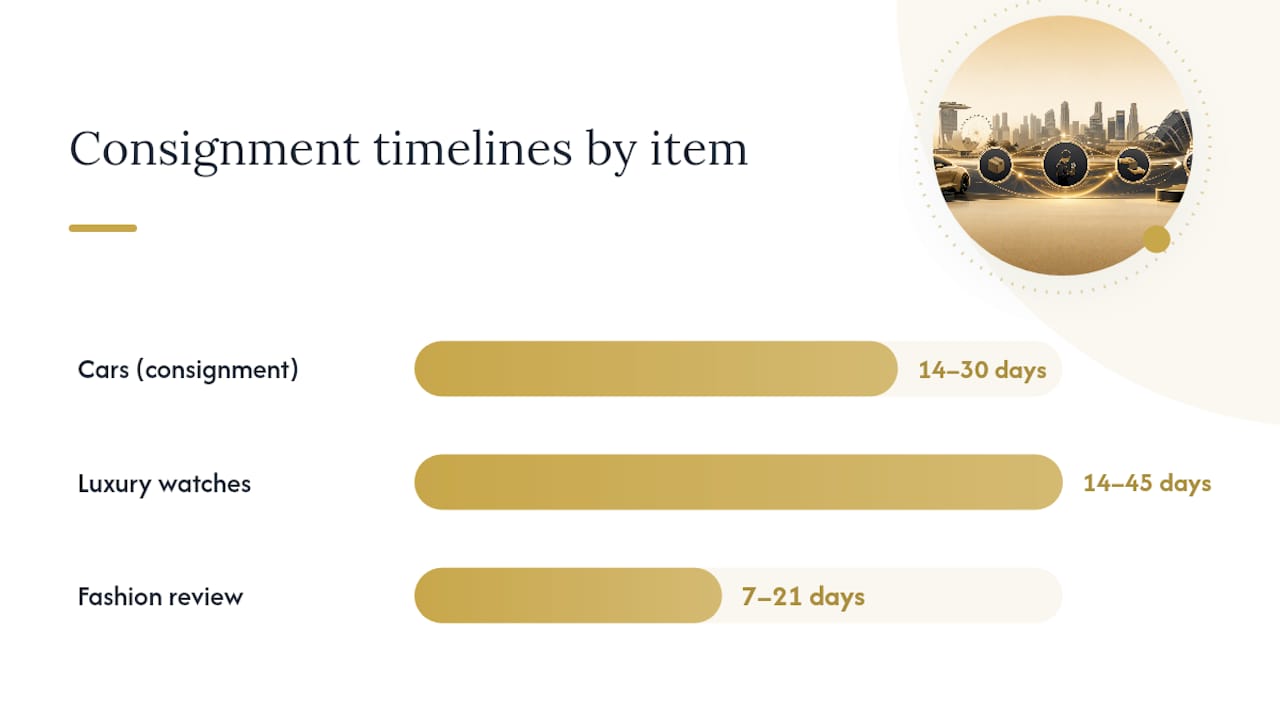
Consignment timelines in Singapore run 14 to 30 days for cars, 14 to 45 days for luxury watches, and 7 to 21 days just to get a quote on fashion and retail items, with payout often landing the following month. The trade-off is consistent across categories: consignment takes longer than a direct cash sale but usually nets more money, unless you own a model in such high demand it sells in days regardless of the route.
TL;DR:
- Consignment in Singapore typically takes 14 to 30 days for cars and 14 to 45 days for watches, with payouts usually issued the month after the sale.
- Items priced at market value tend to move faster, while overpricing or lack of demand can extend the timeline, especially for less sought-after pieces.
- The first 7 to 14 days after listing are critical, as strong early interest indicates a well-priced item, while silence suggests a need for price adjustment.
- Demand increases during specific seasons, such as year-end for cars and bonus season for watches, influencing how quickly items sell.
- Speed can be improved by professional presentation, offering buyer financing options, and setting shorter or non-exclusive consignment terms.
Table of Contents
- Consignment Timeline Singapore: Typical Ranges by Item Type
- What Actually Changes How Long Your Consignment Takes
- Consignment vs. Direct Sale: Speed vs. Money in Singapore
- The Consignment Process Step by Step: Where the Time Actually Goes
- How to Shorten Your Consignment Timeline Without Cutting Your Price
- Singapore Customs Rules That Can Affect Your Consignment Timeline
- What We've Learned Managing Consignment Timelines for Singapore Sellers
- How Bavarian Keeps Your Consignment Timeline Moving
- Sources
- FAQ
Consignment Timeline Singapore: Typical Ranges by Item Type
The honest answer to "how long is consignment in Singapore" depends entirely on what you're selling. A 2019 Porsche 911 moves differently than a stainless steel Rolex, and both move differently than a handbag going through a retail consignment store. Here's how the ranges actually break down.
Cars typically sell within 14 to 30 days through a consignment dealer, according to Paragon Motors' 2026 guide comparing direct sale against consignment in Singapore. That range assumes reasonable pricing and a car in good condition. Push past 6 weeks and you're usually looking at a pricing problem, not a market problem. Popular models in tight supply (think a well-kept manual Porsche Cayman or a low-mileage BMW M3) can move in under two weeks.
Luxury watches run a wider band: 14 to 45 days, or roughly 2 to 8 weeks, per WatchCapital's 2026 consignment guide. Highly sought references (a steel Nautilus, a discontinued Daytona configuration) often sell within the first week because demand outstrips supply before the listing even gets traction. Less sought pieces, or watches priced optimistically, can sit for the full 8 weeks or longer.
Fashion and smaller retail items work on a different clock entirely. Consignment stores like REFASH typically take 7 to 21 days just to review your items and issue a quote, and payout is commonly processed by the end of the month following the sale, not immediately after. REFASH also offers instant cash events for sellers who want to skip the wait and take a lower, immediate offer instead.
Across every category, dealers watch what's often called the momentum window, the first 7 to 14 days after listing. Strong early interest signals a well-priced item. Silence in that window almost always means the price needs adjusting, not that the market has gone cold.
A few patterns hold true regardless of what you're consigning:
- Items priced at or near fair market value move within the low end of their range.
- Overpriced listings drift toward the high end, or beyond it, until the seller adjusts.
- Rare or in-demand pieces compress the timeline in every category, sometimes dramatically.
- Payout timing almost always trails the sale itself by several business days to a few weeks.
What Actually Changes How Long Your Consignment Takes
Some factors are within your control. Others aren't. Knowing the difference saves you from chasing the wrong fix when a listing stalls.
- Demand and seasonality. Singapore's car market sees predictable swings around COE bidding cycles and year end, when buyers rush to close deals before certificate costs shift. Watches see similar patterns around bonus season, roughly November through February, when buyers have fresh cash.
- Pricing strategy. A listing price set 10 to 15% above comparable sold listings routinely adds weeks to the timeline. A reserve set too close to your ideal price gives the dealer no room to negotiate a quick close.
- Condition, presentation, and documentation. A car with full service records, recent detailing, and no outstanding issues sells faster than one with gaps in its history. A watch with original box, papers, and service records clears authentication faster than one without.
- Dealer marketing reach. A listing pushed only to one platform sits longer than one marketed across SgCarMart, Instagram, TikTok, and a physical showroom simultaneously. Exposure compounds.
- Financing availability. Buyers who can access installment plans through the dealer close faster than buyers hunting for financing on their own.
- Paperwork and logistics. Outstanding car loans, COE transfer requirements, or cross-border movement of goods all add administrative days that have nothing to do with buyer interest.
Contract terms matter more than most sellers realize going in. Exclusivity clauses, withdrawal conditions, and no-sale administrative fees vary by dealer, and Shopify's guide to consignment inventory notes that agreements commonly specify fixed consignment periods of three or six months along with defined payment schedules. Read that section of your contract before you sign, not after your item has sat for five weeks.
Pro Tip: Ask your dealer directly what they consider a "stalled" listing and at what point they'll recommend a price cut. A dealer with no clear answer probably isn't tracking your listing's performance closely enough to act on it.
Consignment vs. Direct Sale: Speed vs. Money in Singapore
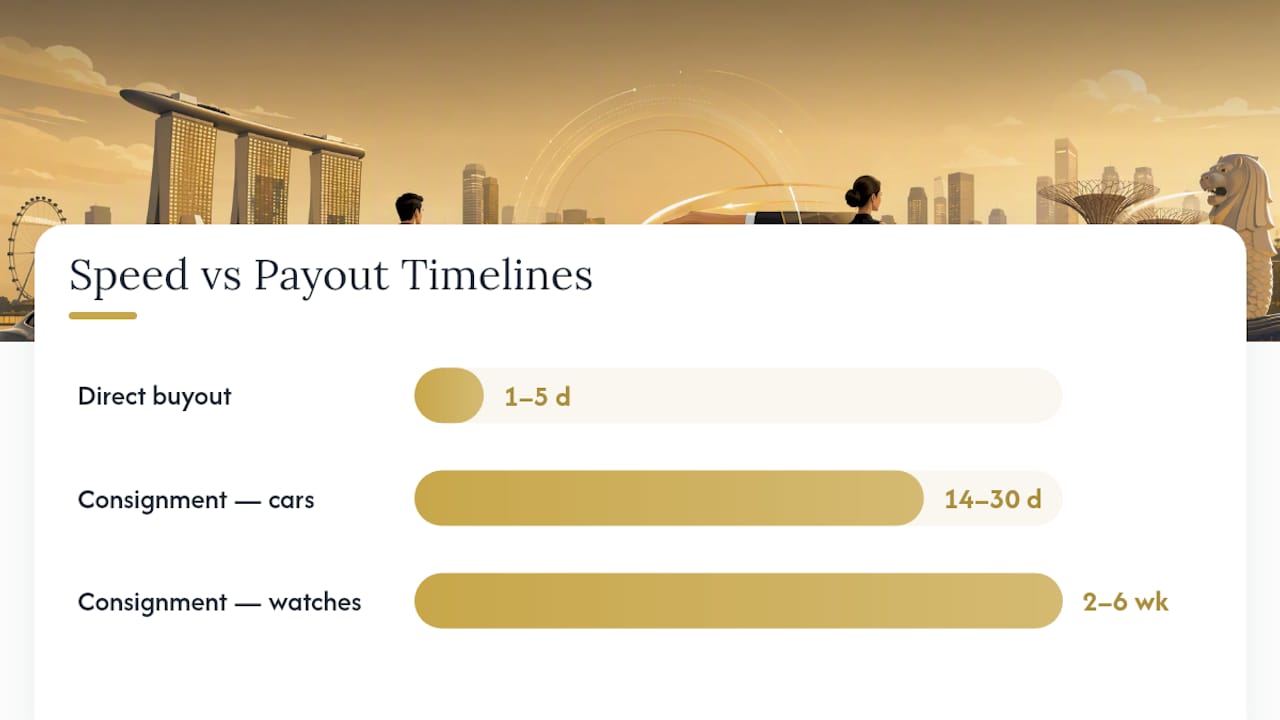
If you need cash this week, consignment isn't your answer. A direct dealer buyout in Singapore typically completes in 1 to 5 working days, sometimes as fast as 24 to 72 hours once you accept an offer. Consignment, by comparison, commonly runs 14 to 30 days for cars and longer for watches. The gap exists because a dealer buyout skips the marketing, viewing, and negotiation stages entirely, and the dealer prices in that convenience by offering less than open-market value.
The calculus comes down to a simple question: what's your time worth against the price gap?
- Choose a direct buyout if you need funds within days, your COE is nearing renewal decisions, or your car has issues that make marketed sale harder.
- Choose consignment if your item has real demand and you can tolerate a 2 to 6 week window for a meaningfully higher net.
- Watch for financing effects: dealers who offer buyer financing expand the pool of qualified buyers, which can shorten a consignment timeline even while keeping the price premium intact.
Industry analysis of watch sales frames this as a straightforward time value trade, where dealer marketing and buyer financing access are the two levers that most often shorten the calendar without sacrificing price. The same logic applies almost identically to cars.
The Consignment Process Step by Step: Where the Time Actually Goes
Sellers who understand where the days go stop panicking during normal parts of the process and start noticing when something's genuinely off track.
- Initial appraisal and valuation (1 to 7 days). The dealer inspects the item, checks documentation, and sets a market-based price. Cars need a physical inspection; watches need authentication, which can extend this stage if the piece requires third-party verification.
- Photography, authentication, and listing setup (1 to 7 days). Professional photos and, increasingly, short video content get produced during this window. For cars, this is where detailing happens too, since presentation quality directly affects how fast serious inquiries come in.
- Marketing push and first exposure (the critical 7 to 14 days). The listing goes live across platforms. This is the momentum window every dealer watches closely, and it's the single best early indicator of whether your price is right.
- Viewings and negotiations (days to several weeks, highly variable). Serious buyers request viewings, test drives, or private showings. Negotiation length depends entirely on how close your asking price sits to actual demand.
- Buyer financing and payment clearance (3 to 14 days). Cash buyers move fast. Financed buyers need loan approval, which can add up to two weeks depending on the bank and the buyer's credit profile.
- Transfer of ownership and final payout (3 to 7 working days after paperwork clears). For cars, this means LTA ownership transfer documentation. One detail worth knowing: in some car consignment arrangements you can keep driving the vehicle right up until a buyer is confirmed, while high-value watches typically require physical handover to the dealer upfront for security and authentication purposes. That difference changes how quickly your item can actually be shown to buyers.
Add it up and a smooth car consignment lands around 3 to 4 weeks from drop-off to funds in your account. A watch consignment can run similarly or stretch toward 6 to 8 weeks if the piece isn't in immediate demand. For a deeper breakdown of each stage specific to vehicles, Bavarian's car consignment process guide walks through the documentation requirements in more detail.
How to Shorten Your Consignment Timeline Without Cutting Your Price
Speed and value aren't always opposed. A few moves compress the timeline while protecting what you take home.
- Price at fair market value from day one rather than testing a high number and cutting it later. Late price cuts read as desperation to buyers watching the listing.
- Invest in professional photography and video. Listings with strong visual presentation get more inquiries in the first week, which is exactly when it matters most.
- Ask your dealer about buyer financing options and make sure installment availability is visible in the listing itself, not buried in a phone call.
- Consider a shorter or non-exclusive consignment term if speed matters more to you than squeezing out the last few percent of value.
- Use the first 14 days deliberately. Ask your dealer to schedule a price review or a marketing boost at the two-week mark rather than waiting for you to notice the listing has gone quiet.
Pro Tip: If your listing has zero serious inquiries by day 10, don't wait out the full momentum window hoping it turns around. Call your dealer and ask for a market comparison against similar sold listings that week.
Singapore Customs Rules That Can Affect Your Consignment Timeline
Most consignment sales within Singapore never touch import or export rules. But if your item needs to cross borders, either for authentication, restoration, or a buyer overseas, Singapore Customs' Temporary Import/Export Scheme becomes relevant.
The scheme permits temporary import for up to six months, with extension requests filed through TradeNet. Extensions require supporting documents and add processing time, so build in lead time if your item's timeline is already tight. The scheme's overview also covers GST and duty suspension conditions, which matter if you're moving a high-value watch or car component across borders temporarily rather than selling it outright.
A few practical numbers worth knowing before you start:
- Maximum temporary import window: six months, extendable via TradeNet application.
- Controlled goods may need additional Competent Authority approval before a permit is issued.
- Missing documentation is the single most common cause of permit delay, not the review process itself.
Have these ready before you start: proof of ownership, item valuation, and any prior import/export permits tied to the item. Working with a licensed, regulated dealer that handles documentation and verification on your behalf removes most of this friction from your plate entirely, since private sellers navigating TradeNet solo tend to lose days to paperwork they didn't know they needed.
What We've Learned Managing Consignment Timelines for Singapore Sellers
Most sellers overestimate how much control they have over demand and underestimate how much control they have over presentation. That's backwards, and it costs people money every week.
The cars that sell in under two weeks almost never win on rarity alone. They win because the listing had real photos, a video that actually showed the car running, and a price that matched what similar cars were closing at that month, not what the seller hoped to get. Bavarian tracks every consignment against that first 7 to 14 day momentum window deliberately, because a quiet first two weeks is data, not bad luck. If a listing isn't generating serious inquiries by then, the fix is almost always a price conversation, not a marketing one.
The other pattern worth naming: sellers who insist on exclusivity terms that lock them in for months, then get frustrated when a slow market keeps their car sitting past week six. Flexibility in the contract matters as much as flexibility in the price. A seller who can adjust course at day 14 almost always does better than one who waits until day 45 to admit the number was wrong.
— Shawn
How Bavarian Keeps Your Consignment Timeline Moving
Bavarian is the alternative to guessing your way through a private sale in Singapore. Every listing gets professional photography, viral-style video content, and simultaneous exposure across SgCarMart, Instagram, TikTok, and Facebook from day one, the exact combination that shortens the momentum window instead of leaving your car buried on one platform.

That exposure is only half the work. Bavarian handles every inquiry, viewing, and negotiation, then takes over the LTA documentation and ownership transfer paperwork that trips up private sellers, and manages secure payout once the deal closes. If your car has an outstanding loan, that gets untangled too, since financing complications are one of the most common reasons a private sale drags past six weeks. For sellers weighing what they'll actually take home, the commission structure is laid out clearly before you commit, with no surprise deductions at payout.
If you own a BMW, Porsche, Mercedes-Benz, or another performance or luxury car and want a realistic sense of what your timeline and net proceeds could look like, request a free valuation from Bavarian and see where your car stands before you list it anywhere else.
Sources
For readers who want to go deeper on specific pieces of this process, a few sources are worth bookmarking. Singapore Customs' Temporary Import/Export Scheme pages cover permit durations and extension procedures in full. WatchCapital's consignment guide breaks down watch-specific commission structures and timing in more depth than covered here.
On the car side, Bavarian's own consignment fee breakdown and marketing approach explain how presentation and commission interact to affect your final payout. For general dealer selection standards, CarPulse Albania's guide to reputable dealerships offers useful, transferable criteria on what separates a transparent dealer from one that isn't.
- The Ultimate Guide to Luxury Watch Consignment in Singapore (2026 Edition)
- Consign your bags & wallets | REFASH
- A guide to consignment inventory for retailers and suppliers (Shopify Singapore)
FAQ
How long does consignment last in Singapore?
Consignment periods vary by contract but commonly run three to six months as a maximum term, though most cars and watches sell well before that ceiling, typically within 14 to 45 days depending on the item.
How long is the consignment period at similar resale platforms like The RealReal?
Platforms outside Singapore, such as The RealReal, set their own internal review and payout windows that don't apply locally; Singapore-based consignment stores like REFASH typically quote 7 to 21 days just to review items and issue an offer.
What does "consignment car" mean in Singapore?
A consignment car is a vehicle a private owner hands to a dealer, like Bavarian, to market and sell on their behalf, with the dealer handling inquiries, viewings, negotiations, and LTA paperwork in exchange for a commission upon sale.
Where can I sell unwanted items in Singapore?
Cars and luxury watches move fastest through specialist consignment dealers with strong marketing reach, while fashion and smaller goods typically go through consignment retailers like REFASH or direct online marketplaces.
Is consignment faster or slower than a direct sale?
Direct dealer buyouts complete in 1 to 5 working days, while consignment takes longer, usually 14 to 30 days for cars, but typically nets a higher final price.