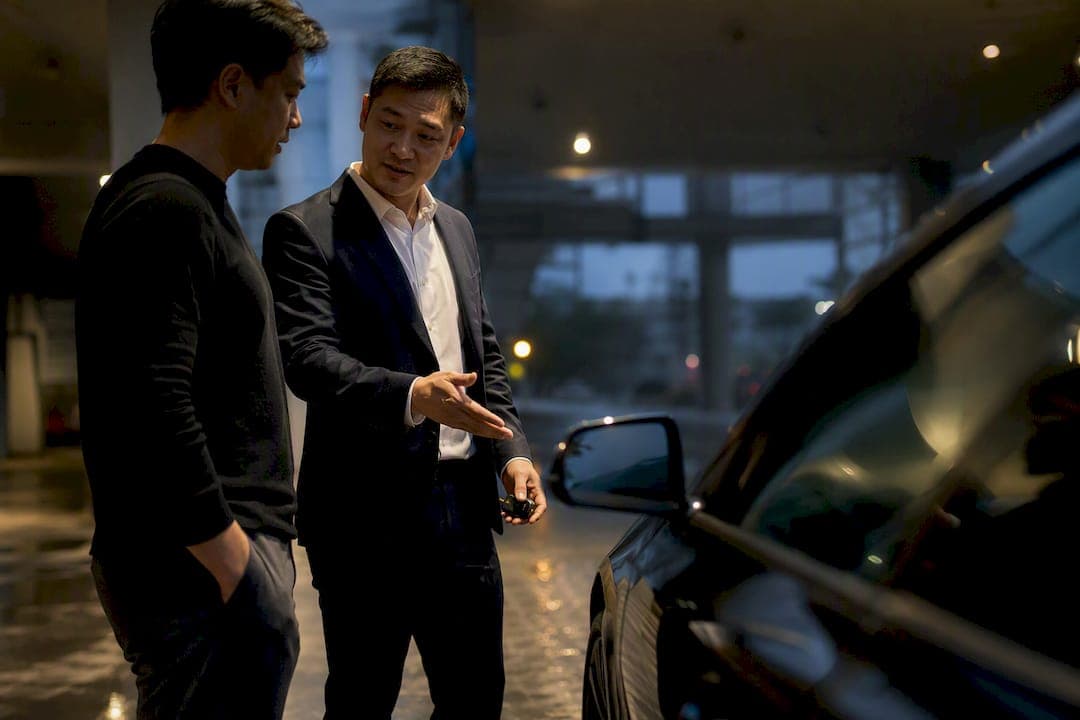
You remain legally liable until the LTA ownership transfer completes, so demand cleared funds and a signed deposit agreement before handing over keys. Ownership, and the liability that rides with it, stays with you until the transfer confirms through Singpass, not the moment a buyer verbally agrees to the price. Insist on written terms covering insurance during viewings, payment tied to cleared funds, and bank loan settlement if you're still financing the car.
TL;DR:
- Sellers must ensure funds are fully cleared and ownership is officially transferred via Singpass before releasing the car to avoid ongoing liability.
- Insurance coverage during test drives and showings must be verified in writing through the dealer's trade policy, not just verbally assurance.
- Full disclosure of the vehicle's defects, accident history, and mechanical issues is essential, as Singapore's Lemon Law provides limited protection for consignment sales.
- Outstanding loans must be settled before transfer, with written confirmation of loan discharge required; failure to do so can leave sellers liable for shortfalls.
- Carefully drafted consignment agreements should specify minimum prices, insurance, test-drive protocols, and dispute resolution methods to safeguard seller interests.
Table of Contents
- Who's Liable for Seller Liability in Consignment During Test Drives and Dealer Custody?
- What Must You Disclose About Defects and Vehicle History?
- How Do Outstanding Loans Affect Your Consignment Liability?
- When Does Seller Liability End Under LTA Transfer Rules?
- Which Consignment Agreement Clauses Protect Sellers Most?
- Seven Steps to Limit Your Liability While Consigning
- Who Pays for Third-Party Claims During Consignment?
- What Consumer Protection Rules Apply to Consignment Sellers?
- Are There Tax Implications When You Consign a Car for Sale?
- How Are Disputes Resolved Under a Consignment Agreement?
- What Happens if the Dealer Misuses the Car or Acts Negligently?
- A Consignor's Perspective on What Actually Protects High-End Sellers
- How Bavarian Handles Seller Liability Throughout Your Consignment
- Sources
Who's Liable for Seller Liability in Consignment During Test Drives and Dealer Custody?
Handing your car to a consignment dealer doesn't automatically transfer risk. Your personal motor insurance and the dealer's showroom policy operate differently, and the gap between them is where sellers get burned. Most private motor policies exclude commercial use or sale-related activity, which means your insurer may deny a claim if the car is damaged while sitting in a dealer's showroom or out on a test drive with a stranger behind the wheel.
A reputable dealer carries its own trade insurance or a dedicated policy covering vehicles in its custody, including test drives. Before you sign anything, ask for the policy number, the coverage limit, the excess amount, and the exact dates it applies. Don't accept a verbal assurance. Get it in writing, and keep a copy with your consignment file.
Test drives deserve their own scrutiny. A dealer should escort every test drive, verify the driver's license, and confirm the driver is named or covered under the trade policy before the car leaves the lot. Bavarian's own test drive liability guide walks through cases where sellers ended up disputing bills because nobody had confirmed coverage in advance.
If damage happens while the car is under dealer care, act fast: photograph everything immediately, get a written incident report from the dealer, and notify the relevant insurer within 24 hours.
Pro Tip: Ask the dealer for a certificate of insurance, not just a policy summary. A certificate names the insured party and effective dates, which matters if you ever need to prove coverage was active on the day of an incident.
What Must You Disclose About Defects and Vehicle History?
Full disclosure protects you more than it protects the buyer. Under a consignment arrangement, you're expected to tell the dealer everything material about the car's condition and history: prior accidents, structural or chassis repairs, flood exposure, outstanding recall notices, and any mechanical issue you know about but haven't fixed. Leaving these out doesn't make them disappear. It just means the dispute surfaces later, usually after money has changed hands.
The safest move is to write these details directly into the consignment form, not just mention them verbally to the salesperson. A documented disclosure protects you if a buyer later claims they weren't told something.
This matters more in Singapore than in many other markets because Singapore's Lemon Law generally does not apply to consignment sales, since the transaction is often treated as consumer-to-consumer rather than a dealer sale, according to SGCarMart's reporting on the issue. Straits Times coverage of the growing consignment trend among used-car dealers confirms the same gap. That shifts more of the burden onto accurate disclosure at the point of sale, since the buyer has fewer statutory protections to fall back on afterward. Bavarian's breakdown of Lemon Law and consignment cars covers this in more detail.
When describing the car to buyers, stick to facts you can back up with paperwork. Things worth including:
- Full service history with workshop invoices, not just a mileage log.
- Any accident repairs, even cosmetic ones, with dates and repairer names.
- Outstanding recalls or known mechanical quirks, however minor.
Avoid phrases like "no issues whatsoever" or "perfect condition." Those read as warranties, and warranties create liability you didn't intend to take on.
How Do Outstanding Loans Affect Your Consignment Liability?
If your car still carries a hire-purchase balance, that loan does not disappear when you hand the keys to a dealer. It has to be settled before ownership can transfer, and how that settlement gets handled determines whether you walk away clean or end up owing money.
- Disclose the loan upfront. Tell the dealer the outstanding balance and the financing bank the moment you sign the consignment agreement.
- Request a bank settlement letter. This confirms the exact payout figure needed to discharge the loan, and a competent dealer will coordinate this directly with your bank.
- Watch for negative equity. If the sale price doesn't cover the outstanding loan, you're liable for the shortfall. Know this number before you agree to a minimum sale price.
- Confirm cleared funds before transfer. Buyer payment should sit in escrow or clear in full before the bank discharges the loan and before LTA transfer is authorized.
- Get written confirmation of discharge. The bank should confirm the loan is closed, not just that a payment was received.
Dealers handle bank settlements often, largely because many private buyers can't secure financing approval on high-COE performance cars and need the dealer to manage it. A dealer asking you to transfer title before you have proof of settlement is a red flag, full stop.
Pro Tip: Never sign a transfer authorization until your bank confirms in writing that the loan is discharged. A verbal "it's been handled" from a salesperson is not proof. Bavarian's car loan takeover guide walks through the settlement workflow step by step.
When Does Seller Liability End Under LTA Transfer Rules?
The LTA sets a firm rule: ownership transfer must complete within a short timeframe after the transaction, and sellers must never let a third party, including the dealer's staff, use their Singpass to authorize the transfer on their behalf, according to LTA's own transfer guidance. This transfer window is strictly enforced. Miss it, and you're still the registered owner on paper, with all the liability that implies.
The transfer becomes official the moment OneMotoring confirms it through your Singpass session and the buyer accepts via their own SMS or app prompt, a process detailed in OneMotoring's FAQ on the digitalized registration process. That system notification, not a handshake or a signed receipt, is the moment your liability legally ends.
Before you authorize anything through Singpass:
- Confirm the buyer has accepted the transfer on their end.
- Confirm payment has cleared, not just been initiated.
- Save screenshots of the OneMotoring confirmation screen and any transfer reference numbers.
Bavarian's LTA ownership transfer guide covers the OneMotoring workflow step by step if you want the full walkthrough.
Which Consignment Agreement Clauses Protect Sellers Most?
Your consignment form is the single document doing the most work to protect you, and a vague one is where most disputes start. Templates commonly used in Singapore, such as the GenieAI auto consignment template, lay out the clauses that matter most:
- Minimum acceptable price, written explicitly, with no clause allowing the dealer to drop below it without your written consent.
- Commission structure, ideally "no sale, no fee," with the exact percentage stated, not left as "market rate."
- Payment timing, specifying that funds must clear in full before any transfer authorization happens.
- Insurance responsibility, naming who covers the car during listing, viewings, and test drives.
- Test-drive controls, requiring escorted drives and verified, insured drivers only.
- Termination terms, spelling out what happens if you want to withdraw the car early and any penalty involved.
Watch for clauses that let the dealer adjust price unilaterally, that ask you to hand over the title or spare keys before payment clears, or that use broad indemnity language shifting undefined future liabilities onto you. None of those are standard, and all are negotiable.
Pro Tip: If a clause uses phrases like "seller agrees to indemnify the dealer against all claims," ask exactly which claims. Vague indemnities are where sellers unknowingly absorb risk that should sit with the dealer. For high-value cars, a quick legal review before signing costs little relative to what's at stake. Bavarian's consignment fees breakdown also explains typical commission ranges so you know what's reasonable to negotiate.
Seven Steps to Limit Your Liability While Consigning
- Get a documented valuation and agree on a written minimum price before listing.
- Sign a consignment form that spells out insurance responsibility, commission, and payment timing.
- Confirm the dealer's insurance policy and test-drive protocol before handing over keys.
- Disclose any outstanding loan and secure a bank settlement letter early.
- Require a signed buyer deposit agreement before any handover or test drive happens.
- Verify buyer payment and transfer acceptance in OneMotoring before authorizing anything.
- Keep every Singpass confirmation, bank receipt, and message thread on file.
Pro Tip: Treat step 5 as non-negotiable. Never hand over keys or possession without a signed deposit agreement, regardless of how confident the buyer sounds. Bavarian's handover checklist covers the documents worth collecting at each stage.
Who Pays for Third-Party Claims During Consignment?
If a test driver rear-ends someone, or the car is damaged in an accident while under the dealer's care, liability generally follows whoever had control at the time, not automatically the registered owner. That said, "generally" is the operative word, and this is exactly where a weak consignment agreement leaves sellers exposed.
If the dealer's trade insurance was active and the driver was properly authorized, the dealer's insurer typically handles the third-party claim. But if the dealer let an unverified buyer take the car unescorted, or the trade policy had lapsed, you as the registered owner could still be named in a claim simply because your name is on the vehicle log card until transfer completes.
This is why the insurance verification covered earlier isn't optional paperwork. It's the difference between a claim landing on the dealer's policy and a claim landing on your doorstep months after you thought the sale was done. Ask specifically whether the dealer's policy covers third-party bodily injury and property damage, not just damage to the vehicle itself.
If you ever receive correspondence about a claim involving your car after it's been consigned but before transfer completes, don't ignore it. Forward it to the dealer immediately, request their insurer's claim reference, and keep a paper trail. Your consignment agreement should specify that the dealer's insurer is the first point of contact for any incident occurring while the car is in their custody, not you personally.
What Consumer Protection Rules Apply to Consignment Sellers?
Singapore's consumer protection framework was built primarily to protect buyers, which means as a seller you have fewer statutory shields than you might expect, and more depends on what you put in writing yourself.
The Consumer Protection (Fair Trading) Act targets misleading or false representations made in the course of a sale. If you, as the consignor, make a written claim about the car's condition or history that turns out to be false, you can be held accountable for that misrepresentation, even though the dealer handled the transaction. This is a direct reason to keep your written disclosures factual and specific rather than promotional.
As covered earlier, Lemon Law protections generally don't extend to consignment arrangements structured as private sales facilitated by a dealer, per SGCarMart's coverage. That absence of a statutory safety net for the buyer indirectly raises your exposure, since a dissatisfied buyer with no Lemon Law recourse may look instead to claims of misrepresentation against you personally.
Your practical protection is documentation: a consignment form that states exactly what you disclosed, when, and to whom. If a dispute ever escalates, that paper trail is what separates an honest seller from one accused of hiding known defects.
Are There Tax Implications When You Consign a Car for Sale?
Private individuals selling a personal vehicle through consignment in Singapore generally don't face income tax on the sale proceeds, since it's treated as the disposal of a personal asset rather than trading income. That changes if you're consigning multiple vehicles in a pattern that looks like a business activity, in which case the tax authority could view the proceeds differently.
The costs that do apply are commission fees, which dealers deduct from the sale proceeds rather than charge as tax. These fees vary depending on the vehicle's value and are negotiated as part of your consignment agreement, so read that clause carefully rather than assuming a flat industry rate.
If your car carries outstanding COE rebate value or road tax that's been prepaid, factor that into your net proceeds calculation. These aren't taxes in the traditional sense, but they affect what you actually walk away with after the dealer's commission and any loan settlement are deducted.
Keep every invoice and settlement document from the sale. If you ever need to demonstrate the transaction wasn't business income, or need proof of the sale price for any future dispute, that paperwork is your evidence.
How Are Disputes Resolved Under a Consignment Agreement?
Most consignment disputes in Singapore never reach a courtroom, and that's by design if your agreement is written properly. A solid consignment form should specify how disagreements get handled before they happen, not leave you figuring it out after a dealer stops responding to calls.
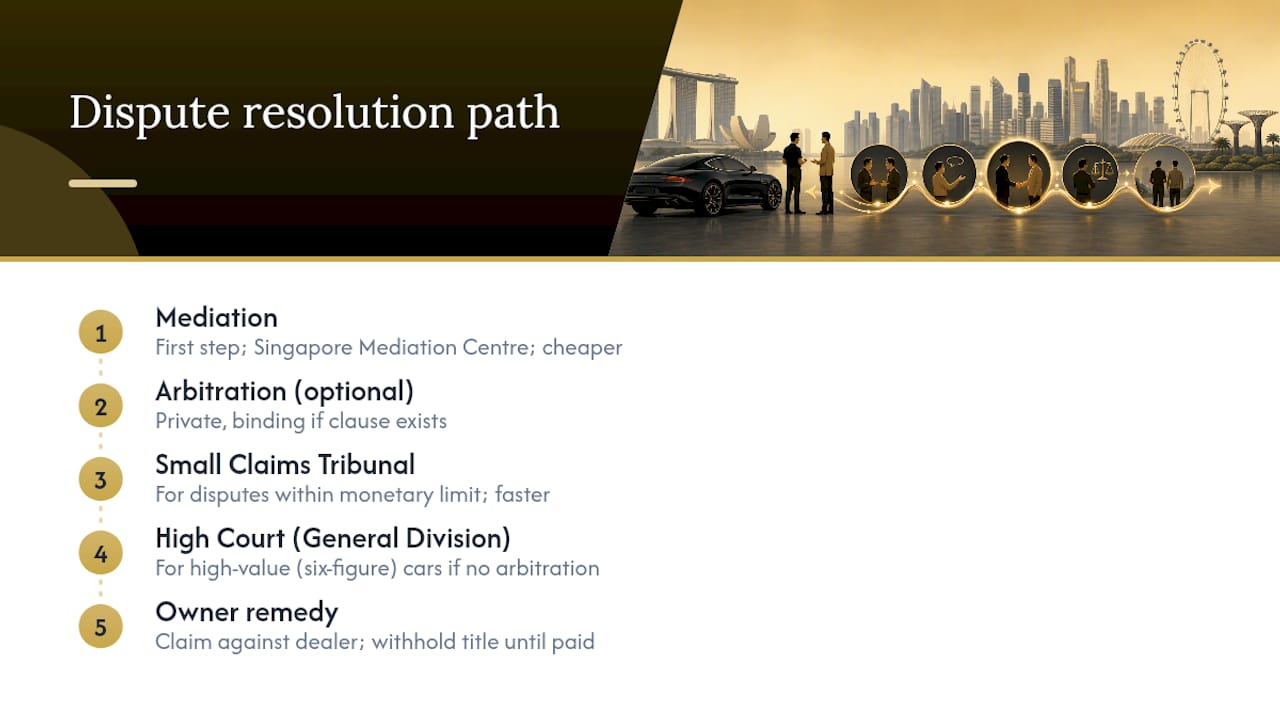
Mediation is usually the first step, often through the Singapore Mediation Centre or a clause built directly into the consignment agreement requiring both parties to attempt mediation before litigation. It's faster and cheaper than court, and most legitimate disputes over commission, payment timing, or damage responsibility resolve here.
If mediation fails, your agreement might specify arbitration, a private process where a neutral third party issues a binding decision. Not every consignment form includes this, so check for it specifically if you're consigning a high-value vehicle where the stakes justify the extra protection.
Small Claims Tribunals in Singapore handle disputes up to a defined monetary limit and offer a faster, cheaper route than the High Court for straightforward payment disputes. For anything involving a six-figure performance car, though, you're often looking at the General Division of the High Court if arbitration isn't specified.
One point worth remembering: your legal relationship is with the dealer, not the eventual buyer. If a dealer sells your car and doesn't pay you, your claim sits with them, and you can withhold the title until compensated, according to legal guidance on a similar consignment dispute case. No court can force you to sign over title without payment first.
What Happens if the Dealer Misuses the Car or Acts Negligently?
Here's where sellers often assume more liability than they actually carry. If a dealer lets an unauthorized person drive your car, ignores your test-drive protocol, or is flatly negligent, whether that's failing to secure the vehicle overnight or letting an unlicensed employee move it, that liability sits with the dealer, not you.
The catch is proving it. If your consignment agreement doesn't specify who's authorized to drive, store, or display the car, you're left arguing after the fact about what was "reasonable," and that's a weak position. Spell out in writing who can access the vehicle and under what conditions, so any deviation is a clear breach of contract rather than a gray area.
If a dealer's negligence causes damage, your recourse depends on that contract and the dealer's insurance coverage. This is another reason the insurance verification from earlier matters so much: if the dealer's trade policy doesn't cover their own negligence, or if the policy has lapsed, you could find yourself fighting for compensation directly from the dealer's business assets rather than an insurer, a far slower and less certain process.
A reputable consignment dealer will not resist naming these terms clearly. Hesitation on this point is itself a signal worth taking seriously before you sign.
A Consignor's Perspective on What Actually Protects High-End Sellers
High-value consignments concentrate risk. A scratched door on a six-figure Porsche isn't a S$200 problem, and a financing mismatch on a performance car with a large outstanding loan can turn into real negative equity fast. What actually protects sellers isn't a longer contract. It's verified insurance, a clean payment workflow, and a dealer who treats bank settlement as routine, not an afterthought. If you're consigning something collectible, a specialist model built around that exact risk profile is worth serious consideration.
— Shawn
How Bavarian Handles Seller Liability Throughout Your Consignment
Every risk covered above, insurance gaps during viewings, disclosure disputes, loan settlement timing, LTA transfer accuracy, comes down to one thing: whether the dealer managing your sale actually has a system for it. Bavarian is built around premium and performance vehicles specifically, which means insurance verification, bank settlement coordination, and LTA documentation aren't afterthoughts bolted onto a generic used-car process. They're the core of how a consignment is run from listing to transfer.
Bavarian handles the professional photography and targeted marketing that get your car in front of serious buyers, but the part that matters for liability is what happens behind the scenes: confirming trade insurance before any test drive, coordinating directly with your bank on loan discharge, and managing the OneMotoring transfer so nothing gets authorized before funds clear. For owners who'd rather hand the administrative risk to a team that handles it daily, Bavarian's consignment service starts with a free valuation. Reach out to get yours and see exactly how the process would run for your car.
Sources
For the transfer rules themselves, go directly to LTA's transfer ownership guidance and the OneMotoring digitalization FAQ. For Lemon Law limits on consigned cars, see SGCarMart's coverage. For consignment-form structure, the GenieAI template is a solid starting reference, and Butter Classics offers useful general context on how consignment arrangements typically work.
- LTA | Transfer ownership
- SGCarMart article on consignment and Lemon Law implications
- Straits Times: used-car dealers turning to consignment deals
- GenieAI — Auto Consignment Form template (Singapore)