Remaining road tax gets refunded to the last registered owner only when a vehicle is deregistered, scrapped, or exported. Sell your car instead, and the unused road tax simply follows the vehicle to its new owner. No refund lands in your bank account.
That single distinction trips up more sellers than anything else in the disposal process. Here's the quick version:
- Deregister, scrap, or export the vehicle: LTA refunds the unused portion to you, the last registered owner.
- Sell or transfer the vehicle: the buyer inherits the remaining road tax. You get nothing back automatically.
- Refunds move through GIRO or PayNow, tracked through your OneMotoring account.
Get this wrong and you either wait for a refund that was never coming, or you sell your car for less than it's worth because you forgot to price in eight months of prepaid tax.
Key Takeaways
Road tax refunds in Singapore go only to owners who deregister, scrap, or export their vehicle; sellers must price unused road tax into the sale instead of expecting a refund.
| Point | Details |
|---|---|
| Refund trigger | Deregistration, scrap, or export refunds unused road tax to the last registered owner. |
| Sale trigger | Selling transfers remaining road tax to the buyer with no refund to the seller. |
| Payment channel | LTA pays refunds via GIRO or PayNow, so OneMotoring details must stay current. |
| Delay fix | Check OneMotoring, confirm PayNow linkage with your bank, then call LTA with your deregistration reference. |
| Seller math | Divide remaining months by 12 (or 6 for half-year payments) and multiply by the tax paid to price it in. |
Table of Contents
- Deregistration vs. Sale: Which Triggers a Road Tax Refund?
- How Do You Claim a Road Tax Refund in Singapore?
- How Long Does a Road Tax Refund Take to Arrive?
- Selling? Here's How to Recover Unused Road Tax Value
- What Bavarian Does to Protect Your Road Tax Value
- Ready to Sell Without Losing Road Tax Value?
- Where to Verify Road Tax Rules and Refund Details
- What the Official Process Gets Right, and Where It Leaves Sellers Exposed
- Frequently Asked Questions
- Sources
Deregistration vs. Sale: Which Triggers a Road Tax Refund?
The rule is straightforward once you separate the two paths a vehicle can take out of your hands.
- Deregistration for scrap ends the vehicle's life on Singapore roads entirely. LTA calculates the unused road tax from the deregistration date and refunds it to the last registered owner.
- Export deregistration works the same way. Once the vehicle leaves Singapore's vehicle population permanently, the leftover tax comes back to you.
- Permanent deregistration without scrap or export (rare, but it happens with vehicles headed to long-term storage or specific exemptions) follows the identical refund logic.
- Sale or ownership transfer does not trigger a refund at all. The road tax validity period simply transfers with the vehicle, so the new owner benefits from whatever months remain.
A few edge cases catch people out. If your car is stolen and later confirmed unrecoverable, deregistration still applies and you can pursue a refund from the point LTA processes the deregistration. Laid-up vehicles (off the road under an approved scheme) generally don't accrue road tax during the layup period, so there's nothing to refund on those months. And if you're mid-sale but the transfer hasn't been finalized on OneMotoring, the tax obligation stays where the registration currently sits. Sellers should treat "transfer is the default" as the planning assumption, not an afterthought.
How Do You Claim a Road Tax Refund in Singapore?
Claiming a refund in Singapore is less about filling out forms and more about making sure LTA's automated systems can find you. Here's the sequence that actually works.
Step 1: Confirm which event applies to you. Check whether you're deregistering, scrapping, or exporting, and confirm you're the registered owner listed against the vehicle in LTA's records. Refunds go to whoever is on file at the point of deregistration, not whoever paid the original tax bill years ago.
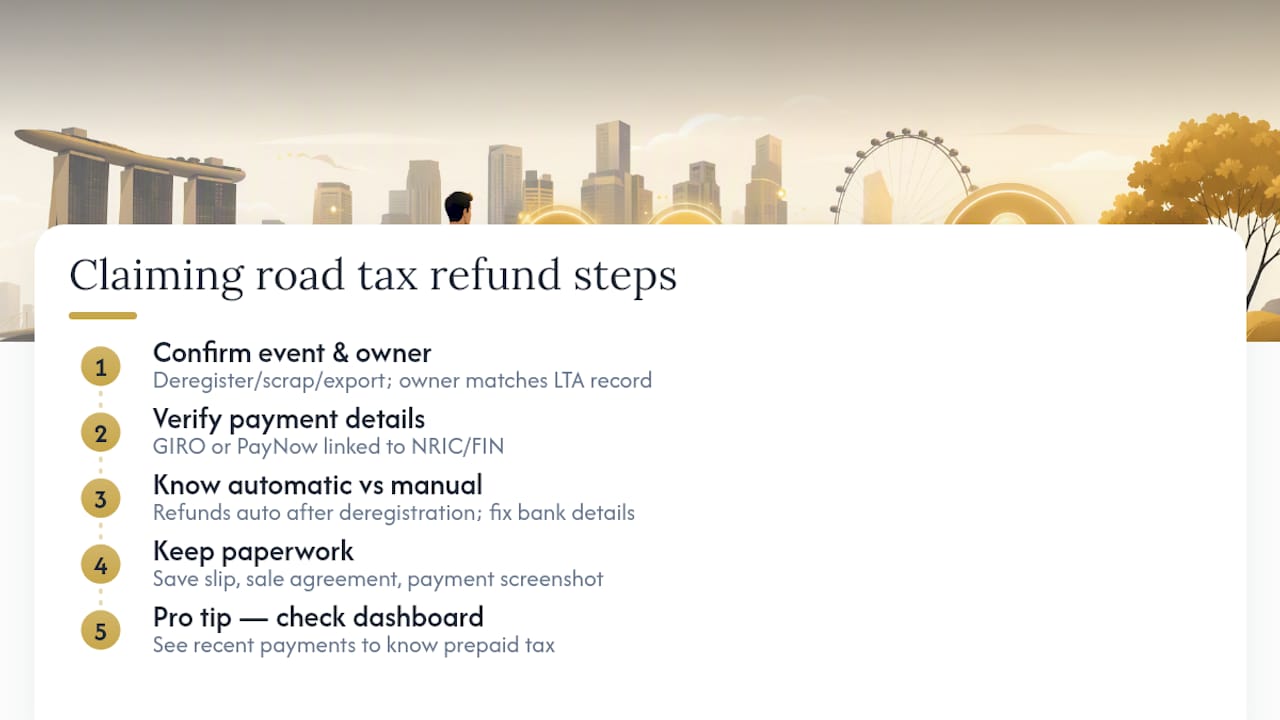
Step 2: Check your OneMotoring payment details before you deregister. Log in and verify your GIRO account or PayNow (linked to your NRIC or FIN) is current. LTA pays refunds through GIRO or PayNow, and if those details are outdated or missing, the refund stalls even though the amount is calculated correctly on LTA's end.
Step 3: Understand what's automatic versus what needs your input. Most refunds process automatically once deregistration completes and your bank or PayNow details are registered. You don't file a separate refund application. What does need your input is fixing bad bank details before or immediately after the transaction, since LTA explicitly requires accurate registration of these details to release funds smoothly.
Step 4: Keep your paperwork. Save your deregistration slip, the sale agreement if one exists, and a screenshot of your OneMotoring payment settings at the time of the transaction. This becomes your reference point if a refund doesn't show up when expected.
Pro Tip: Check your OneMotoring dashboard now, even if you're not selling for months. It shows recent road tax payments and receipts going back roughly three months, so you'll know exactly how much prepaid tax is sitting on the vehicle before you negotiate anything.
How Long Does a Road Tax Refund Take to Arrive?
LTA notifies affected owners through e-notification, SMS, or a hardcopy letter, depending on which contact method you have registered. In the late 2025 refund exercise covering diesel and diesel-hybrid goods-cum-passenger vehicles, roughly 1,700 owners received notice that refunds totaling around S$1.4 million would land via GIRO or PayNow, with no action required from anyone whose bank details were already registered.
That "no action required" line only holds if your details are actually correct. The most common causes of a delayed refund are:
- Missing or outdated PayNow/GIRO registration in OneMotoring.
- A mismatch between the NRIC or FIN on file and the name on the linked bank account.
- Address changes that mean a hardcopy notification never reaches you.
If a refund hasn't arrived within what feels like a reasonable window after deregistration, check OneMotoring first for any pending flags, then call your bank to confirm PayNow is correctly linked to your NRIC or FIN. If both check out, contact LTA directly with your deregistration reference number in hand. That single reference number is what lets an LTA officer trace exactly where in the process your payment sits.
Selling? Here's How to Recover Unused Road Tax Value
Since a sale doesn't trigger a refund, the money you'd otherwise lose has to come from the buyer, not from LTA. There are two practical routes.
- Fold it into the asking price. Calculate the unused months and add that value to your listed price, then let the buyer know the road tax is already accounted for. This is the simpler route and the one most private sellers use.
- Negotiate a pro-rated settlement at the point of sale. Instead of baking it into the sticker price, agree on a separate line item that credits you for the remaining months, calculated and paid at transfer.
The math is simple: remaining months ÷ 12 × annual road tax paid gives you the prorated value for a full-year payment. If you paid your road tax in a six-month cycle instead, swap 12 for 6 in the denominator. A car with eight months left on a $1,200 annual road tax bill carries roughly $800 of unused value, which is real money to leave on the table if you forget to mention it.
Pro Tip: Don't assume the buyer will just "figure it out." Spell out the remaining road tax months and dollar value in your listing or sale conversation. Buyers negotiate harder when they think a number is hidden, and softer when you've already shown your work.
This is exactly where a consignment approach to selling earns its keep. Professional consignment services factor residual road tax directly into the valuation they present to buyers, so it's never an afterthought tacked on during final negotiations.
What Bavarian Does to Protect Your Road Tax Value
Every seller working through consignment should run the same short checklist before listing a car: update your OneMotoring bank and PayNow details, decide firmly between selling and deregistering, gather your paperwork (log card, sale agreement, deregistration slip if applicable), and confirm the buyer's particulars are ready for a clean ownership transfer.
Bavarian builds these steps into its consignment process rather than leaving sellers to handle them solo. Every valuation accounts for the exact number of unused road tax months remaining on the vehicle, so that value shows up in the asking price from day one instead of getting negotiated away later. Buyer disclosure happens upfront: whoever buys the car knows precisely what road tax coverage they're inheriting, which speeds up negotiations and avoids disputes at the transfer desk. Bavarian's team also manages the LTA paperwork and ownership transfer directly, including confirming the seller's banking details are current in case any residual refund situation applies.
Because remaining road tax follows the vehicle rather than the seller in Singapore's system, the sellers who protect the most value are the ones who price it in before listing, not the ones who try to claim it back afterward.
If you're weighing whether to sell privately or deregister outright, understanding your consignment fee structure upfront helps you see how road tax value nets out against commission before you commit either way.
Ready to Sell Without Losing Road Tax Value?
Most sellers who lose money on unused road tax don't lose it to LTA. They lose it during negotiation, when a buyer quietly discounts the price because nobody clarified how many months of tax were left on the vehicle. Bavarian handles that calculation as a standard part of every consignment valuation, alongside the photography, marketing, and paperwork that come with selling a performance or luxury car in Singapore. If you're planning to sell rather than deregister, get a free valuation from Bavarian before you list anywhere else, and let someone else chase the LTA transfer paperwork while you focus on picking your next car.
Where to Verify Road Tax Rules and Refund Details
Check these sources directly if you want the underlying detail behind any figure or process mentioned above:
- LTA road tax guidance on OneMotoring: official rules on deregistration refunds and payment detail requirements.
- LTA's 2025 refund press release: explains the diesel and diesel-hybrid goods vehicle refund exercise and GIRO/PayNow process.
- CNA's coverage of the exercise: real numbers on how many owners were affected and how refunds were paid.
- Bavarian's consignment services: for sellers who want road tax value handled as part of the sale process.
What the Official Process Gets Right, and Where It Leaves Sellers Exposed
LTA's refund system works exactly as designed for anyone deregistering, scrapping, or exporting a car. Update your PayNow details, and the money arrives without a claim form in sight. That part of the process is genuinely well built.
Where the conventional advice falls short is in treating deregistration and sale as interchangeable topics. Most guides mention both in the same breath, as if the refund logic applies broadly, when in fact the sale path offers zero refund mechanism whatsoever. That gap is where private sellers quietly lose money, not through any LTA failure but through their own assumption that "road tax refund" applies to their situation when it doesn't.
If you're selling, the priority isn't chasing a refund that doesn't exist. It's calculating your unused tax value before you list the car and making sure that number is visible in your asking price or settlement terms. Get that sequence backward, and a buyer will happily pocket the difference instead of you.
Frequently Asked Questions
Do I get a road tax refund if I sell my car privately in Singapore? No. Selling transfers the remaining road tax validity to the buyer. Only deregistration, scrap, or export triggers a refund to the last registered owner.
How does LTA pay out road tax refunds? Through GIRO or PayNow, provided your bank or PayNow details linked to your NRIC or FIN are correctly registered in OneMotoring. No separate application is usually needed once deregistration is processed.
What if my road tax refund never arrives? Check OneMotoring for pending flags, confirm your PayNow is linked correctly with your bank, then contact LTA with your deregistration reference number for a direct trace.
Can I still claim leftover road tax value when selling instead of deregistering? Not as a refund from LTA, but you can recover that value by pricing it into your sale or negotiating a pro-rated settlement with the buyer, which is standard practice in consignment sales.
Sources
- Road Tax - Singapore
- Refund of Road Tax Collected for Diesel and Diesel-Hybrid Goods-Cum-Passengers Vehicles
- LTA to refund S$1.4m in extra road tax collected from commercial vehicles after 'discrepancy' discovered - CNA