
Yes, you can usually withdraw your car from consignment, but your written agreement decides how fast and how cheaply. Check three things immediately: the notice period and whether it auto-renews, any early-withdrawal fee, and outstanding prep or storage costs. Then send written notice today requesting pickup and ask for an acknowledgement receipt.
TL;DR:
- The notice period and auto-renewal clauses in the consignment agreement determine how quickly and cheaply you can withdraw your car.
- You must review clauses on early withdrawal fees, minimum price, and insurance terms, as verbal assurances are unreliable once disputes arise.
- Coordinating a temporary release requires documentation, a scheduled return window, and ensuring no pending buyer interest to avoid complications.
- Withdrawal costs often include detailing, storage, or advertising fees already incurred, and any outstanding loan payments remain your responsibility before sale completion.
- Properly documenting the withdrawal process and understanding contract terms can prevent disputes and save time when retrieving your vehicle.
Table of Contents
- How to Withdraw a Car from Consignment in Singapore
- What Contract Clauses Actually Control Your Withdrawal Rights?
- What Happens at Pickup, and Can You Get the Car Temporarily?
- What Will Withdrawing Actually Cost You?
- Should You Withdraw, or Just Renegotiate?
- Why Transparent Handover Documentation Matters Most
- Want a Consignor Who Handles Withdrawal the Same Way They Handle a Sale?
- Where to Read More Before You Decide
- Sources
- FAQ
How to Withdraw a Car from Consignment in Singapore
Getting your car back starts on paper, not at the showroom. Before you call anyone, pull out the consignment agreement you signed and find three clauses: the notice period, the exclusivity terms, and any fee schedule. These sections govern everything that happens next, and most disputes trace back to someone skipping this step.
Here's the sequence that keeps things clean:
- Locate the notice clause. Confirm how many days' written notice you owe and whether the contract auto-renews if you miss that window.
- Send written notice. Reference the contract number, your car's VIN, your desired pickup date, and a request for an itemized invoice of any charges owed.
- Ask for acknowledgement. Request written confirmation within a set window, so there's no argument later about when you gave notice.
- Schedule pickup around existing interest. If a buyer viewing or offer is already in motion, ask the consignor how they'll handle it rather than forcing an abrupt cutoff.
- Bring the right paperwork. Your ID, proof of registration and insurance, spare keys, and any signed receipts covering fees already paid.
Pro Tip: Put your withdrawal request in writing even if you've already discussed it by phone or WhatsApp. A text message confirming "as agreed, sending my formal notice today" turns a casual chat into a paper trail you can point to if a dispute comes up later.
Consignment terms in general run 30 to 90 days and can auto-renew if you don't act inside the notice window, so timing your request matters as much as the request itself.
What Contract Clauses Actually Control Your Withdrawal Rights?
The clauses that matter are rarely the ones sellers remember signing. Most owners glance at the commission rate and skip the fine print that governs everything else.
- Notice period and auto-renewal. Watch for phrasing like "this agreement shall automatically extend for a further [term] unless written notice is received [X] days prior to expiry." Miss that window and you're locked in again.
- Early withdrawal fees. Some agreements charge a flat fee or a percentage if you pull the car before the term ends; others bill separately for prep, inspection, or storage costs already incurred.
- Exclusivity and minimum price. Check whether you're barred from listing elsewhere while under contract, and whether a minimum acceptable sale price is written in or just verbally mentioned.
- Custody and insurance terms. A solid agreement spells out who insures the car while it sits with the consignor and what happens if it's damaged during a test drive.
Verbal reassurances mean nothing once a fee dispute starts. If a consignor tells you "don't worry, no charge for early pickup," get that in writing before you sign anything, and get any fee figure and payment deadline written down too. Bavarian's guide on consignment contract red flags walks through the specific wording sellers should insist on before ever committing to a term.
What Happens at Pickup, and Can You Get the Car Temporarily?
Retrieving your car mid-consignment involves more coordination than picking up a car from a friend's driveway, especially once marketing has already started and the listing has traction.
- Temporary release requests are common, but most dealers require no pending buyer interest, a written request in advance, and an agreed return window.
- Bring ID, registration and insurance proof, and any receipts covering fees you've already settled, so pickup doesn't turn into a paperwork scramble.
- Ask for an itemized invoice before you arrive, covering detailing, storage, or advertising costs the consignor may have already incurred.
- Coordinate around active showings. Consignors typically hold spare keys and manage test drives themselves, so a short-notice pickup can clash with a scheduled viewing if you don't flag it early.
A clean release request sounds like this: "Requesting temporary release of [plate number] on [date], no pending offers as of today, will return by [time]." Specific, timestamped, and impossible to misread.
What Will Withdrawing Actually Cost You?
Money surprises are the most common complaint sellers raise after pulling a car early, and almost all of them trace back to fees that were disclosed but never fully understood.
- Detailing and inspection charges often apply if the consignor already prepped the car for listing photos or a buyer walkthrough.
- Storage fees can accrue if the car sat on a dealer's lot or in a showroom bay for weeks.
- Advertising costs are sometimes billed separately if a package included paid placement on SgCarMart or boosted social posts.
If a sale is already in progress, dealers coordinate lien payoff and title transfer at closing, but pulling out before that point leaves any outstanding car loan squarely your responsibility. Payout timing after a completed sale should also be spelled out. A contract that stays vague on payment deadlines is a warning sign worth pushing back on.
Pro Tip: If a charge on your final invoice doesn't match anything in your written contract, don't pay it on the spot. Ask for the specific clause it's based on, request a corrected invoice, and escalate in writing if the consignor can't point to one. Bavarian's post on limiting consignment liability covers how to document a handover so disputed charges don't linger after the car's already back in your driveway.
Should You Withdraw, or Just Renegotiate?
Pulling the car isn't always the best move. If inquiries have gone quiet or buyers keep mentioning the same objection, a reposition often works better than starting over somewhere else.
- Read the signals first. Few serious inquiries, repeated buyer feedback about price, or a shift in the used luxury market are all cues to adjust rather than withdraw.
- Try smaller interventions. A price cut, refreshed photography or video, or broader distribution across SgCarMart and social channels sometimes revives a stale listing without any contract changes.
- Propose an amendment. A short extension, a temporary commission reduction, or an added marketing push are all reasonable asks in a negotiation email.
- Weigh the reputational cost. Relisting the same car across multiple dealers in a short window often signals to buyers that something's wrong with it, which can quietly erode your asking price.
Bavarian's breakdown of car price negotiation tactics covers how to frame that conversation with your current consignor before you decide to pull the plug entirely.
Why Transparent Handover Documentation Matters Most
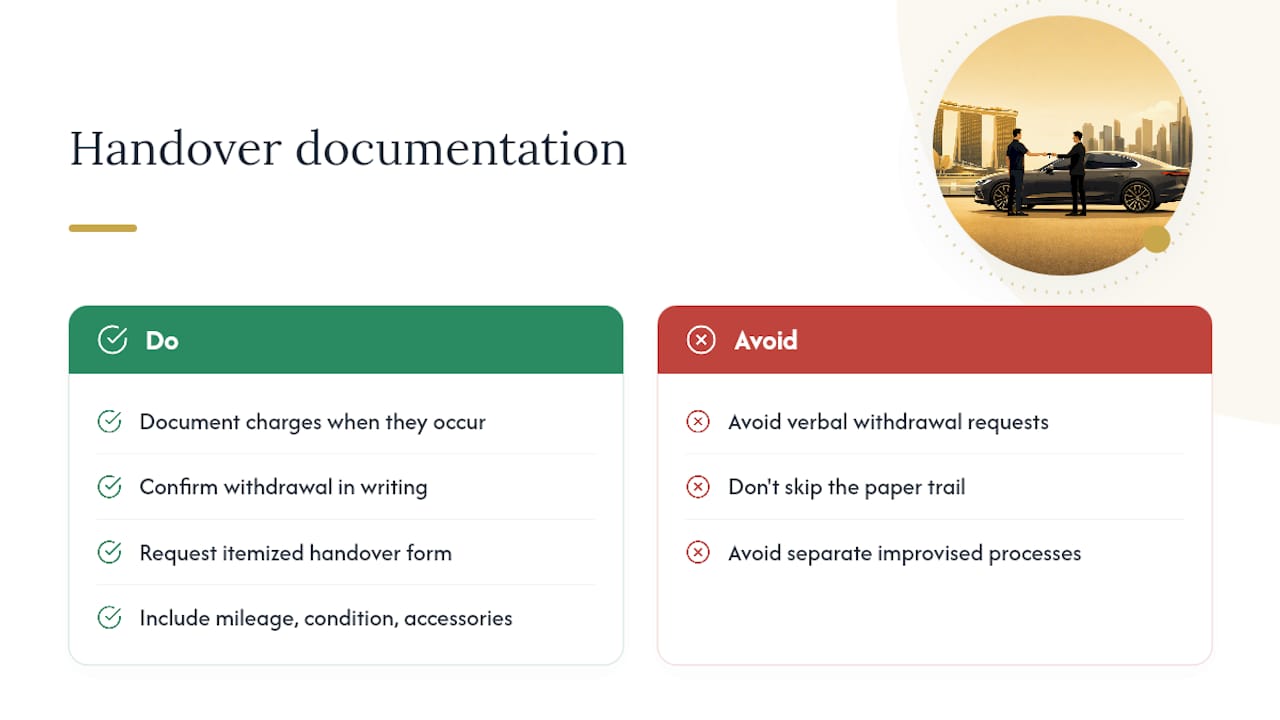
Most withdrawal disputes in Singapore's consignment market aren't about bad faith. They're about missing paperwork. A consignor who documents charges as they happen, and confirms withdrawal requests in writing rather than over a phone call, saves both sides a headache later.
Some dealers operate out of dedicated showrooms and handle the full sale cycle, from professional photography and video to LTA documentation and transfer of ownership, which means withdrawal requests run through the same paper trail as everything else, not a separate improvised process. That consistency matters more than any single clause. When you retrieve a car, ask for an itemized handover form noting mileage, condition, and which accessories came back with the vehicle, since that single document prevents most of the "who owes what" arguments that drag on for weeks.
— Shawn
Want a Consignor Who Handles Withdrawal the Same Way They Handle a Sale?
If you're mid-consignment and weighing whether to pull your car or push for a reposition instead, some consignment services offer alternatives like a written agreement upfront, a valuation before you commit to anything, and full handling of photography, listings, LTA paperwork, and transfer of ownership under one roof.

That means fewer moving parts to track if you ever need to renegotiate terms or ask for a temporary release. Reach out through Bavarian for a first-call checklist covering your car's details, current listing status, and any existing contract terms, so you walk into the conversation knowing exactly what to ask for, whether that's a clean withdrawal, a relist, or a fresh valuation.
Where to Read More Before You Decide

Start with Bavarian's guides on contract red flags and Singapore's consignment process, then use a general inspection checklist to verify your car's condition at handover.
Sources
- How to Sell a Vehicle on Consignment: Process and Risks - LegalClarity
- How to Sell My Car on Consignment: The Complete 2026 Guide
FAQ
Can I Withdraw My Car From Consignment at Any Time?
Usually yes, but your written agreement sets the notice period and any early-withdrawal fee, so check that before assuming you can collect the car today.
Will I Owe Money if I Withdraw Early?
You might. Some agreements bill for detailing, inspection, storage, or advertising already incurred, so request an itemized invoice before you agree to any figure.
Can I Get My Car Back Temporarily Without Fully Withdrawing?
Many consignors allow a temporary release if there's no pending buyer interest and you submit a written request with a scheduled return window.
What Happens if a Buyer Has Already Made an Offer?
Ask the consignor how they plan to handle the pending offer before you finalize your pickup date. Withdrawing mid-negotiation can affect what you owe and how the sale is resolved.
How Long Does the Withdrawal Process Usually Take?
Once written notice is sent and acknowledged, pickup can often be scheduled within days, though outstanding fees or an active viewing can extend that timeline.